An Anniversary Image With Geological-Scale Drama
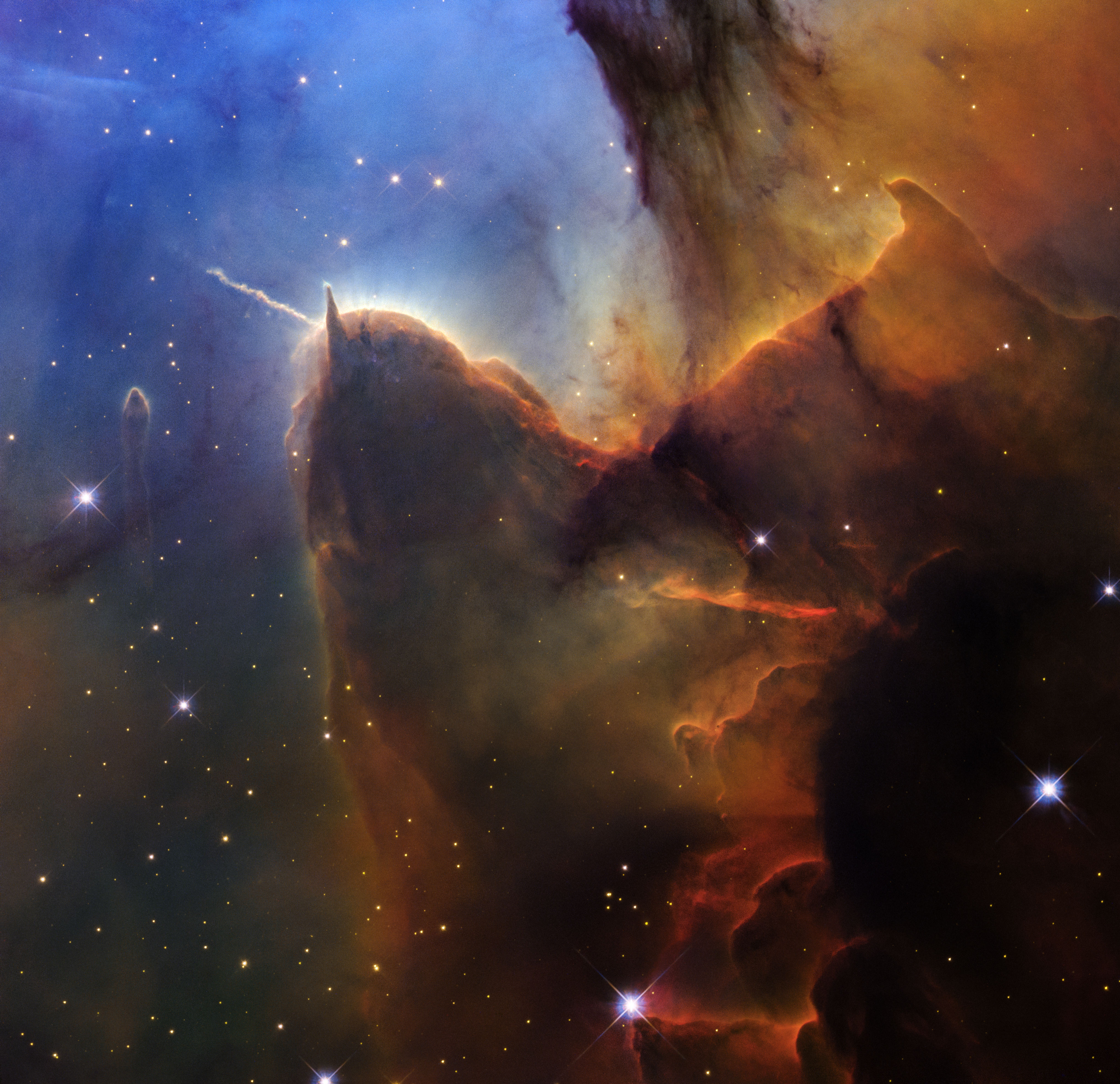
To mark the 36th anniversary of the Hubble Space Telescope’s launch, NASA released a close-up image of the Trifid Nebula that captures a dense, turbulent region of ongoing star formation about 5,000 light-years from Earth.
The image, released April 20 and highlighted again on April 24, presents the nebula less as a distant postcard and more as an active environment. In visible light, the scene resembles a suspended underwater cloud, packed with fine-grained structures and glowing material. The visual effect is striking, but the scientific story is more important: this is a region still being reshaped by stellar forces.
A Small Window Into a Larger Stellar Machine
NASA says several massive stars outside the image field have spent at least 300,000 years shaping this part of the Trifid Nebula. Their winds have blown an enormous bubble through the surrounding cloud, and the newly released Hubble image shows a small section of that larger structure.
That detail helps explain why the scene appears so textured and disturbed. It is not a static cloud. It is part of a system under pressure, where radiation and stellar winds compress gas and dust and help trigger new rounds of star formation.
This feedback process is central to how nebulae evolve. Massive stars do not simply emerge from clouds and leave them untouched. They alter their surroundings, eroding some material while packing other regions tightly enough to seed future stars. The Trifid image is therefore not just visually dramatic; it is an observational snapshot of cause and effect in stellar nurseries.
Why Hubble Still Matters at 36
Hubble launched on April 24, 1990, and few science instruments have had a public life as long or as influential. The telescope has survived multiple servicing missions, dramatic technical recoveries, and repeated predictions that it would soon be superseded. Yet it remains one of astronomy’s most productive observatories.
This anniversary release underlines one reason why. Hubble’s visible-light imaging still offers a combination of resolution, continuity, and scientific familiarity that makes it invaluable for studying nearby cosmic structures. New observatories may extend astronomy into other wavelengths or greater sensitivities, but Hubble continues to generate useful science and iconic images at the same time.
The Trifid Nebula image also serves as a reminder of Hubble’s special role in linking research with public understanding. A technical paper can describe gas compression, stellar winds, and triggered star formation. A detailed image lets non-specialists see those ideas in one frame.
The Trifid Nebula as a Laboratory
The Trifid Nebula has long attracted attention because it combines bright emission, dark dust lanes, and active stellar birth in one object. NASA’s new close-up does not attempt to show the full nebula. Instead, it isolates one region where the interaction between stars and cloud material is especially visible.
That narrower framing is useful. Wide-field images can reveal beauty and overall shape, but close-up studies are what allow astronomers to inspect texture, boundaries, and the fine structures that indicate how energy is moving through a cloud. The new image highlights those subtleties.
NASA describes the observed region as a place where powerful winds continue to push and compress gas and dust. Compression matters because it can destabilize denser pockets, helping gravity take over and form new stars. In that sense, the image shows both destruction and creation at once: winds clearing cavities while also setting the stage for additional stellar births.
More Than a Commemorative Release
Anniversary imagery can sometimes feel ceremonial, but this release works because it connects celebration to the telescope’s core mission. Hubble is being marked not with nostalgia alone, but with new observational detail from an active cosmic environment.
That distinction matters for space science. Long-lived observatories earn their place by continuing to produce relevant data, not only by surviving. NASA’s framing makes clear that Hubble remains a working scientific instrument capable of revealing how stars shape the interstellar medium over long timescales.
There is also an institutional message in the timing. By pairing Hubble’s launch anniversary with a fresh look at the Trifid Nebula, NASA reinforces the telescope’s place in a broader continuum of astronomical exploration. Missions age, but discoveries accumulate.
The Long View
The most compelling aspect of the Trifid image may be the sense of timescale it compresses into a single scene. NASA says the responsible massive stars have been sculpting the region for at least 300,000 years. Hubble, by contrast, has watched the universe for 36. Human observers receive only a thin slice of that history, but instruments like Hubble let us infer the larger process from structure and light.
That is why images such as this still land with force. They are not merely pictures of distant beauty. They are evidence of dynamic environments where stars inherit, alter, and regenerate the very clouds that made them. For a telescope entering its 37th year in orbit, that remains a powerful argument for continued relevance.
This article is based on reporting by NASA. Read the original article.

Originally published on nasa.gov