A symbolic update for a highly unusual aircraft
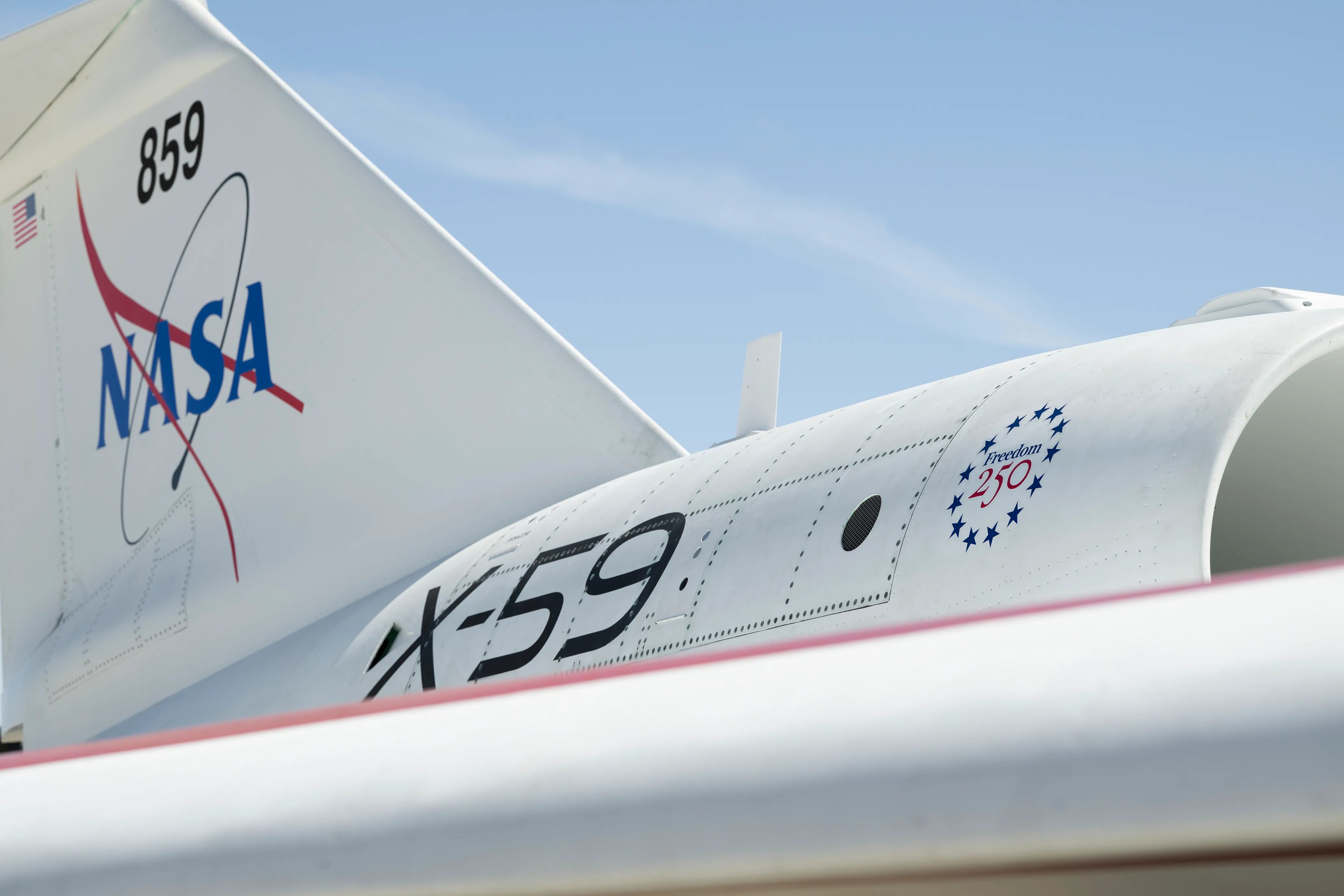
NASA’s X-59 has received a new Freedom 250 logo on its tail and jet engine area, according to a NASA image release, tying the aircraft’s livery to the United States’ 250th anniversary in 2026. On its face, the update is visual rather than technical. But the choice of aircraft matters. The X-59 is not a ceremonial showpiece. It is the centerpiece of NASA’s Quesst mission, a research effort built to demonstrate supersonic flight without the loud sonic booms that have historically defined it.
That makes the branding change more than a paint-note curiosity. It places one of NASA’s most distinctive aeronautics projects into a broader public narrative at a moment when the agency is trying to turn years of technical development into a visible, understandable mission story.
What the X-59 is designed to prove
NASA describes the X-59 as a one-of-a-kind research aircraft intended to demonstrate technology for flying faster than the speed of sound while avoiding the disruptive sonic booms associated with conventional supersonic aircraft. The core ambition of Quesst has long been to show that supersonic travel over land might be made acceptable if the shock signature can be transformed into something far less intrusive.
That goal matters because the sonic boom problem has been one of the main constraints on civil supersonic operations. High speed alone has never been enough. Commercial viability depends not only on aircraft performance, but on whether communities and regulators can tolerate the acoustic effects of flight. NASA’s effort is therefore as much about public acceptability and future rulemaking as it is about aerodynamics.
Why a livery update can still matter
Space and aeronautics programs often use insignia, mission patches, or special paint treatments to mark milestones, partnerships, or public campaigns. In this case, the Freedom 250 logo connects the aircraft to a national commemorative year. That is symbolically useful for NASA because the X-59 occupies an unusual space in the agency’s portfolio. It is technologically advanced, visually striking, and easier for general audiences to grasp than many abstract research programs.
The aircraft’s long, narrow form already communicates that it is something different. Adding a commemorative insignia reinforces its role as a public-facing emblem of American aerospace experimentation. Even when such updates do not alter the test program itself, they help frame how the mission is introduced to broader audiences beyond technical communities.
The real significance remains in the Quesst mission
The deeper story is still the aircraft’s purpose. NASA’s vision for the X-59 is tied to low-boom supersonic flight, a field with implications for future commercial aviation if technical performance can translate into regulatory change. The challenge is not merely to build an aircraft that flies fast. It is to produce the kind of acoustic signature and data that can support a new conversation about what overland supersonic travel might look like in practice.
That is why the X-59 has drawn sustained attention. It sits at the intersection of research, policy, and industrial possibility. If the aircraft can demonstrate the intended low-boom performance and generate convincing community-response data, it could influence how future supersonic aircraft are designed and assessed.
For now, the NASA release does not announce a test milestone or a new flight result. It announces a livery update. But because the aircraft is central to a mission with larger regulatory and commercial implications, even a symbolic update lands within a wider context of anticipation.

Public identity and experimental aircraft
Experimental aircraft often pass through long periods where engineering progress is real but not easily legible to the public. Branding and visual presentation help bridge that gap. They create continuity between technical work in hangars and the story a national agency wants to tell about innovation, capability, and future impact.
In that sense, the Freedom 250 mark is a reminder that major research programs also function as public institutions. NASA does not develop aircraft only for engineers and procurement officials. It also develops them in view of citizens, legislators, schools, industry observers, and future partners. Small visual choices can therefore serve a strategic communications role, especially when attached to a platform as singular as the X-59.
What to watch next
The most important developments ahead for the X-59 remain technical rather than cosmetic. Observers will be looking for continued movement in the Quesst program and for the next major milestones that show how close the aircraft is to delivering the low-boom demonstration NASA has long promised. Public updates, whether through images, blog posts, or mission briefings, help maintain attention between those harder milestones.
The Freedom 250 insignia does not change the mission’s physics, schedule, or stakes. What it does do is place the aircraft more explicitly into the national imagination during a commemorative year. For an experimental program aiming eventually to reshape how the public experiences supersonic flight, that connection is not trivial.

A small update on a big research story
NASA’s image release is brief, and the underlying change is simple: the X-59 now carries a Freedom 250 logo. But the aircraft it appears on remains one of the most interesting civil aeronautics projects in the U.S. research portfolio. The X-59 is a testbed for a specific and consequential idea, that supersonic aircraft might one day fly with far less acoustic disruption.
So while the logo itself is ceremonial, the platform is not. The update serves as a visible reminder that the Quesst mission is still one of NASA’s signature attempts to connect advanced flight research with a possible future for aviation policy and design.
This article is based on reporting by NASA. Read the original article.
Originally published on nasa.gov