Falcon Heavy returns for a major commercial satellite mission
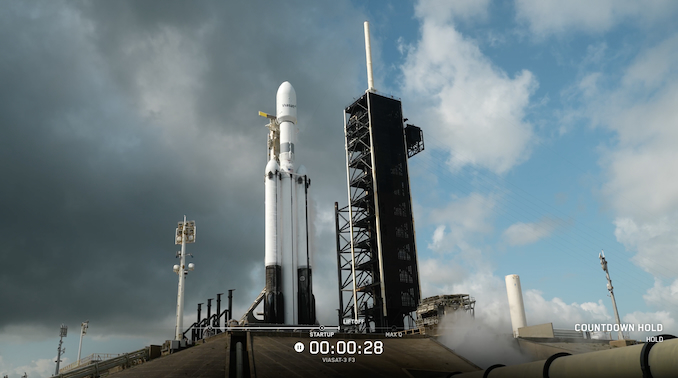
SpaceX is preparing to launch the ViaSat-3 Flight 3 communications satellite on a Falcon Heavy rocket from Launch Complex 39A at NASA’s Kennedy Space Center, a mission that carries weight for both the launch provider and the customer. For SpaceX, it is the first Falcon Heavy flight in more than a year and a half. For Viasat, it is the final launch in a satellite program that has stretched across more than a decade and helped reshape the company’s position in the global communications market.
Liftoff is scheduled for 10:21 a.m. EDT on April 27, 2026, at the opening of an 85-minute launch window. The mission will send the six-metric-ton satellite toward geosynchronous transfer orbit, with deployment from the rocket’s upper stage planned nearly five hours after launch. That profile reflects the kind of high-energy mission for which Falcon Heavy remains one of SpaceX’s most important offerings: moving large payloads to demanding destinations that sit beyond the routine reach of smaller launch systems.
The end of the ViaSat-3 buildout
The satellite itself is significant because it completes the ViaSat-3 constellation effort. Viasat executive Dave Abrahamian described the mission as the end of an era, noting that the program has occupied more than 10 years of work. His remarks also point to how much the company has changed during that span. When the program began, Viasat operated with a much smaller orbital footprint. Since then, it has launched two other ViaSat-3 satellites and merged with Inmarsat, materially changing the scale and scope of its business.
That context matters. Satellite launches are often treated as isolated events, but this one closes out a strategic architecture. Completing the third ViaSat-3 satellite gives Viasat another major asset in orbit at a time when connectivity demand, competitive pressure, and expectations for resilient communications networks continue to rise. The company is operating in a different environment than it was when the program was conceived, and the final launch reflects that new landscape.
The completion of a long-running program also highlights a reality of space infrastructure: timelines are extended, capital intensity is high, and corporate strategies can change dramatically before a constellation or platform is fully deployed. The ViaSat-3 Flight 3 mission sits at the intersection of those long cycles and the faster-moving business shifts that define the current satellite communications sector.

Why this Falcon Heavy mission stands out
This launch is noteworthy not only because of the payload but because of the rocket operations involved. SpaceX plans to recover the two side boosters at Cape Canaveral Space Force Station, targeting Landing Zone 2 and Landing Zone 40. The company says this will be the first use of Landing Zone 2 and Landing Zone 40 simultaneously, adding an operational wrinkle to a mission that already stands out on the calendar.
The booster lineup is also unusual. The two side boosters, tail numbers 1072 and 1075, are set for their second and 22nd flights respectively, while the center core, B1098, is brand new. SpaceX does not plan to recover that center core; it will be expended into the Atlantic Ocean after its first and only flight. The combination of reused and expendable hardware shows the flexibility SpaceX now applies to mission design. Reusability remains a defining part of the company’s model, but high-performance missions still require tradeoffs, especially when payload mass and destination demand every bit of available energy.
Falcon Heavy has never been SpaceX’s highest-volume vehicle, but it occupies a crucial niche. Its missions tend to be strategically important, highly visible, and technically demanding. A successful ViaSat-3 Flight 3 launch would reinforce the rocket’s role as a heavy-lift option for commercial and government customers that need substantial performance without waiting for next-generation systems to become routine.
Weather and mission risk factors
Launch weather was assessed by the 45th Weather Squadron as 70 percent favorable for the opening window. Forecasters said they were watching possible violations tied to cumulus cloud and surface electric field rules. A Carolina Low and a weak back door cold front moving through central Florida early Monday could affect cloud development near the spaceport, particularly as the sea breeze begins to form.
Those are manageable but real constraints. Florida launch weather often looks acceptable in broad probability terms while still presenting specific, timing-sensitive hazards. For a vehicle as visible as Falcon Heavy, weather delays can quickly become part of the story, especially when booster landings and a narrow operational sequence are involved. Even so, a 70 percent favorable outlook leaves the mission in a generally strong position heading into the window.

A launch with commercial and symbolic weight
The ViaSat-3 Flight 3 mission is not just another entry on SpaceX’s manifest. It is a demonstration of how the launch market and satellite industry have matured together. Viasat is closing a long chapter in its fleet development. SpaceX is returning Falcon Heavy to service with a payload that justifies the rocket’s lift capacity and complex recovery choreography. And the mission itself points to the ongoing demand for large, high-capability communications spacecraft even as lower Earth orbit constellations dominate many headlines.
If the launch proceeds as planned, it will mark a consequential milestone for both companies. Viasat will complete a decade-spanning effort with its final ViaSat-3 satellite on the way to orbit. SpaceX will add another heavy-lift mission to a rocket family that flies infrequently but carries outsized importance each time it leaves the pad.
Key mission details
- Launch time is scheduled for 10:21 a.m. EDT on April 27, 2026, from Kennedy Space Center’s Launch Complex 39A.
- The payload is ViaSat-3 Flight 3, a six-metric-ton communications satellite bound for geosynchronous transfer orbit.
- The two side boosters are planned to land at Landing Zone 2 and Landing Zone 40.
- The center core will be expended into the Atlantic Ocean after launch.
For SpaceX, a clean launch and recovery sequence would underline Falcon Heavy’s continuing relevance. For Viasat, it would close one of the most consequential space infrastructure programs in the company’s history. That combination makes this more than a launch-day spectacle. It is a transition point for both the rocket and the business it is serving.
This article is based on reporting by Spaceflight Now. Read the original article.
Originally published on spaceflightnow.com