Another Starlink launch underscores the pace of Falcon 9 operations
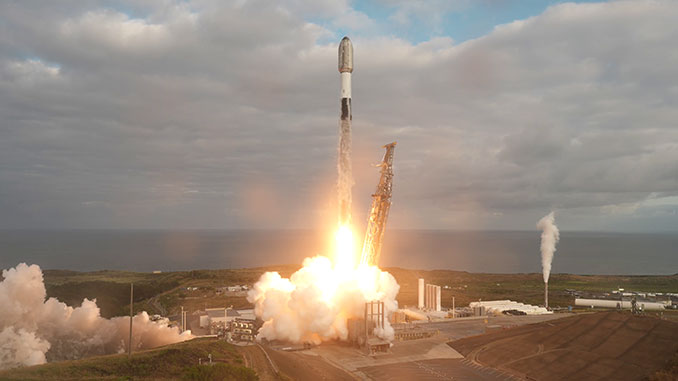
SpaceX planned to launch 25 Starlink V2 Mini broadband satellites from Vandenberg Space Force Base on April 26, a mission that would mark the company’s 50th Falcon 9 launch of 2026. By itself, a Starlink deployment is now routine. The significance of this flight lies in what the count says about cadence, reuse, and the normalization of rapid orbital logistics.
According to the mission details published by Spaceflight Now, liftoff for the Starlink 17-16 mission was scheduled for 7:37 a.m. PDT, or 14:37 UTC, from Space Launch Complex 4 East on the California coast. The rocket was set to carry the satellites southward after departure, continuing the steady expansion of SpaceX’s low-Earth-orbit broadband constellation.
Fifty Falcon 9 launches before the end of April would represent a striking operational rhythm for a rocket once treated as a high-value, infrequent launch vehicle. The number does not merely reflect manufacturing output. It reflects a launch system built around repeatable booster recovery, fast turnaround, and a manifest increasingly dominated by a vertically integrated customer in Starlink.
Reuse remains central to the model
The first-stage booster assigned to the mission, B1088, was scheduled to fly for the 15th time. The source lists prior missions including NROL-126, Transporter-12, SPHEREx, NROL-57, and 10 previous Starlink launches. That history is important because it illustrates what Falcon 9 has become commercially and technically: not simply reusable in theory, but reusable often enough that high flight counts are part of standard mission planning.
Each additional reuse cycle strengthens the logic of the system. A booster that can support national security missions, rideshare flights, science payloads, and repeated Starlink deployments becomes the backbone of a launch architecture rather than a one-off vehicle. It also compresses the gap between launch demand and launch supply, allowing SpaceX to sustain a schedule that would have been difficult under older expendable models.
The mission profile called for B1088 to land on the drone ship Of Course I Still Love You roughly 8.5 minutes after liftoff. If successful, that would be the 193rd landing on that vessel and the 603rd booster landing overall, according to the source. Those totals matter because they convert reusability from headline into infrastructure. What once had to be proven now has to be maintained at industrial scale.
Starlink is still driving the tempo
Although Falcon 9 serves a wide range of customers, Starlink continues to provide the densest rhythm of flights. That matters strategically. When a launch provider also controls a large internal satellite program, it can generate demand that keeps factories, crews, recovery assets, and range operations continuously exercised. The result is a launch business that learns by doing at unusually high frequency.
That operating model has several effects. It keeps mission teams in constant practice. It spreads fixed costs over more flights. It allows incremental spacecraft and mission changes to be introduced without waiting months for the next launch opportunity. And it gives SpaceX a persistent mechanism for replenishing and expanding a constellation that is central to its commercial strategy.
The 25 satellites on this mission were identified as Starlink V2 Mini spacecraft. The mini designation points to SpaceX’s effort to increase capability while staying compatible with Falcon 9 deployment constraints. Even without broader context beyond the source, the pattern is clear: the company continues to iterate its constellation architecture while using its most mature launch vehicle as the workhorse for deployment.
Why the 50-launch mark matters
The round-number milestone is notable not because 50 launches has symbolic value, but because it comes so early in the year. Reaching that mark in late April suggests a launch ecosystem that now behaves less like a traditional aerospace program and more like an always-on transportation network.
That shift has implications beyond SpaceX. Competitors, suppliers, insurers, regulators, and government customers are all operating in a market reshaped by one provider’s ability to make launch frequency itself a differentiator. The baseline expectation for what a mature launch company can deliver has changed.
It also changes how constellations are built and maintained. If replacement or expansion launches are available at high cadence, spacecraft operators can think differently about redundancy, upgrade cycles, and deployment pacing. The launch sector’s bottleneck begins to move away from rocket access and toward satellite production, regulatory approvals, or downstream business models.
A mission that is routine and revealing at once
The Starlink 17-16 flight does not carry the singular drama of a crewed mission or a flagship science probe. It is, in many ways, ordinary by current SpaceX standards. But that ordinariness is precisely what makes it revealing. A 50th Falcon 9 flight of the year tied to another 25-satellite Starlink batch shows how repetition has become a strategic asset.
When launches become frequent enough, the story stops being one mission and starts being the system behind it. On that measure, this flight is a useful marker. It captures a company still scaling the constellation that underpins its connectivity business while simultaneously demonstrating the operational maturity of the rocket that makes that scaling possible.
For the wider industry, that is the more durable takeaway. Falcon 9 is no longer only a reusable rocket. It is an example of what happens when reusability, vertical integration, and demand density reinforce each other over hundreds of landings and dozens of annual launches.
- SpaceX scheduled the Starlink 17-16 mission for April 26 from Vandenberg Space Force Base.
- The flight would carry 25 Starlink V2 Mini satellites and mark the 50th Falcon 9 launch of 2026.
- Booster B1088 was set for its 15th flight and a landing attempt on Of Course I Still Love You.
- The mission highlights how booster reuse and Starlink demand sustain exceptionally high launch cadence.
This article is based on reporting by Spaceflight Now. Read the original article.
Originally published on spaceflightnow.com