Planetary interiors keep producing stranger physics
Uranus and Neptune are often described as ice giants, but the term can be misleading. Deep inside those planets, ordinary ideas of ice, liquid and gas stop being very useful. The pressures are immense, the temperatures reach the thousands of degrees, and familiar molecules do not survive in recognizable form. Under those conditions, matter can organize itself in ways that are difficult to imagine from everyday experience.
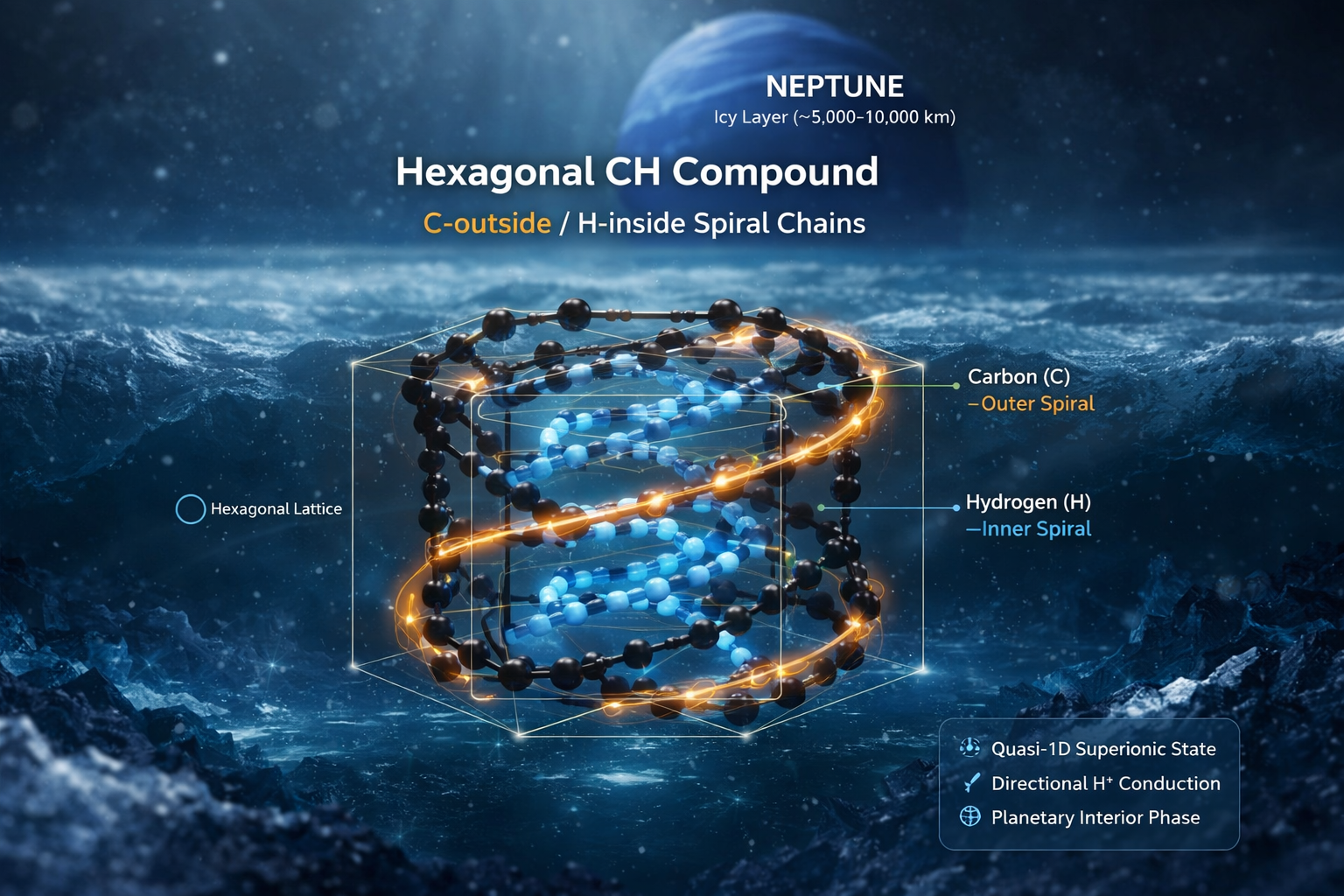
A new study highlighted by Universe Today adds another candidate to that list: a “quasi-1D superionic” phase formed from carbon and hydrogen. The work, published in Nature Communications by researchers at the Carnegie Institution, suggests that at sufficiently high pressures and temperatures, carbon and hydrogen can combine into a stable compound with an unusual structure that may exist inside ice giants such as Uranus and Neptune.
If the result holds up, it would add a new state of matter to the growing inventory of exotic planetary materials and could alter how scientists think about the internal structure and evolution of these distant worlds.
How the proposed material behaves
The study begins from a known problem in planetary science. Methane and similar molecules are not expected to remain intact under the crushing conditions inside ice giants. Previous work has suggested methane breaks apart at around 95 gigapascals, producing hydrogen-rich materials and carbon allotropes such as diamond.
The new research pushes far beyond that regime. According to the source text, at pressures above 1100 gigapascals, carbon and hydrogen form a stable compound in which carbon atoms lock into a rigid lattice shaped like a chiral helix. That alone would be unusual. But the more interesting behavior emerges when temperature is added.
Between 1000 and 3000 kelvin, the compound reportedly enters a superionic state. In superionic matter, part of the structure remains solid while another component becomes mobile, behaving somewhat like a liquid inside the solid framework. In this case, the source describes a twist on that idea: a quasi-one-dimensional form in which the mobile behavior is strongly constrained by the underlying structure.
That is where the “quasi-1D” label comes from. Rather than a conventional fluid-like motion through a three-dimensional solid framework, the transport appears to be channeled in a more restricted way.

Why researchers relied on simulation
These results come from simulation rather than direct laboratory observation, and for good reason. Recreating the relevant conditions on Earth is extremely difficult. The interior pressures of Uranus and Neptune can reach into the terapascal range, levels that challenge both experimental hardware and containment strategies.
The article notes that researchers often use computational models such as “Synthetic Uranus” to approximate the environments inside these planets. But the new paper takes a first-principles approach, allowing the quantum mechanics of the system to determine the behavior more directly rather than relying as heavily on simplified assumptions.
That does not make the findings certain, but it does make them notable. First-principles simulations are often where new candidate phases emerge before experimentalists find ways to test them. In planetary science, that sequence is common because conditions of interest can be so extreme that theory and computation have to move first.
Why it matters for Uranus and Neptune
Understanding what sits inside ice giants is not a niche curiosity. The internal structure of Uranus and Neptune affects their heat flow, magnetic behavior, density profiles and evolutionary history. Exotic materials can influence how energy moves through the planet and how different layers interact over time.
If a quasi-1D superionic carbon-hydrogen phase really exists there, it could become part of the explanation for some of the unusual physical behavior observed in these worlds. The source does not claim a complete planetary model, but it does suggest that the material could plausibly inhabit the extreme environments found in their interiors.
The work also matters beyond our solar system. Ice-giant-like planets are common in exoplanet surveys, and better models of exotic high-pressure chemistry can improve how scientists interpret their composition and formation. Materials science at extreme pressure is increasingly part of comparative planetology.
A reminder of how incomplete planetary knowledge still is
The deeper lesson here is that planets continue to surprise researchers not only in where they are found but in what matter can do inside them. Every time simulations or experiments reach further into extreme pressure regimes, new combinations of order and mobility appear. “Solid” and “liquid” stop being clean categories. Chemistry becomes entangled with planetary dynamics.
This study does not prove that Uranus and Neptune contain the proposed phase. It does, however, offer a concrete and physically motivated possibility grounded in a peer-reviewed modeling effort. That is enough to push the conversation forward. Future work will need to test the stability of the phase further and, if possible, search for experimental signatures that could validate the prediction.
For now, the most compelling takeaway is simple: the interior of an ice giant may host forms of matter with no ordinary analog on Earth. The further scientists look into those worlds, the less conventional they appear.
Key points
- A new simulation study proposes a quasi-1D superionic carbon-hydrogen phase at extreme pressure and heat.
- The material could plausibly exist inside Uranus and Neptune.
- The result could influence models of ice-giant interiors and exoplanet composition.
This article is based on reporting by Universe Today. Read the original article.
Originally published on universetoday.com