A Detailed Look at a Familiar Cosmic Form
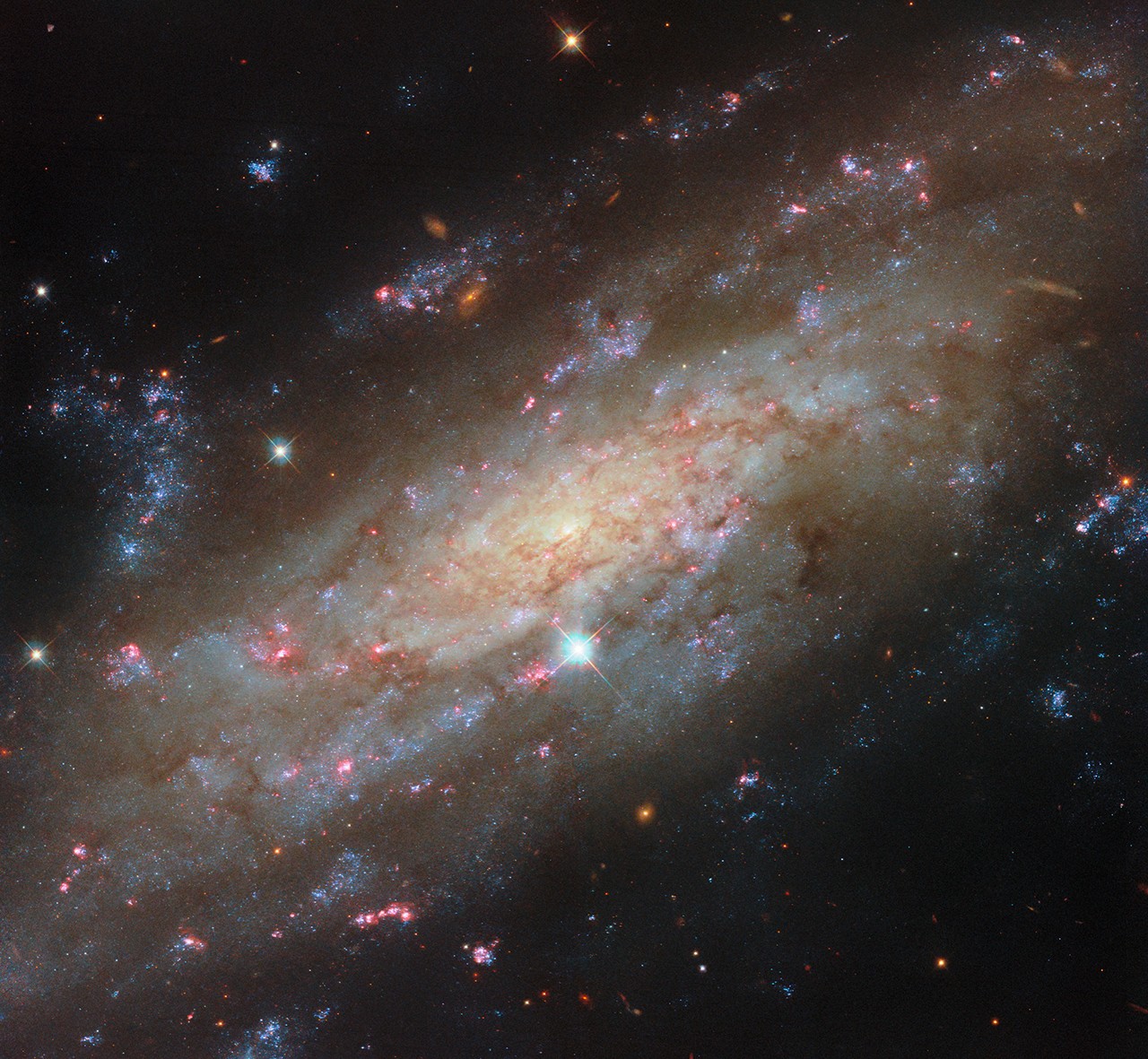
NASA’s Hubble Space Telescope has released a new image of the spiral galaxy NGC 3137, a system about 53 million light-years away in the constellation Antlia. At first glance, the image is a reminder of Hubble’s unmatched ability to turn astronomical observation into something visually immediate. But the scientific value goes further. NGC 3137 offers astronomers a relatively nearby spiral system that can be used to study how stars form, how galactic structures evolve, and how galaxy groups compare with the one that contains the Milky Way.
The image was built from observations in six different color bands, producing a view rich enough to highlight multiple features at once. Across the disk, star clusters glitter against winding spiral structure. Near the center, dusty clouds trace a more tangled internal environment around a black hole that NASA says is estimated to be 60 million times more massive than the Sun. This combination of accessible scale and intricate detail is exactly why nearby spirals remain so important to astronomy.
Why NGC 3137 Matters
Spiral galaxies are familiar because our own Milky Way belongs to the same general family. But “spiral galaxy” covers a wide range of internal conditions, histories, and local environments. NGC 3137 is useful because it sits close enough for detailed study while also belonging to a galaxy group that may parallel aspects of our own neighborhood.
NASA notes that NGC 3137 travels through space with the NGC 3175 group, which is thought to be similar to the Local Group that includes the Milky Way and Andromeda. In both cases, there are two large spiral galaxies surrounded by smaller dwarf companions. Researchers have found more than 500 dwarf galaxy candidates associated with the NGC 3175 group, though the final census is not yet known. By studying such a group, astronomers can test ideas about how galaxies interact with satellites, how structure grows over time, and how our own galactic environment might fit into broader patterns.
This is part of what makes nearby galaxy groups so valuable. They are not merely isolated targets; they are comparative systems. They let researchers ask whether the Local Group is typical, unusual, or only one version of a wider galactic arrangement repeated across the nearby universe.
A Window on Stellar Birth and Death
NASA describes NGC 3137 as an excellent opportunity to study the cycle of stellar birth and death. Spiral galaxies are especially useful for this because their arms often host ongoing star formation. Gas and dust collect in patterns shaped by rotation and gravitational structure, providing sites where new stars can emerge. Over time, older stellar populations, supernova remnants, and black-hole activity add further layers to the galaxy’s history.
The new Hubble image does not simply show a spiral outline. It resolves texture within that outline. Dust features become visible. Star clusters separate from the broader glow. The central region appears distinct from the outer arms. For astronomers, those differences matter because they connect visible morphology to physical processes. Where stars are forming, where dust is concentrated, and how matter is arranged around the center can all help researchers understand the evolutionary state of the galaxy.
Nearby systems like NGC 3137 are particularly helpful because they can be studied across multiple instruments and wavelengths. Hubble’s optical and near-optical detail can then be combined with data from other telescopes to build a more complete picture of gas content, stellar populations, and internal dynamics.
The Black Hole at the Center
One especially notable detail from NASA’s description is the estimated mass of the central black hole: roughly 60 million solar masses. That places it firmly in the supermassive category, the class of black holes found at the centers of large galaxies. Supermassive black holes are now understood to be common, but the specifics of how they grow alongside their host galaxies remain a central problem in astrophysics.
Every well-observed nearby spiral with a measurable central black hole adds useful data to that question. The dusty circumnuclear structure visible in Hubble’s image underscores that galactic centers are not just abstract coordinates. They are crowded, dynamic environments where gas, stars, and gravity interact over immense timescales.
Understanding those centers matters because black holes are linked to broader galactic evolution. Their mass correlates with properties of the host galaxy, hinting at a deep relationship between central growth and overall structure. Images like this one do not solve that puzzle alone, but they sharpen the observational record on which those theories depend.

Hubble’s Continuing Scientific Role
There is also a telescope story here. More than three decades after launch, Hubble remains scientifically productive not only because it can see distant objects, but because it can characterize nearby ones with extraordinary clarity. In an era shaped by the James Webb Space Telescope and new survey facilities, Hubble still occupies a powerful niche. It provides high-resolution imagery that remains essential for comparative astronomy, especially for well-chosen targets that bridge visual beauty and scientific utility.
That enduring role is evident in projects focused on nearby galaxies, where Hubble’s detailed imaging can anchor broader datasets and support long-term studies of star formation, structure, and galactic ecology. NGC 3137 fits that pattern neatly: close enough to study in depth, structured enough to reward it, and situated in a group that raises larger questions about our own cosmic home.
More Than a Picture
The public release of a Hubble image often arrives as a moment of visual spectacle, and this one earns that attention. But the deeper value lies in what the picture represents. NGC 3137 is a test case for how galaxies like ours are built, how they change, and how they live within families of companion systems.
A single image can therefore do several things at once. It can reveal star clusters and dust lanes with enough detail to guide research. It can point to a central black hole and the structures around it. And it can place one beautiful spiral galaxy inside a larger scientific comparison with the Local Group. That is a strong reminder of why nearby galaxies remain so important: they are legible enough to examine carefully, yet large and complex enough to still surprise us.
- Hubble released a new six-band image of the spiral galaxy NGC 3137.
- The galaxy lies 53 million light-years away in the constellation Antlia.
- NASA says NGC 3137 sits in a galaxy group thought to resemble the Local Group.
- The system offers a way to study star formation, galactic structure, and a central black hole estimated at 60 million solar masses.
This article is based on reporting by science.nasa.gov. Read the original article.

Originally published on science.nasa.gov