A propulsion milestone aimed beyond today’s missions
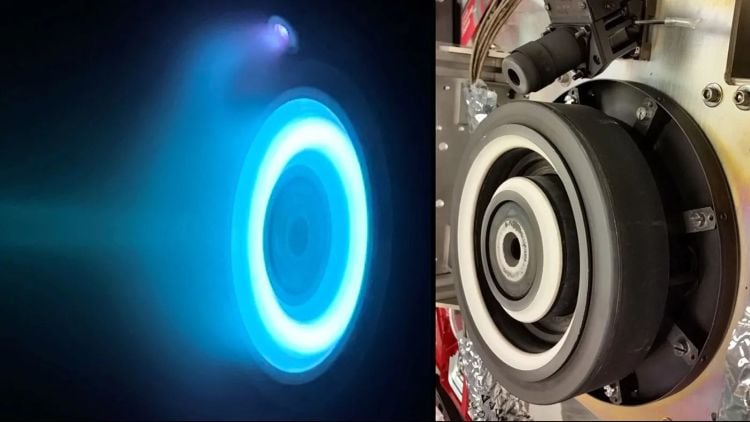
NASA engineers have tested a next-generation electric propulsion system that uses lithium metal vapor as fuel and reached 120 kilowatts of power, a new U.S. record according to Universe Today’s summary of the work. The result does not put astronauts on a faster Mars ship tomorrow, but it does mark a meaningful step toward the kind of high-power propulsion that future human deep-space missions would require.
Electric propulsion differs from chemical rocketry in a way that can seem counterintuitive. Instead of delivering a short, violent burst of thrust, it provides a gentler push that builds speed continuously over time. That is why the technology is so attractive for long-duration missions. The acceleration may begin modestly, but sustained operation can eventually produce enormous velocities while using far less propellant than conventional systems.
The source notes that electric propulsion can save up to 90 percent of the fuel required by chemical rockets. That kind of efficiency is one reason agencies keep investing in it even when the systems are technically demanding and less intuitive to the public. In spaceflight, efficiency is not a luxury. It can decide whether a mission is feasible at all.
Why 120 kilowatts matters
The new test benchmark is important partly because of its relation to existing missions. Universe Today compared the 120-kilowatt result with NASA’s Psyche spacecraft, which carries the most powerful electric thrusters yet built for flight and is en route to asteroid 16 Psyche. The new propulsion system’s tested power level is estimated at about 25 times greater than Psyche’s.
That does not mean it is ready to replace current spacecraft hardware immediately. It does mean NASA is moving into a much higher-power regime of electric propulsion testing, which is exactly where future human exploration concepts need progress. Power scales matter enormously in electric propulsion because the usefulness of these systems for large spacecraft depends on whether they can operate far above the levels used on today’s robotic missions.
James Polk, a senior research scientist at NASA’s Jet Propulsion Laboratory, said the team not only showed the thruster works but also hit the power levels they were targeting. Just as important, he said, they now have a strong testbed for addressing the challenges of scaling up.
Mars-class missions would need much more
For all its significance, 120 kilowatts is still well short of what a human Mars mission would likely require. Universe Today said NASA estimates such a mission would need 2 to 4 megawatts of power across several thrusters, with more than 23,000 hours of operation. That scale underscores how early the work still is. A promising test is not a deployment plan.
But the gap between today’s result and future needs is not a reason to dismiss the milestone. It is the reason the milestone matters. Space propulsion advances are built through step changes in demonstrable capability. Before a multi-megawatt architecture can be trusted for crews, engineers have to validate subsystems, fuels, operating conditions, and endurance in smaller but still ambitious increments.
The use of lithium metal vapor is part of what makes the work notable. New propellant approaches can alter performance envelopes and design tradeoffs in ways that become critical as systems scale. The source describes the test as a potential gamechanger, and while that label should always be treated cautiously, the underlying point is fair: propulsion architecture is one of the core constraints on how quickly and efficiently humans can move through the solar system.
Electric propulsion is about mission design, not just speed
Popular descriptions of advanced thrusters often focus on top speed, and for good reason. The article imagines a future Mars vehicle reaching more than 400,000 kilometers per hour after a week of continuous acceleration. But the deeper importance of electric propulsion lies in what it does for mission design. High-efficiency propulsion can reduce fuel mass, expand payload options, and potentially improve flexibility for missions that would otherwise be prohibitively expensive or slow.
That applies to robotic science missions as much as human exploration. More capable electric propulsion could help spacecraft travel farther, reposition more effectively, or carry instruments that would be difficult to support under tighter propellant constraints. In that sense, the technology is not only about Mars. It is about widening the design space for exploration across the solar system.
A long road, but a meaningful one
The record-setting test does not erase the engineering barriers ahead. Multi-megawatt power systems, very long operational lifetimes, thermal management, reliability, and full mission integration remain major challenges. Yet NASA’s progress shows that those challenges are being attacked at the right level: through hardware, measurement, and incremental validation rather than distant concept art alone.
That is why this test stands out. It is not just another futuristic Mars story. It is an example of the practical work required to turn deep-space ambitions into credible systems. By proving a lithium-vapor electric thruster at 120 kilowatts, NASA has moved one piece of that architecture forward.
If future tests continue in the same direction, electric propulsion may become one of the enabling technologies that makes faster, more efficient travel to Mars and beyond less speculative and more operational. For now, the achievement is best understood as a solid engineering milestone on a path that still has a long distance to cover.
Why this story matters
- NASA tested a lithium-vapor electric propulsion system at a record 120 kilowatts.
- The result is far above current flight-class electric propulsion power levels cited in the source.
- High-power electric propulsion is considered a key requirement for future human Mars missions.
This article is based on reporting by Universe Today. Read the original article.
Originally published on universetoday.com