A large cluster census with a simple but important result
NASA’s James Webb Space Telescope has been used to study nearly 9,000 star clusters across four nearby galaxies, producing a result with broad consequences for astrophysics: more massive star clusters appear to emerge more quickly from the gas and dust clouds in which they form.
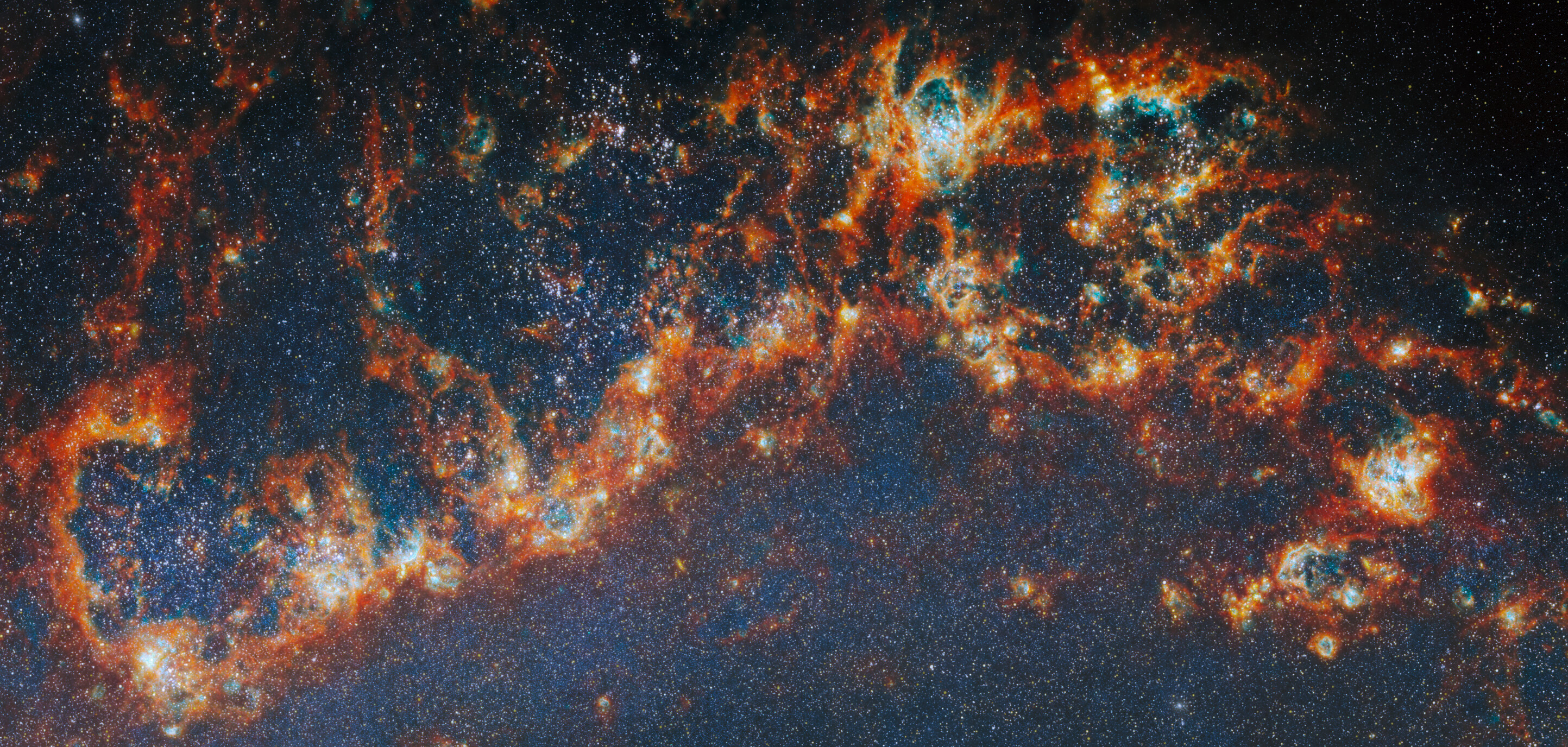
The finding was highlighted alongside a near-infrared image of a spiral arm in Messier 51, one of the galaxies included in the survey. While the image is visually striking, the underlying significance is scientific. Star clusters are the environments where many stars are born, and understanding how they clear their natal clouds helps explain how galaxies evolve over time.
Why emergence speed matters
Stars do not form in empty space. They are born inside dense clouds of gas and dust that can obscure them from view and shape their early development. A key question in star formation research is how long young stars and star clusters remain embedded before their own energy, radiation and dynamics disperse the surrounding material.
The Webb result suggests that mass is a major factor in that process. More massive clusters seem to push their way out sooner. That matters because emergence changes how effectively a cluster can influence its surroundings, from triggering or suppressing nearby star formation to redistributing gas across a galaxy.
A telescope built for this kind of problem
Webb is particularly well suited to this work because its infrared instruments can peer through the dusty regions that hide young stars from many visible-light observations. That capability lets astronomers compare clusters at different stages of development and assemble a more complete timeline of how stellar nurseries evolve.
By surveying four nearby galaxies rather than a single object, the study also gains comparative power. A sample spanning thousands of clusters across multiple galactic environments makes it easier to distinguish a broad pattern from a one-off feature of any individual galaxy. In this case, the pattern appears robust enough to point to a general property of massive cluster formation.
Galactic evolution starts with local processes
The practical importance of the result extends beyond star clusters themselves. NASA notes that learning how stars form helps researchers understand galactic evolution, internal galactic dynamics, and how and where planets form. Those links are not abstract. The way clusters emerge affects how energy and matter move through a galaxy, how long gas remains available for future star formation, and what kinds of environments planetary systems eventually inherit.
Massive clusters may therefore play an outsized role not only because they contain more stars, but because they restructure their surroundings faster. If they clear birth clouds more efficiently, they can alter the timing of feedback processes that regulate a galaxy’s star-forming activity.
What this adds to the field
The Webb study is a reminder that astronomy often advances through scale as much as spectacle. The headline image of M51 helps communicate the mission’s power, but the stronger contribution here is the statistical sweep of nearly 9,000 clusters. Large samples allow astrophysicists to move from isolated examples to population-level behavior.
That does not mean the problem is solved. The public summary does not detail which physical mechanisms dominate the faster emergence of massive clusters, and further work will be needed to connect the observational pattern to simulations and theory. Even so, identifying the trend is a meaningful step because it narrows the range of viable explanations.
Webb’s role in this research also underscores how the telescope continues to mature from headline-making first images into a workhorse for structured surveys. Those surveys may prove just as important as singular discoveries, because they build the data foundation needed to test how universal different astrophysical processes really are.
This article is based on reporting by NASA. Read the original article.
Originally published on nasa.gov