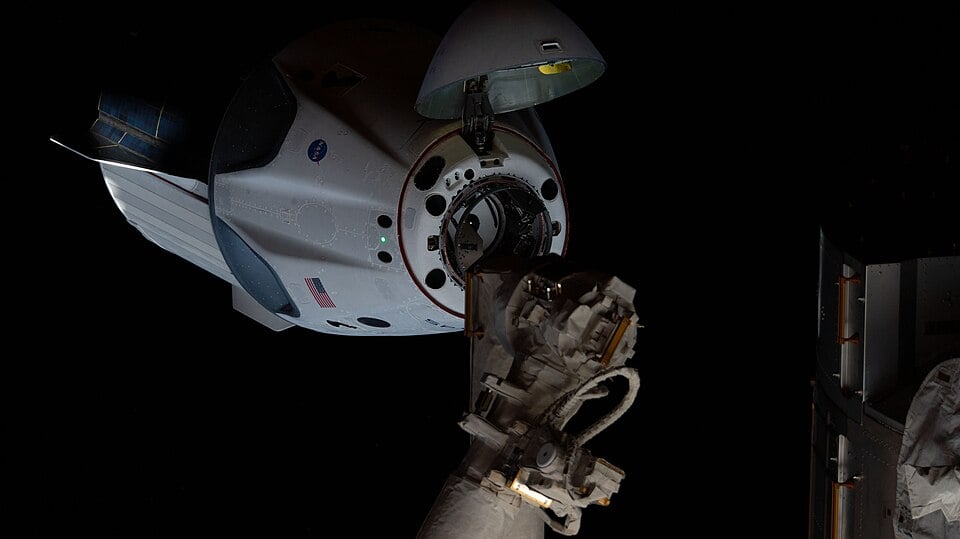
The Hardest Parking Job in the Solar System
Docking a spacecraft with the International Space Station looks, in animations, like a slow and graceful ballet. The reality is closer to a high-stakes physics nightmare. The station orbits at roughly 28,000 kilometers per hour, and an approaching capsule must match that speed while sliding into a docking port with tolerances measured in centimeters. As Universe Today contributor Andy Tomaswick put it, it is like traveling down a highway at 28,000 km/h and parallel parking into an open garage on a multi-billion-dollar laboratory moving at the same speed.
Orbital mechanics adds cruel twists that drivers on Earth never face. If a pilot tries to accelerate forward, the spacecraft actually drifts upward. There is no air friction to naturally slow the vehicle down. And the consequences of failure are catastrophic: a collision could kill everyone aboard both the visiting craft and the station, and the resulting debris field could threaten dozens of satellites and even people on the ground.
For decades, aerospace engineers have relied on hard-coded physics equations and human pilots to correct them. Now, a new pre-print paper from researchers at Stanford, available on arXiv, proposes a different approach. The team is building an AI that performs a series of \"mental simulations\" — a capability they say could fundamentally change how future spacecraft interact with each other. Their system is called the Out-of-this-World Model, or OWM.
How Spacecraft Dock Today — and Where It Breaks Down
To appreciate why OWM matters, it helps to understand the conventional toolkit for navigating in Low Earth Orbit (LEO). Traditional navigation computers run a Guidance, Navigation and Control (GNC) algorithm. They also use a mathematical tool called an Extended Kalman Filter, which ingests data from GPS receivers and star trackers and outputs the thruster burn duty cycles needed to steer the vehicle.
Kalman Filters and the Video Problem
Kalman filters are powerful, but they are terrible at processing high-speed video. That limitation pushes engineers toward traditional computer vision techniques. In space, however, those techniques face a serious hurdle: they are fragile. If sunlight glints off a solar array, or if part of the target is suddenly covered in shadow, the computer vision algorithms can be completely thrown off. A docking port that was clearly visible one moment can become an unrecognizable shape the next.
Why Reinforcement Learning Stumbles
Machine learning sounds like the perfect solution, and researchers have tried. They began applying Reinforcement Learning (RL) algorithms — the same family of methods that famously taught computers to win at chess and Dota. But RL has a narrow comfort zone: it excels when the rules are fixed and specific. Change the rules, such as flipping which side of the ISS the docking port is on, and the algorithms no longer know what to do. A docking maneuver that worked flawlessly in one configuration can fail completely in another.
Enter the Out-of-this-World Model
The Stanford team's answer is a \"World Model.\" Rather than memorizing a single set of rules or relying on brittle feature detection, a world model builds an internal representation of the environment and uses it to run mental simulations. The spacecraft can, in effect, dream about possible futures — imagining how its thrusters will change its trajectory, how the station will appear as it rotates, and how lighting conditions might shift — before committing to a burn.
This is a meaningful departure from both classical GNC and pure RL. Classical algorithms depend on hand-crafted equations that must be tuned for each mission. RL agents depend on extensive training in a narrow domain. A world model aims to generalize: by learning a predictive model of how the world works, it can adapt when the scenario changes, such as a different docking port orientation or unexpected shadows.
The Baseball Analogy: Thinking Without Equations
The researchers explain the concept with an analogy that has nothing to do with rockets: a baseball or cricket player catching a fly ball. When an outfielder moves to make a catch, they do not immediately begin solving partial differential equations. Instead, they rely on an intuitive, predictive model of how the ball will travel — a mental simulation built from experience. They run, adjust, and intercept the ball without ever calculating a trajectory on paper.
A world model gives a spacecraft something similar. Instead of explicitly solving the equations of orbital motion at every step, the AI can simulate outcomes internally. It can \"dream\" its way through a docking approach, testing hypothetical actions against its learned model of physics and perception. If the mental simulation predicts a collision or a missed alignment, the system can adjust before the maneuver goes wrong in the real world.
What This Could Mean for Future Spacecraft
The implications reach beyond docking with the ISS. As more spacecraft operate autonomously — servicing satellites, assembling structures in orbit, or navigating traffic in congested orbital lanes — the ability to reason about novel situations becomes essential. Hard-coded equations and fragile computer vision may not scale to a future where vehicles must cooperate, avoid debris, and adapt to conditions no engineer fully anticipated.
The Stanford paper is a pre-print, meaning it has not yet been peer-reviewed, and the source text does not detail the OWM's architecture, training data, or performance benchmarks. But the core idea is compelling: teach spacecraft to build a mental model of their world, then let them practice in their heads before they fire thrusters. If it works, docking may become less of a white-knuckle parallel parking job and more of a routine — one where the spacecraft has already imagined a thousand ways the approach could go wrong and found a path through.
For now, the problem remains as daunting as ever. Matching velocities at 28,000 km/h, compensating for orbital drift, and avoiding a catastrophic collision are not challenges that disappear overnight. But the Stanford researchers are betting that the next generation of spacecraft will not just calculate their way to the station. They will dream their way there.
This article is based on reporting by Universe Today. Read the original article.
Originally published on universetoday.com