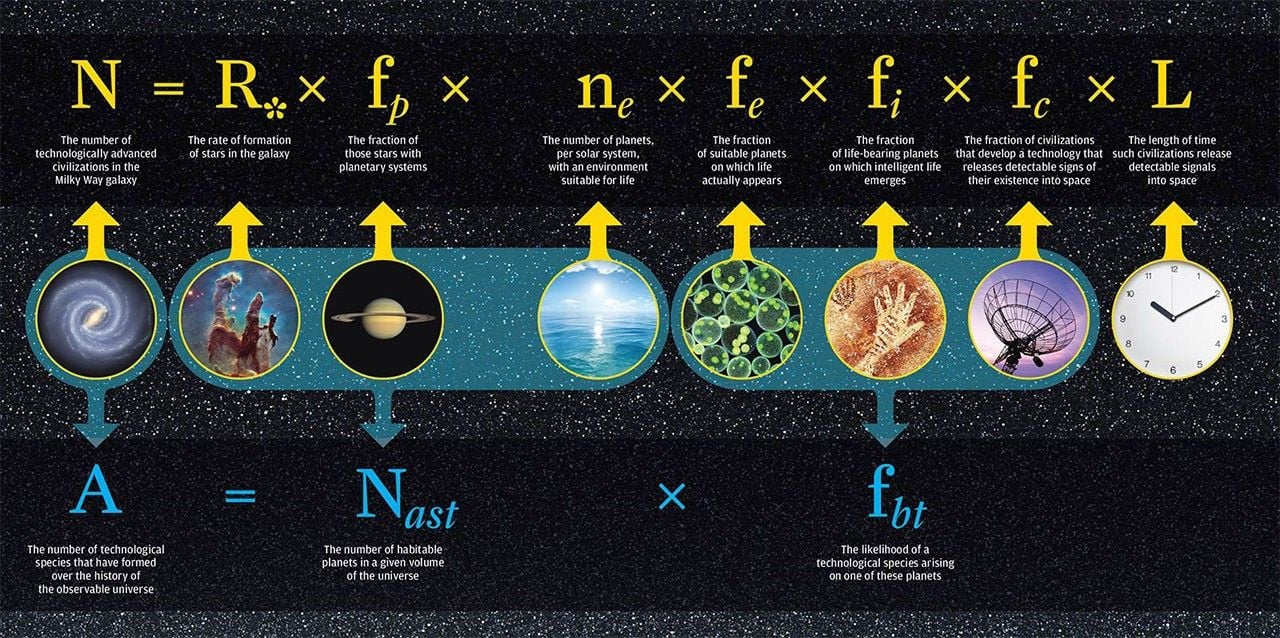
One of SETI’s most practical questions is also one of its bleakest
The search for extraterrestrial intelligence often drifts toward spectacular possibilities, but one of its most durable ideas is far more restrained: maybe civilizations do not remain detectable for very long. In the latest installment of Universe Today’s continuing history of SETI, that possibility is revisited through what the author calls the “Brief Window Hypothesis.”
The argument draws on a central variable in Frank Drake’s famous equation: the longevity factor, often represented as L, or the length of time a civilization emits signals into space. The logic is simple and unforgiving. Even if intelligent life is not exceptionally rare, contact still requires two civilizations to overlap in time while at least one is producing detectable signals. If that communicative phase is short, the odds collapse.
Why longevity may matter more than abundance
Public imagination often treats the Fermi paradox as a numbers problem: with so many stars and planets, where is everybody? The longevity framing changes that. It suggests abundance may not be the limiting factor at all. Civilizations could arise often enough and still miss each other almost entirely if their technological or communicative periods are brief against cosmic timescales.
The series traces this reasoning back to Frank Drake and to early radio astronomer Sebastian von Hoerner, who argued in the 1960s that the existential window of a technologically advanced society might simply be too short. That idea carried the imprint of its era, including concern over nuclear annihilation during the Cold War, but it remains surprisingly relevant. Today the causes people debate may be broader, from war to ecological collapse to technological transformation, but the timing problem remains the same.

A practical answer to the Great Silence
The appeal of the brief-window explanation is that it does not require exotic assumptions. It does not depend on conspiratorial “zoo” theories, hidden empires, or the claim that advanced beings have transcended physical reality. It only requires that civilizations tend to pass through detectable technological phases that are short relative to interstellar distances and cosmic history.
That makes it one of the more practical resolutions to the Great Silence. Civilizations might arise, communicate for a while, and then disappear, withdraw, change technology, or become effectively invisible to searches based on radio leakage or recognizable signaling. In that view, silence is not evidence of emptiness. It may be evidence of poor temporal alignment.
Why the idea still matters now
The concept remains relevant because it influences how SETI thinks about search strategy. If detectable windows are brief, then assumptions about long-lived, steady beacons may be too generous. Search efforts may need to account for transient signals, changing technological signatures, and the possibility that what humanity is looking for is both rarer in time and more diverse in form than early programs assumed.
The article also places the brief-window idea alongside more speculative notions of transcendence, where advanced civilizations evolve in ways that make ordinary communication unlikely. But the longevity factor stands out because it preserves a sober scientific posture. It does not ask us to imagine incomprehensible supercivilizations first. It asks whether even modest civilizations can survive and remain legible long enough to be found.

A mirror held up to humanity
As with much of SETI, the hypothesis doubles as a way of thinking about human futures. The question is not only why we have not heard from others. It is whether our own civilization will maintain a detectable, stable, technologically capable phase long enough for contact to be possible.
That may be why the idea has endured. It converts a cosmic puzzle into a civilizational one. The barrier to interstellar contact may not be distance alone, or even rarity, but durability.
Universe Today’s historical framing is useful for precisely that reason. It reminds readers that SETI is not only about instruments pointed outward. It is also a long-running attempt to understand what kinds of societies can persist, communicate, and remain visible across deep time. If the window is brief, then the silence may be less mysterious than it seems. It may simply be the sound of civilizations failing to overlap.
This article is based on reporting by Universe Today. Read the original article.
Originally published on universetoday.com