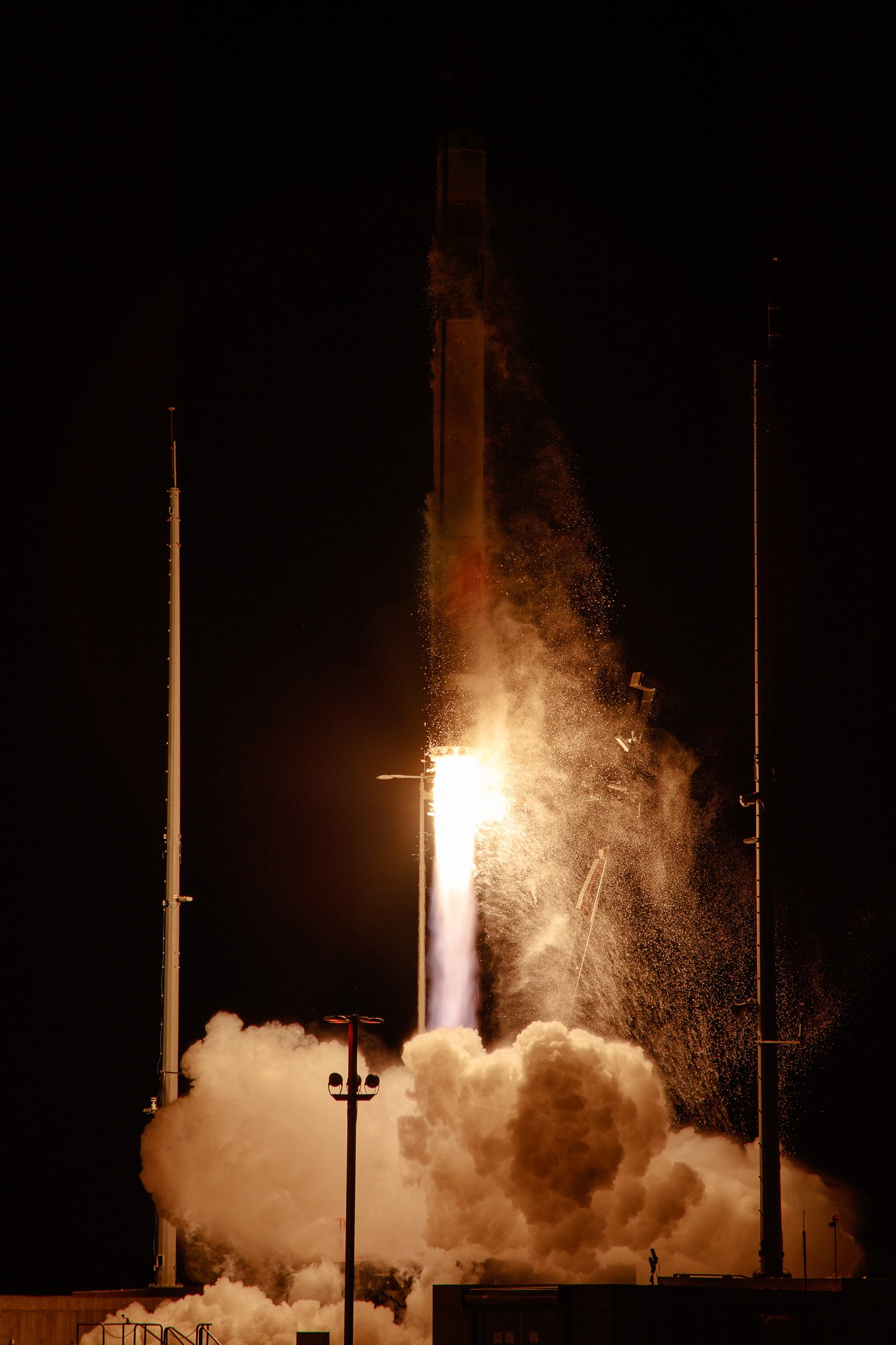
Night Launch From Wallops
Rocket Lab has successfully completed the first HASTE suborbital launch of 2026 from NASA's Wallops Flight Facility on Virginia's Eastern Shore. The nighttime launch lit up the coastline as the vehicle accelerated through the atmosphere on a hypersonic test flight mission, continuing Rocket Lab's expansion beyond its core orbital launch business into the growing market for suborbital hypersonic technology development.
HASTE, which stands for Hypersonic Accelerator Suborbital Test Electron, is a modified version of Rocket Lab's proven Electron orbital launch vehicle, reconfigured to carry experimental payloads on suborbital trajectories that achieve hypersonic speeds. The vehicle provides researchers and defense contractors with a relatively affordable and frequently available platform for testing materials, sensors, and systems at speeds exceeding Mach 5, an environment that is extremely difficult and expensive to replicate in ground-based facilities.
Supporting Hypersonic Research
The specific payload and customer for this mission have not been publicly disclosed, which is typical for HASTE flights that often carry defense-related experiments. Hypersonic technology development has become a top priority for the U.S. Department of Defense, which has invested billions of dollars in developing hypersonic weapons, defense systems, and the underlying materials science needed to operate reliably at extreme speeds and temperatures.
Testing is a critical bottleneck in hypersonic development. Wind tunnels can simulate hypersonic conditions for brief periods, but they cannot replicate the full range of aerothermal, vibration, and electromagnetic environments that a vehicle experiences during actual hypersonic flight. Suborbital test flights like HASTE missions provide real-world data that is essential for validating designs and materials before they are integrated into full-scale weapons systems or vehicles.
Rocket Lab's Expanding Mission Profile
The HASTE program represents a strategic diversification for Rocket Lab, which built its reputation as a dedicated small satellite launch provider with its Electron rocket. By adapting the existing Electron platform for suborbital hypersonic testing, the company leveraged its existing manufacturing infrastructure, flight heritage, and launch site capabilities to enter a new market with relatively modest additional investment.
The economics of the HASTE offering are compelling for customers. A dedicated suborbital test flight on HASTE costs a fraction of what a purpose-built sounding rocket or a slot on a larger hypersonic test vehicle would cost, and Rocket Lab's high launch cadence means customers can get to the pad faster than with many competing options. This combination of affordability and schedule responsiveness has attracted a pipeline of customers that Rocket Lab has described as robust, with multiple missions planned for 2026.
NASA Wallops as Launch Hub
NASA's Wallops Flight Facility has emerged as the primary launch site for HASTE missions, complementing Rocket Lab's orbital launch operations at its dedicated pads in New Zealand and at the Mid-Atlantic Regional Spaceport, also located at Wallops. The facility's location on the Virginia coast provides favorable launch azimuths for suborbital missions over the Atlantic Ocean, where expended stages and test articles can be safely recovered or allowed to impact in designated areas.
NASA's support for commercial launch operations at Wallops reflects the agency's broader strategy of serving as an enabler for commercial space activities. The facility provides range safety services, tracking systems, and infrastructure support that commercial operators like Rocket Lab would otherwise need to build and maintain independently. This partnership model reduces costs for commercial operators while keeping Wallops active and relevant as a national launch asset.
The Hypersonic Market
The market for hypersonic testing services is expected to grow significantly in the coming years as the United States, its allies, and competitors all accelerate their hypersonic development programs. China and Russia have both fielded operational hypersonic weapons, creating urgency in the U.S. defense establishment to close what is perceived as a capability gap. This urgency translates into funding for testing infrastructure, and Rocket Lab's HASTE platform is well-positioned to capture a meaningful share of that spending.
Beyond defense applications, hypersonic technology has potential commercial implications for high-speed point-to-point transportation, which several companies are pursuing as a long-term business opportunity. While commercial hypersonic flight remains years away from operational reality, the testing and materials validation work being conducted on platforms like HASTE contributes to the foundational knowledge needed to make it viable. Rocket Lab's successful 2026 debut sets the stage for an active year of hypersonic testing from Wallops.
This article is based on reporting by NASA. Read the original article.
Originally published on nasa.gov