A new testbed tackles one of reentry engineering's hardest problems
Reusable spacecraft have pushed engineers to revisit one of the oldest constraints in spaceflight: how to survive atmospheric reentry without carrying large amounts of sacrificial hardware. A report on new work from Tokyo Metropolitan University points to a potentially important step in that effort. Researchers there have developed a test setup designed to study magnetohydrodynamic, or MHD, braking, a concept that could reduce heating and increase drag by using magnetic forces to interact with the plasma that forms around a spacecraft during reentry.
The idea has appeal because current thermal protection systems come with familiar tradeoffs. Conventional heat shields often absorb extreme energy by slowly degrading or shedding material. That approach works, but it adds refurbishment time, reduces operational flexibility, and forces vehicles to carry hardware that contributes little outside the reentry phase. For reusable systems, those penalties matter. Turnaround time, payload mass, and maintenance complexity all affect whether reusability pays off in practice.
MHD braking is being explored as an alternative or supplement to those traditional methods. The promise is not that magnetism makes atmospheric heating disappear. It is that a carefully shaped magnetic field might alter the plasma flow enough to ease the burden on the vehicle and slow it more efficiently.
How magnetic braking is supposed to work
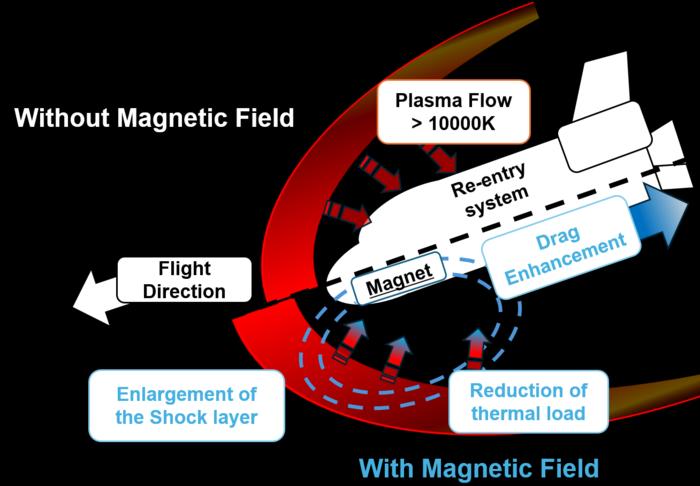
During reentry, the air ahead of a fast-moving spacecraft becomes a weakly ionized plasma. In simple terms, that means the gas is hot and electrically responsive enough for magnetic fields to influence it. According to the report, an MHD system would generate a magnetic field from inside the spacecraft and push against that plasma using the Lorentz force.
If the interaction works as hoped, the field effectively creates an invisible magnetic cushion between the vehicle and the hottest surrounding flow. That could produce two valuable effects at the same time:
- Lower the heat reaching the spacecraft's thermal protection system.
- Increase aerodynamic drag, slowing the vehicle during descent.
Those two outcomes explain why MHD braking continues to attract attention. Reentry systems usually force designers into tradeoffs between protection, mass, and controllability. A method that can both reduce heating and add braking force would be unusually attractive for reusable launch systems and spacecraft that need faster refurbishment.

Why the concept has been difficult to validate
The hard part is not explaining the theory. It is producing a realistic, measurable test environment. The report identifies one bottleneck in particular: the magnets themselves. Permanent neodymium magnets can reach roughly 0.8 tesla, but that level is limited when engineers are trying to influence the extreme flow conditions associated with high-speed reentry. Their rigid shapes create a second design constraint, because they cannot easily conform to different vehicle geometries.
Those limits matter because MHD braking is only as useful as the strength and shape of the field it can generate in realistic conditions. If the magnetic effect is too weak, it may not significantly shift heat transfer or drag. If the field geometry is poorly matched to the spacecraft, the system may be difficult to integrate even before performance is considered.
That is why laboratory infrastructure becomes so important. Researchers need a way to produce short, intense conditions that resemble the shock environment of reentry while also allowing precise measurement of what the magnetic system is doing.
The pulse-forming network changes the experimental equation
The Tokyo team addressed that challenge with a pulse-forming network, or PFN. The report describes the PFN as an electrical circuit built from alternating capacitors and inductors that can store energy and then release a large amount of it in a very short burst. That burst capability is central to the concept. Instead of relying only on permanent magnets with fixed performance limits, the system can generate a much more powerful magnetic event for a fraction of a second.
The short operating time brings its own practical advantage: the setup does not require a dedicated cooling system because the pulse lasts only briefly. In other words, the researchers are trading long-duration operation for a controllable, high-power impulse that can be synchronized with a test event. For lab work, that is a sensible exchange. The goal is not to reproduce an entire reentry trajectory in one continuous run. It is to isolate the relevant physical interaction and measure it under conditions that are strong enough to matter.
To do that, the researchers built an eight-meter expansion-tube facility called MX-6.0. According to the report, the tube can fire shockwaves similar to those seen in reentry and reach velocities of up to 7.7 kilometers per second. That gives the team a way to expose test hardware to severe flow conditions while observing how the pulsed magnetic field changes the surrounding plasma behavior.
Why this matters for reusable launch systems
The immediate result is a better test platform, not a flight-ready spacecraft brake. That distinction matters. Reentry technologies often look promising in concept and then struggle when moved into experiments, integration studies, or full-scale missions. Still, better experimental tools are often the difference between a speculative idea and an engineering program that can advance.
For reusable vehicles, the incentive is clear. If MHD braking can reduce the workload on traditional heat shields, operators could gain faster turnaround and potentially higher payload efficiency. Even a partial reduction in thermal stress could translate into less refurbishment between flights. And because the concept also aims to increase drag, it may offer system-level benefits that go beyond thermal protection alone.
The larger context is that reusability is forcing a more exact accounting of what spacecraft carry and what maintenance they require after each mission. Hardware once treated as acceptable dead weight becomes harder to justify when launch cadence and operational cost are central to the business case. That pressure creates room for unconventional approaches, including magnetic interaction with plasma flows that earlier programs may have viewed as too difficult to pursue.
A research step worth watching
The most important contribution here may be methodological. By building a dedicated platform around pulsed magnetic fields and a high-speed expansion tube, the researchers have created a way to observe MHD braking under more demanding and relevant conditions. That does not prove the concept will become standard on reusable spacecraft. It does mean the field has a stronger basis for testing, comparison, and design iteration.
If follow-on experiments show measurable reductions in heat load or meaningful drag changes, MHD braking could move from an intriguing reentry concept toward a practical technology candidate. If the gains prove small or hard to scale, the new testbed will still have served an important role by clarifying the limits.
Either way, this is the kind of work that tends to matter later. Reentry innovation often advances through better instruments and better experiments before it shows up in vehicles. The MX-6.0 platform and its pulse-forming magnetic system appear to be aimed at exactly that stage: turning an elegant idea about plasma, drag, and heat into data engineers can actually use.
This article is based on reporting by Universe Today. Read the original article.
Originally published on universetoday.com