New Euclid detections push deeper into the universe’s first billion years
One of the hardest problems in modern astrophysics is explaining how supermassive black holes grew so quickly in the early universe. A new set of quasar detections from the European Space Agency’s Euclid space telescope does not solve that puzzle outright, but it adds important data at exactly the point where astronomers need it most: the era when the first giant black holes were already shining less than a billion years after the universe began.
According to the supplied source text, a paper newly published in Astronomy & Astrophysics reports that researchers found 31 new quasars during the first year and a half of Euclid’s wide-angle survey. Among them are two of the most distant quasars ever observed. Those detections came from about 3,000 square degrees of sky coverage, with follow-up spectroscopy carried out using the Keck, Magellan, and Large Binocular Telescope observatories.
That combination matters. Euclid’s survey power can identify candidate objects across large areas of sky, but spectroscopy is what helps confirm what those objects are and where in cosmic history they sit. In this case, the result is a new batch of extremely distant quasars that can be used to probe how black holes and galaxies evolved in the universe’s early stages.
Why quasars are so useful
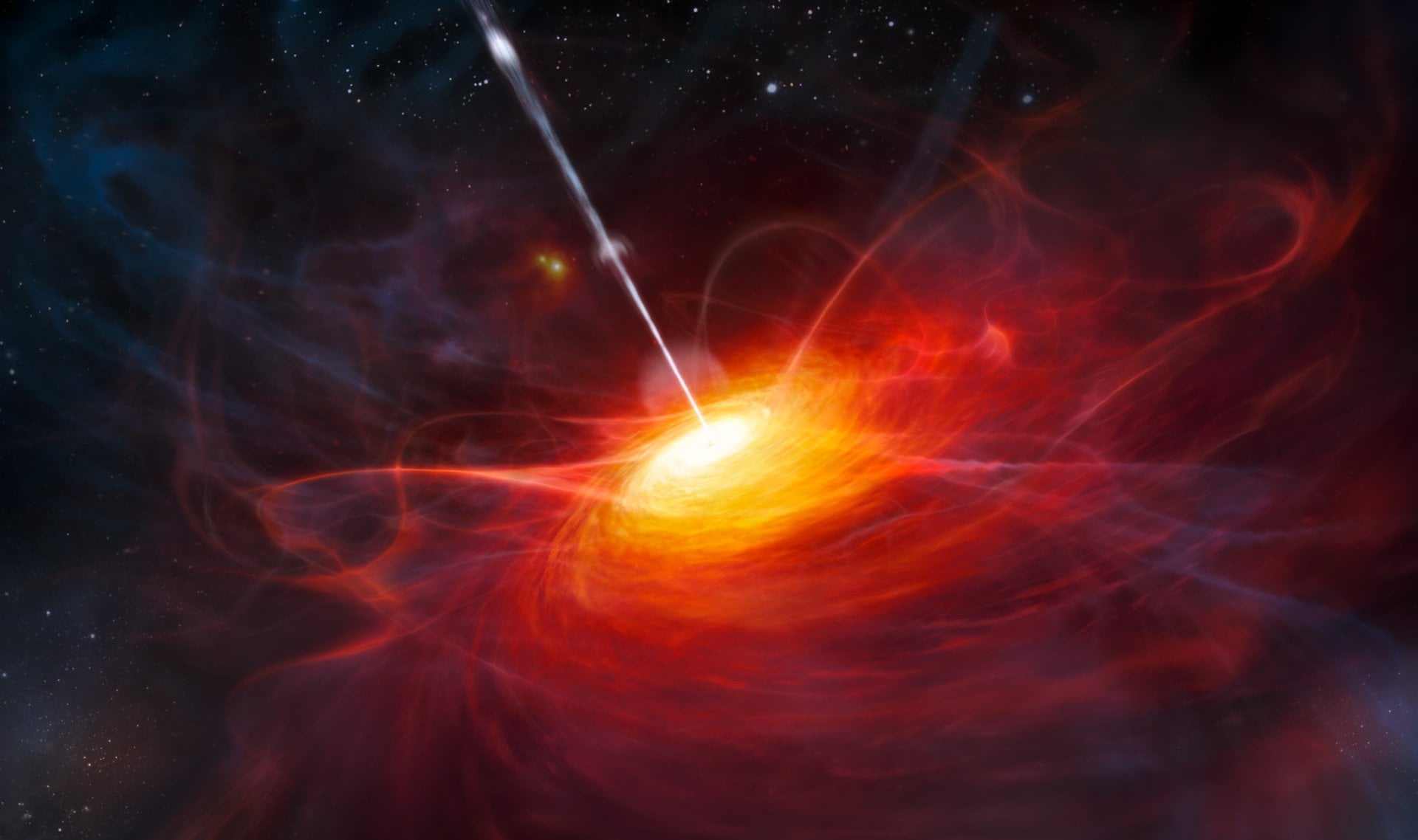
Quasars are among the brightest known objects in the cosmos, not because the black holes at their centers emit light directly, but because infalling matter heats up as it spirals inward. The supplied article quotes Imperial College London astrophysicist Daniel Mortlock explaining the basic picture: large galaxies host central supermassive black holes, and when material falls into those black holes and heats up, it can outshine all the stars in the surrounding galaxy. That blazing output is what astronomers observe as a quasar.
The most distant quasars are especially valuable because they act like signposts from a very young universe. If astronomers can see an already massive and luminous quasar at such an early epoch, then the black hole powering it must have formed and grown rapidly. That is the source of the deeper mystery. Standard growth processes can struggle to explain how some black holes became so enormous so soon after the Big Bang.
In other words, every new high-redshift quasar is more than a point of light. It is evidence about timing, growth rate, and environmental conditions in the universe’s first few hundred million years. Finding more of them helps researchers build a less anecdotal, more statistical picture of early black hole evolution.
A bridge between the first quasars and later galaxies
The significance of the new Euclid detections lies partly in sample building. Rare objects are difficult to understand when there are only a handful of examples. With 31 new quasars identified in the survey’s first 18 months, astronomers gain more opportunities to compare brightness, distance, and other properties across a wider population. The two especially remote detections are notable because they extend observations toward the dawn of galaxy formation.
The supplied text frames these objects as a crucial link in understanding the earliest supermassive black holes, and that is a fair reading of the evidence provided. Massive spiral galaxies are common across cosmic time, and today astronomers believe supermassive black holes sit at the centers of essentially all large galaxies, including the Milky Way. Tracing the active quasar phase in the early universe helps connect the brilliant, fuel-rich black holes of the past to the quieter galactic centers seen today.
This is also why quasars, despite being less culturally prominent than they once were, remain scientifically important. They are not just exotic outliers. They are a way of studying the co-evolution of black holes and galaxies, including how intense early accretion may have influenced star formation, galactic structure, and the surrounding intergalactic environment.
Euclid’s role in the search
Euclid was designed for wide-field cosmological surveying, and this result shows the value of that strategy. Rare high-redshift quasars are scattered sparsely across the sky, so finding them efficiently requires both reach and scale. The survey area cited in the source, roughly 3,000 square degrees, underscores that point. These are not targets that reveal themselves easily in small, narrow campaigns.
The follow-up effort also shows how modern astronomy increasingly works as a coordinated system. A space telescope can identify promising candidates, but confirmation often depends on large ground-based observatories with the right spectroscopic tools. Keck, Magellan, and the Large Binocular Telescope each played a role in validating the detections. That handoff from survey discovery to detailed confirmation is now central to frontier astrophysics.
The broader implication is that Euclid may deliver many more such finds as its survey expands. The first year and a half has already produced dozens of new quasars and two among the most distant known. If that pace continues, the telescope could materially strengthen the dataset available for testing models of early black hole formation and growth.
An old question, sharper new evidence
The source text places the discovery in the longer history of quasar research, from their first identification in the radio spectrum in the 1950s to later recognition that they are powered by supermassive black holes. That historical arc matters because it shows how the field has shifted from basic identification to origin questions. Astronomers no longer ask what quasars are in the broad sense. They ask how the earliest and most extreme examples appeared so quickly, and what that says about the young universe.
The new Euclid detections do not yet provide a final answer. They do, however, improve the evidence base. More confirmed distant quasars mean better constraints on how common such objects were, how bright they became, and how early the underlying black holes must have assembled. For theoretical models, that is exactly the kind of observational pressure that drives progress.
For now, the central takeaway is straightforward. Euclid’s early survey data have already uncovered a meaningful new set of quasars, including two of the most distant yet seen. That gives astronomers fresh leverage on one of the most persistent problems in cosmology: how the universe built supermassive black holes so fast, so early, and on such a grand scale.
This article is based on reporting by Universe Today. Read the original article.
Originally published on universetoday.com