A one-hour flash with outsized implications
A brief brightening seen in December 2019 is forcing astronomers to weigh some unusually consequential possibilities. The event, detected in a high-cadence survey of the Large Magellanic Cloud, lasted about an hour and matched the smooth, symmetrical pattern expected from gravitational microlensing rather than from an ordinary variable star, flare, or asteroid.
The object responsible has been nicknamed Phoebe. What makes it notable is not only that the event appears genuine, but that the inferred mass is extraordinarily small. Working backward from the event timescale, the researchers estimated a mass of roughly three times that of Earth’s Moon. That places Phoebe in a category far below normal planets and far below the mass expected for familiar black holes formed by collapsing stars.
Why microlensing matters here
Microlensing is one of the clearest observational consequences of general relativity. When a compact object passes between Earth and a distant background star, its gravity bends and magnifies the star’s light. That produces a temporary brightening with a characteristic shape. The method is valuable because it can reveal objects that emit little or no light of their own.
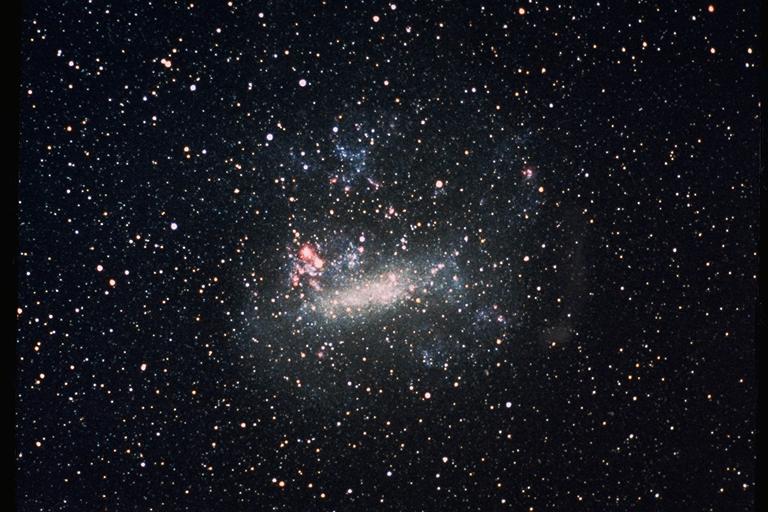
In this case, the target star sits in the Large Magellanic Cloud, one of the Milky Way’s satellite galaxies. Phoebe’s passage briefly amplified that star’s light, then the signal disappeared and the star returned to normal. That clean, one-off behavior is part of why astronomers regard the detection as a credible microlensing candidate.

Three possibilities, all interesting
The research team outlined three leading interpretations. The first is a free-floating planet: a body that formed in a planetary system and was later ejected, leaving it to wander through space untethered to a star. The second is similar but even more unusual: an object of that type residing not in the Milky Way, but in the Large Magellanic Cloud itself. If so, it could amount to the first extragalactic microlensing planet detection.
The third possibility is the most exotic. Phoebe could be a primordial black hole, a hypothetical object formed from density fluctuations in the early universe rather than from stellar collapse. Because the estimated mass is so low, the standard stellar-remnant explanation does not fit. That keeps the primordial-black-hole idea in play, even if it remains speculative.
The detection limit is part of the story
Phoebe sits near the edge of what current surveys can detect. Short-duration microlensing events are easy to miss because they demand rapid, repeated observations of the same field. A one-hour signal does not leave much room for gaps in coverage. That means the result is also a reminder that instrument cadence can determine what kinds of hidden populations astronomers are able to find.
If more events like this appear, astronomers may be able to determine whether Phoebe belongs to a wider population of moon-mass wanderers, whether rogue planetary bodies are more common than expected, or whether rare compact objects from the early universe remain detectable today through precision monitoring.
What comes next
The current result does not settle Phoebe’s identity. It sharpens the puzzle. That is often how frontier observations work: first a clean anomaly, then a debate over which class of explanation survives closer scrutiny. Here, the puzzle is unusually rich because each option carries a different scientific payoff.
A free-floating object would add to the case that planetary systems eject large numbers of bodies into interstellar space. An extragalactic example would expand microlensing’s reach beyond the Milky Way. A primordial black hole interpretation would touch one of cosmology’s long-running questions about what kinds of compact objects could have formed in the earliest moments after the Big Bang.
For now, Phoebe is less a solved object than a sharply defined clue. A distant star brightened for an hour, and that brief fluctuation may end up telling astronomers something important about rogue worlds, the limits of survey design, or relics from the infant universe.
This article is based on reporting by Universe Today. Read the original article.
Originally published on universetoday.com