A fuller map of TESS’s sky
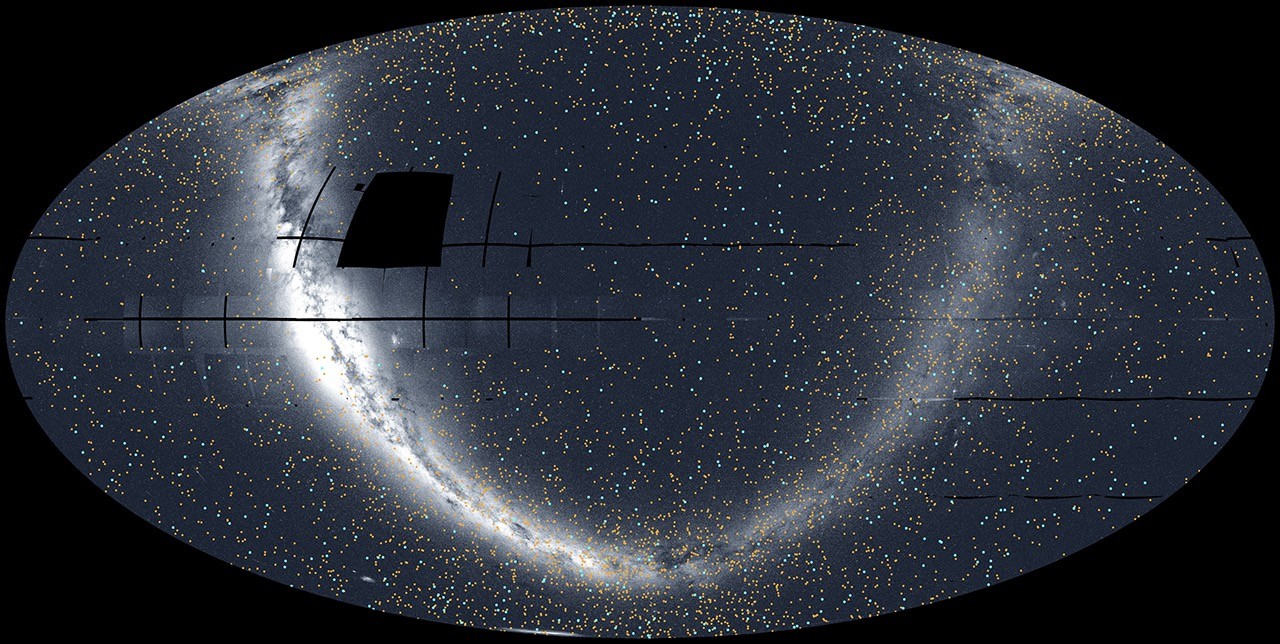
NASA’s Transiting Exoplanet Survey Satellite, or TESS, has released what the agency describes as its most complete view of the night sky so far. The new mosaic fills in gaps from earlier observations and presents a broad visual record of the mission’s work from April 2018 through September 2025.
The image is built from 96 sectors observed during that period. TESS scans one sector of the sky for about a month at a time using four cameras, watching tens of thousands of stars for subtle changes in brightness that could indicate an orbiting planet passing in front of its host star.
Thousands of worlds in one image
What makes the new mosaic especially striking is the overlay of exoplanet discoveries. NASA says nearly 6,000 colored dots are scattered across the image, marking either confirmed exoplanets or candidate worlds identified by the mission as of the end of TESS’s second extended mission in September 2025.
By that point, TESS had discovered 679 confirmed exoplanets, shown in blue, and 5,165 candidates, shown in orange. The result is both a scientific map and a reminder of how quickly exoplanet astronomy has expanded in the past decade.
Rebekah Hounsell, a TESS associate project scientist at the University of Maryland Baltimore County and NASA’s Goddard Space Flight Center, said the mission has become a “fire hose” of exoplanet science over the last eight years. According to NASA, TESS has helped researchers identify planets of many kinds, from small Mercury-like worlds to planets larger than Jupiter.

More than a count of planets
The value of TESS is not just the number of worlds it helps uncover. NASA says some of the planets it has found lie in habitable zones, where liquid water could potentially exist on the surface. That does not make them inhabited or even necessarily Earth-like, but it does place some of them in the category of worlds that deserve close follow-up.
The mission’s catalog also includes stranger classes of planets. NASA highlights worlds that may be covered by volcanoes, worlds being destroyed by their stars and planets orbiting binary stars, where a sunrise and sunset would unfold under two suns.
The candidate list remains especially important. More than 5,000 TESS worlds still await verification, underscoring how survey missions feed a much larger observational pipeline. TESS is a finder, but confirmation depends on follow-up work across other observatories and techniques.
A wider census of exoplanets
NASA says that, to date, scientists have confirmed more than 6,270 exoplanets using TESS, the retired Kepler Space Telescope and other facilities. TESS’s role in that broader census is central because it surveys large portions of the sky and keeps adding targets for deeper study.
The mosaic also captures familiar large-scale structures in the sky. The bright central arc is the plane of the Milky Way. The Large and Small Magellanic Clouds appear as bright white ovals toward the lower left. Black areas inside the overall oval indicate regions TESS has not yet imaged.
Why the mosaic matters
At one level, the release is a data-rich image product. At another, it is a compact summary of a major era in planet hunting. TESS has been operating long enough that its discoveries can now be visualized not as isolated findings, but as a dense pattern spread across the sky.
That matters scientifically and culturally. Exoplanet discovery is no longer a trickle of rare surprises. It is an ongoing census that keeps widening the range of planetary systems known to exist. The new TESS mosaic makes that abundance visible in a single frame.
This article is based on reporting by science.nasa.gov. Read the original article.
Originally published on science.nasa.gov