NASA lays out the countdown for Roman’s long-awaited launch
NASA has released its public coverage plans for the launch of the Nancy Grace Roman Space Telescope, a mission the agency describes as its next-generation observatory for tackling some of the biggest questions in astrophysics, including dark energy. The launch is targeted for no earlier than 7:26 a.m. Eastern on Sunday, August 30, from Launch Complex 39A at Kennedy Space Center in Florida aboard a SpaceX Falcon Heavy rocket.
The new advisory is partly a scheduling notice, but it also serves as a reminder of the scale of the mission Roman is about to begin. NASA says the telescope combines sharp infrared vision with a field of view at least 100 times larger than Hubble’s. That pairing is the mission’s defining feature: not just seeing deeply, but surveying broadly.
In practical terms, Roman is designed to collect expansive, high-resolution views of the sky that can support several major lines of research at once. NASA says those surveys will help scientists investigate dark energy and dark matter, discover and characterize exoplanets, map billions of galaxies, study black holes, and examine objects ranging from our own solar system to the edge of the observable universe.
That list is unusually broad, even by flagship-mission standards. Roman is being positioned not as a telescope built around a single iconic target, but as an observatory intended to generate large, systematic datasets that can reshape multiple research fields over time.
Why Roman matters
The agency’s emphasis on dark energy places Roman in one of modern cosmology’s most persistent unsolved problems: understanding why the expansion of the universe is accelerating. A mission that can image wide areas of space in infrared at high quality gives astronomers a powerful tool for tracing the structure and evolution of galaxies across cosmic time, one path toward improving measurements related to that expansion.
Roman’s design also matters for exoplanet science. NASA says the telescope will discover and characterize exoplanets, suggesting a role both in finding distant worlds and in learning more about their properties. The observatory’s reach across several scientific domains makes it a multipurpose platform rather than a niche instrument.
The destination reinforces that ambition. After launch and separation from the Falcon Heavy, Roman will travel to the second Sun-Earth Lagrange point, known as L2, about one million miles from Earth. L2 has become a strategically valuable location for major observatories because it allows a stable operating environment well suited to sensitive space astronomy.
NASA says the mission has a five-year primary lifetime and a goal of operating for 10 years. Just as important for the broader scientific community, the agency says Roman’s science data will be made publicly available after processing. That means the mission is expected to function not only as a NASA flagship but also as a major shared data engine for researchers.

The schedule NASA has set
Launch coverage itself begins at 6:20 a.m. Eastern on August 30. Ahead of liftoff, NASA has scheduled a Roman Space Telescope Mission Science Briefing for 9 a.m. Eastern on Saturday, August 29, at the Kennedy Press Site auditorium. Participants listed by the agency include Shawn Domagal-Goldman, director of the Astrophysics Division at NASA Headquarters; Julie McEnery, Roman telescope senior project scientist at NASA Goddard Space Flight Center; Vanessa Bailey, Roman Coronagraph Instrument scientist at NASA Jet Propulsion Laboratory; Kristen McQuinn, Roman Science Operations Center lead at the Space Telescope Science Institute; and Lee Armus, Roman Science Support Center lead at Caltech/IPAC.
NASA also scheduled a prelaunch news conference for 10:30 a.m. Eastern the same day. Together, those events frame the final public phase before launch: one session focused on the science case and another on mission readiness and operations.
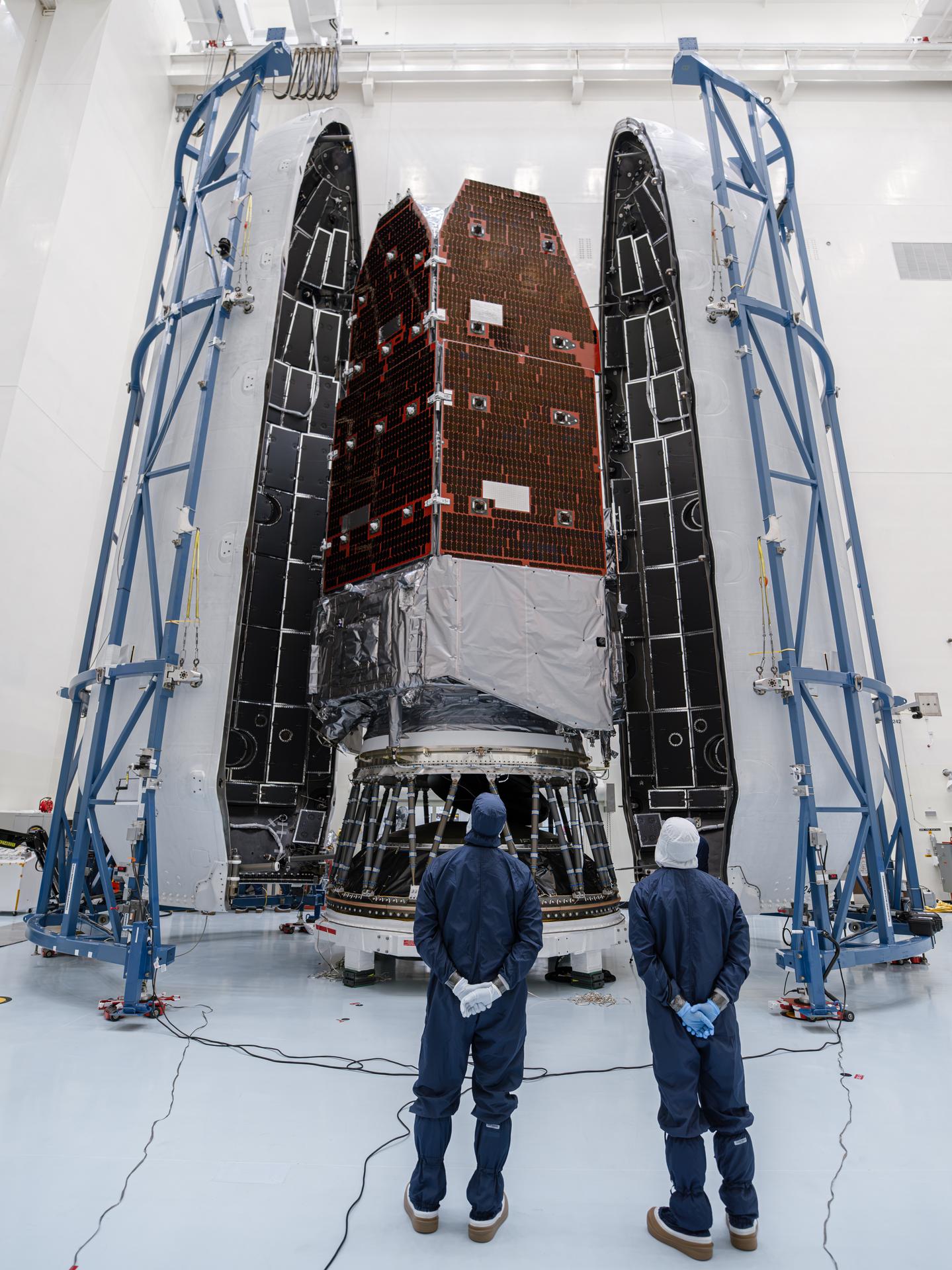
The advisory notes that the telescope has already been encapsulated within the payload fairing at Kennedy Space Center ahead of mating to the Falcon Heavy. That image of the spacecraft in launch configuration signals that Roman is no longer in a conceptual or laboratory phase. It is in the last stretch before flight.
For spaceflight observers, that is significant on its own. Large observatories often carry years of technical work, budget debate, and schedule pressure into their final weeks before launch. The transition from assembly and integration to a published countdown marks a threshold where a mission stops being mostly internal engineering effort and becomes a public event with a defined date, vehicle, and destination.
A major observatory with a broad scientific brief
Roman also fits into a larger pattern in space science: pairing specialized instruments with survey power. NASA says the telescope will deliver crisp, sweeping surveys, language that underscores its role as a mapper and catalog builder as much as a source of singular images. That wide-angle capability can be especially valuable in astronomy because it lets researchers see relationships across populations of objects instead of focusing only on individual standouts.
The mission’s namesake adds historical weight. The telescope is named for Nancy Grace Roman, NASA’s first chief astronomer. Attaching her name to a next-generation observatory situates the mission in a longer institutional story about how space-based astronomy evolved from early advocacy into one of the agency’s defining scientific strengths.
The launch vehicle choice is also notable. Falcon Heavy gives NASA a heavy-lift option from a familiar Florida pad for a mission headed far beyond low Earth orbit. The pairing of a major NASA astrophysics observatory with a commercial heavy rocket reflects the increasingly standard model for U.S. civil spaceflight: government-led science riding on commercially provided launch infrastructure.
If the schedule holds, August 30 will mark the start of Roman’s journey to L2 and the beginning of what NASA hopes will be at least five years of scientific operations, with an aspirational decade of service. Between its field of view, infrared capability, and broad science mandate, the telescope is set up to become one of the agency’s most important astronomy platforms of the coming years.
For now, NASA’s latest announcement does not change Roman’s scientific promise so much as place it on the calendar. After years of development, the mission has entered its public launch window, and the next major step is no longer abstract. It is scheduled.
This article is based on reporting by NASA. Read the original article.
Originally published on nasa.gov