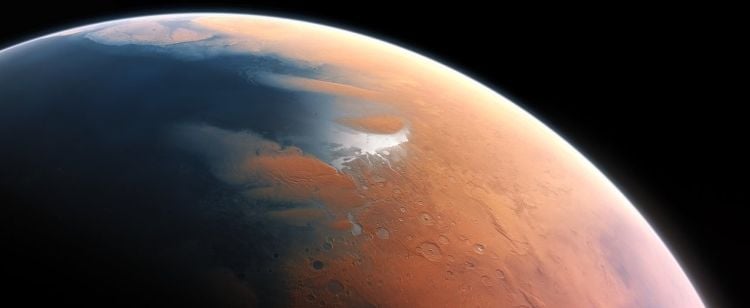
A long-running Martian debate gets a more constrained answer
Mars has offered scientists abundant evidence that liquid water once moved across its surface. What has remained less certain is how dynamic those ancient bodies of water really were. A new study highlighted by Universe Today argues that one familiar Earth process, tidal action, was probably too weak on ancient Mars to be a major landscape-shaping force in two closely watched regions.
The work, recently published in the Journal of Geophysical Research: Planets, focuses on Gale Crater and Utopia Planitia. Those sites matter because they have been explored directly by NASA’s Curiosity rover and China’s Zhurong rover, respectively. Gale Crater is hypothesized to have once held a lake, while Utopia Planitia is thought to have been part of a vast ocean on ancient Mars.
The question the researchers set out to answer was simple but important: could tides in those ancient water bodies have been strong enough to deposit or shape the sedimentary rocks now observed at the two rover sites?
Modeling tides on a lighter world
To test that idea, the researchers used computer models to simulate the speed and movement of tides on ancient Mars. They incorporated the planet’s roughly one-third Earth gravity and then examined whether tidal currents could plausibly account for sedimentary structures at the two locations.
The result was a narrow but useful constraint. The maximum tide speed at both rover locations was calculated at about 0.01 meters per second. That is extremely modest, especially when set beside the Earth comparisons cited in the article. Open-ocean tides on Earth are estimated around 0.05 meters per second, while coastlines can see tidal speeds between 0.5 and 1.0 meters per second.
In other words, the modeled Martian tides were not just somewhat weaker than many terrestrial examples. They were weaker by enough that the researchers concluded tides should rarely be treated as the primary factor when analyzing Martian sedimentary structures in the future.
The study summary quoted in the article states that tides may be considered a secondary factor, but not the main driver. That distinction matters. It does not erase the presence of water, nor does it suggest ancient Martian lakes or seas were geologically inert. It simply reduces the role that tidal forcing is likely to have played.

Why scientists cared in the first place
The attraction of the tidal hypothesis is easy to understand. On Earth, tides are tied to coastal sediment transport, ocean mixing, and broader environmental dynamics. The article notes that terrestrial tides help sustain life and regulate climate by driving ocean currents, circulating nutrients, and mixing oxygen into deeper waters.
If comparable processes had operated strongly on Mars, they might have helped explain certain patterns in rock deposition. They also would have added texture to the picture of ancient Martian habitability. A planet with standing bodies of water is one thing. A planet with energetic, regularly mixed coastal systems is another.
That is why reducing the importance of tides is scientifically significant even though it sounds like a negative result. On a world where direct observation of the deep past is impossible, ruling out mechanisms is a major part of building an accurate environmental history.
Studies like this one are less about dramatic discovery than disciplined elimination. They ask which Earth analogies genuinely travel well to Mars and which do not. Ancient Mars may have had lakes and perhaps oceans, but that does not mean its shorelines behaved like Earth’s.
What this means for Gale Crater and Utopia Planitia
Gale Crater and Utopia Planitia are especially useful test cases because each represents a different kind of ancient water setting. Gale is associated with a lake environment, while Utopia has been linked to a much larger oceanic setting. If tides had come out strong in both places, the case for widespread sedimentary influence would have grown.
Instead, the modeling suggests caution in both contexts. That weakens the idea that observed sedimentary features at either rover site require tidal explanations. Scientists studying layers, grain structures, and depositional patterns in those regions may need to put more weight on other mechanisms.
The supplied article does not list those alternatives in detail, so the safest interpretation is limited: this study trims one candidate process rather than fully replacing it with another. But even that narrower outcome is valuable. It encourages future analyses to treat tides as a possible background influence rather than a default answer.

A more precise picture of ancient Mars
Mars research often advances through a sequence of broad claims followed by more exacting corrections. First comes evidence that water existed. Then researchers ask what kind of water body it was, how persistent it may have been, how it interacted with sediments, and which physical processes were actually strong enough to matter.
This study fits squarely into that second stage. It does not challenge the broader idea that ancient Mars was warmer and wetter. The article says scientists have strong evidence that flowing liquid water once existed on the surface. What it does challenge is the assumption that visible sedimentary records at key sites are likely signatures of robust tidal action.
That refinement matters because planetary geology depends on process-based interpretation. Similar-looking rock structures can emerge from very different environmental conditions. If tidal currents were weak, then some formations that might superficially invite coastal or shoreline analogies could require more restrained readings.
It also affects how researchers think about ancient Martian habitability. On Earth, energetic tidal environments can help circulate materials important to ecosystems. If Martian tides were generally faint, then any comparison to Earth’s life-supporting coastal systems becomes less direct. That does not make ancient Mars uninteresting from an astrobiology perspective, but it does make it more distinct.
The value of a negative result
There is a tendency to treat studies as important only when they add a new phenomenon to the story. In planetary science, narrowing the plausible range of processes can be just as important. Here, the contribution is a cleaner boundary: tides on ancient Mars, at least in the modeled cases at Gale Crater and Utopia Planitia, were probably not strong enough to be a primary architect of the sedimentary record.
That leaves ancient Mars looking slightly quieter than some shoreline narratives imply. Water was likely there. Movement existed. But the pulse of those waters may have been far gentler than on Earth.
For a field trying to reconstruct another planet’s environmental past from scattered clues, that kind of disciplined reduction is progress. It moves the story from imaginative possibility toward a more defensible physical picture, one in which Mars remains watery in its history, but not necessarily tidal in the ways that matter most to landscape formation.
This article is based on reporting by Universe Today. Read the original article.
Originally published on universetoday.com