Why the Lunar Night Makes Solar Power Insufficient
Any long-term human presence on the Moon must contend with a night that lasts approximately fourteen Earth days. During that period, surface temperatures can fall to around -223°C. Solar arrays cannot generate power, and battery storage sized for two weeks of darkness would be prohibitively massive. The Moon also lacks the conventional energy resources that sustain terrestrial grids — there is no coal, natural gas, or wind to fall back on. A reliable, continuously available power source is therefore not a luxury but a prerequisite for survival.
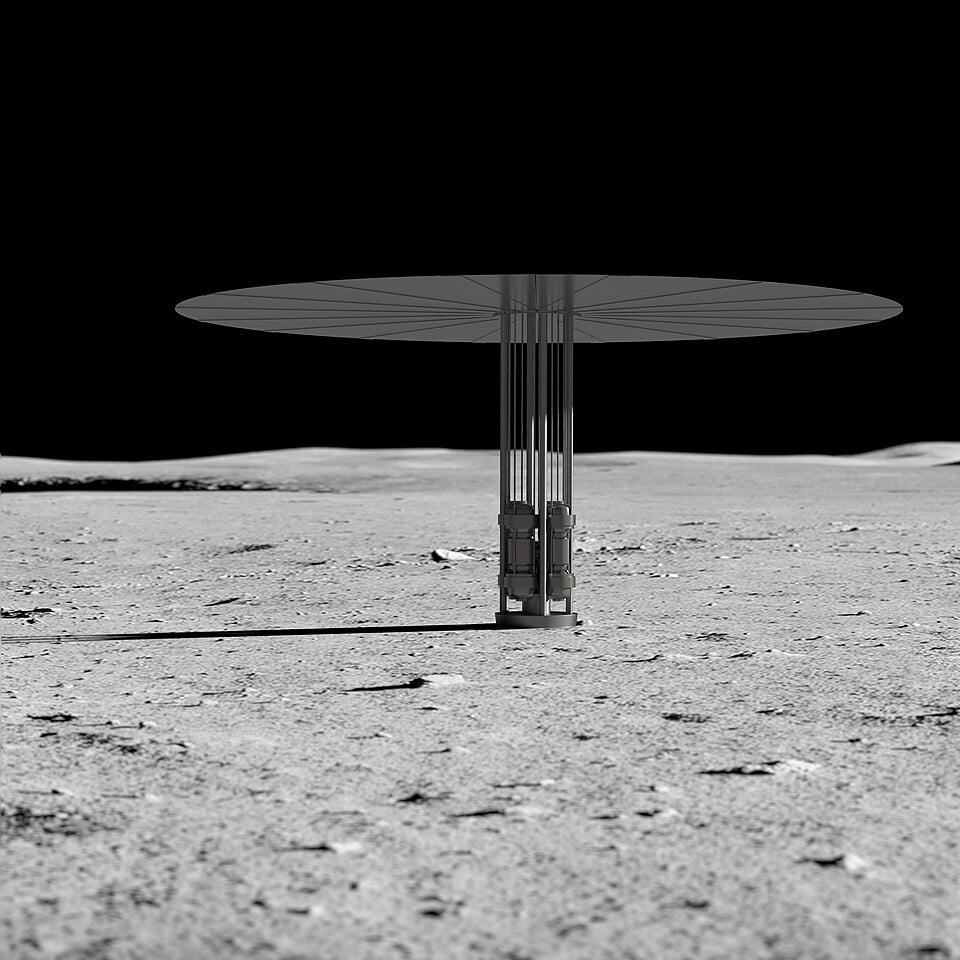
Nuclear fission offers one of the few credible options. A reactor can operate independently of sunlight, produce steady thermal output, and be scaled down for transport. NASA's Kilopower project has already explored the idea of bringing fission power to the lunar surface, but a new concept described in a preprint takes a different approach to how that heat is used.
The MULE Microreactor Concept
The paper, available as a preprint on arXiv, is authored by Julius Mercz of the Technical University of Munich along with co-authors. It describes a system called the Microreactor Utilisation for Lunar Exploration, or MULE. The name may or may not nod to science fiction — the authors do not clarify whether the Foundation series or Starcraft influenced the acronym — but the technical goal is clear: a compact reactor operating at roughly 1,000°C that can support both habitat life support and industrial processes.
What sets MULE apart is its thermal chain. Rather than converting nuclear heat into electricity and then using that electricity to run heaters, the design emphasizes direct use of the reactor's high-temperature output. That distinction matters because conventional electricity-first architectures waste a large fraction of their energy.

Living Off the Land: Regolith and Molten Salt Electrolysis
Building and maintaining a lunar base by shipping everything from Earth is extraordinarily expensive. Each kilogram of cargo delivered to the Moon can cost tens of thousands of dollars, making resupply-heavy architectures impractical for a permanent settlement. The alternative is in-situ resource utilization, often shortened to ISRU — using materials already present on the lunar surface.
The most abundant material available is regolith, the fine dust and broken rock that covers the Moon. Regolith contains oxygen and metals that could be extracted and used for construction, breathable air, and other industrial needs. One promising extraction method is molten salt electrolysis. In this process, lunar dust is dissolved in a molten salt bath, an electrical current is passed through the mixture, and oxygen is separated out. What remains are metallic alloys that can be used to build structures.
The catch is that molten salt electrolysis requires sustained temperatures above 900°C. That is well within the range of the MULE reactor's thermal output, but it is difficult to achieve efficiently using electricity derived from a conventional power system.
The Inefficiency of Electricity-First Designs
Most lunar base concepts that include high-temperature processing rely on electric heaters. Those heaters are powered by a nuclear reactor or solar array, but the conversion of thermal energy into electricity is inherently lossy. Roughly 60% of the energy can be lost as waste heat during that conversion. When a base needs to power an energy-intensive process like molten salt electrolysis, those losses compound quickly, forcing a larger reactor or more solar panels than would otherwise be necessary.
The MULE concept seeks to bypass that bottleneck by using the reactor's heat directly. If the reactor already operates at around 1,000°C, and the industrial process needs temperatures upward of 900°C, then routing thermal energy straight to the electrolysis unit avoids the efficiency penalty of generating electricity first. The same heat can also support habitat environmental systems, keeping crews warm and equipment operational through the long lunar night.

What a Dual-Use Reactor Could Enable
A microreactor that serves both life support and materials processing could change the economics of lunar settlement. Instead of treating power generation and industrial capability as separate problems, the MULE design treats them as a single thermal management challenge. The potential benefits include:
- Continuous power for habitat heating, air revitalization, and other environmental control systems during the fourteen-day lunar night.
- Direct thermal energy for molten salt electrolysis, enabling extraction of oxygen and metallic alloys from regolith.
- Reduced reliance on Earth-launched supplies, lowering the cost and risk of maintaining a permanent base.
- A pathway to local construction materials, which could support expansion of habitats and infrastructure over time.
- Greater operational resilience, because the reactor does not depend on sunlight or battery storage for critical functions.
If these capabilities can be demonstrated, a lunar base would not simply survive the night — it could continue productive work through it.
Open Questions and Next Steps
The MULE proposal is still at the preprint stage, meaning it has not yet undergone peer review. As with any early-stage reactor concept, many engineering details would need to be resolved before deployment. The paper outlines a thermal architecture, but turning that architecture into a flight-ready system would require extensive design, testing, and safety analysis. The concept's value at this stage is in framing the problem: how to deliver both survival power and industrial heat with a single compact source.
The broader point is that the lunar night problem and the materials processing problem share a common solution space. A reactor that produces high-grade heat can address both, provided the thermal chain is designed from the start to deliver that heat where it is needed.
The Bottom Line
Permanent Moon bases will require power that does not rise and set with the Sun. They will also require the ability to turn local dirt into useful materials. The MULE microreactor concept, with its 1,000°C operating temperature and emphasis on direct thermal use, attempts to solve both challenges at once. Whether it becomes the blueprint for the next era of lunar exploration depends on further analysis and testing, but the approach highlights a crucial insight: on the Moon, heat itself may be the most valuable product of a nuclear reactor.
This article is based on reporting by Universe Today. Read the original article.
Originally published on universetoday.com