A rare window into the young universe
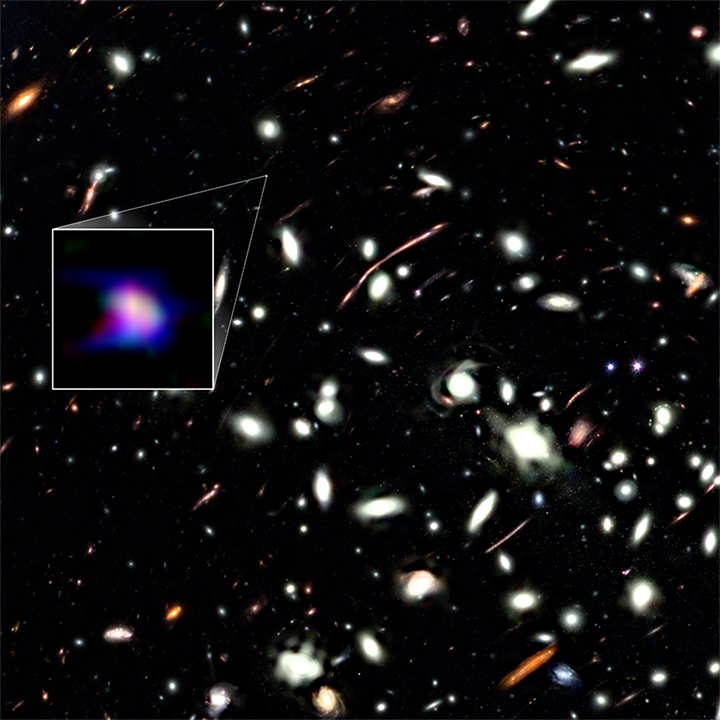
Astronomers using the James Webb Space Telescope have identified what they describe as the most chemically primitive galaxy yet observed in the early universe. The object, known as LAP1-B, existed roughly 800 million years after the Big Bang and appears to contain extraordinarily low levels of elements heavier than hydrogen and helium.
The finding matters because those heavier elements, known to astronomers as metals, did not exist in the universe’s earliest moments. They were forged later inside stars and spread outward by stellar explosions. A galaxy with extremely low metal content therefore offers an unusually direct view of cosmic conditions before generations of star formation had time to enrich the universe.
In practical terms, LAP1-B may provide one of the clearest available glimpses of what early galaxies looked like while the cosmos was still transitioning out of the so-called Cosmic Dark Ages.
Why metal-poor galaxies are so important
The early universe was simple in composition and difficult to observe. After the Big Bang, matter was dominated by light elements such as hydrogen and helium. The first stars, often referred to as Population III stars, are thought to have transformed that chemical simplicity by producing heavier elements in their cores and then ejecting them into space.
Astronomers have long wanted to catch systems as close as possible to that transition point. Doing so could help clarify how the first stars formed, how quickly galaxies began to evolve and how the universe became chemically complex enough to support later generations of stars, planets and eventually life.
LAP1-B is valuable precisely because it is so faint and so chemically unevolved. If a galaxy still shows extremely low metal content 800 million years after the Big Bang, it may be preserving conditions that were once widespread but are now hard to find.

Webb and gravity made the observation possible
The international team led by Kimihiko Nakajima of Kanazawa University used two modern tools that have transformed high-redshift astronomy. The first is Webb itself, whose infrared instruments can detect ancient light shifted out of the visible spectrum by the expansion of the universe. The second is gravitational lensing, which uses the gravity of a massive foreground object to magnify a much more distant source behind it.
That combination allowed the researchers to characterize an ultra-faint galaxy that would otherwise be extremely difficult to study. Webb’s spectrometers provided the decisive evidence, letting the team examine the galaxy’s chemical makeup rather than merely detecting its presence.
This is where the result becomes stronger than a standard distant-galaxy announcement. Many early-universe objects can be seen as faint points of light, but far fewer can be chemically described with enough confidence to support claims about their evolutionary state. Here, the team argues they can do exactly that.
What LAP1-B may tell us about the first stars
The broader scientific interest goes beyond one galaxy. Astronomers have spent decades trying to find evidence of the first stellar populations that began enriching the cosmos. Those stars are expected to have been massive, short-lived and hard to observe directly. But their fingerprints may survive in galaxies that formed while enrichment was still minimal.
If LAP1-B truly represents the most metal-poor early galaxy yet known, it could serve as a proxy for environments shaped by the first rounds of star formation. It may help researchers test theories about how quickly primordial gas clouds collapsed, how the first supernovae altered surrounding matter and how rapidly later generations of galaxies inherited heavier elements.
Because the study appeared in Nature on May 13, it also enters a field that is moving quickly. Webb has already rewritten expectations about how bright, massive and structured some early galaxies can be. A chemically primitive system like LAP1-B adds a different kind of evidence, suggesting that beneath the surprising diversity of the early universe, there are still objects that preserve a more primordial state.
The bigger picture
The Epoch of Reionization remains one of the most consequential but difficult periods in cosmic history. During this era, the first luminous sources began transforming the fog of neutral hydrogen that filled the universe. Understanding the galaxies that lived in that period is essential to understanding how the modern universe became visible and structured.
LAP1-B does not solve that story on its own. But it provides a rare anchor point. It is an ultra-faint system seen at a time when the universe was still young, and its extreme metal poverty suggests it has undergone relatively little chemical processing compared with later galaxies.
That makes the discovery more than a record claim. It is a demonstration of how Webb is changing the discipline from detection to diagnosis. Astronomers are no longer only finding ancient galaxies. They are beginning to read their histories in detail, and in the case of LAP1-B, that history appears to reach close to the beginning of chemical complexity itself.
This article is based on reporting by Universe Today. Read the original article.
Originally published on universetoday.com