Introduction
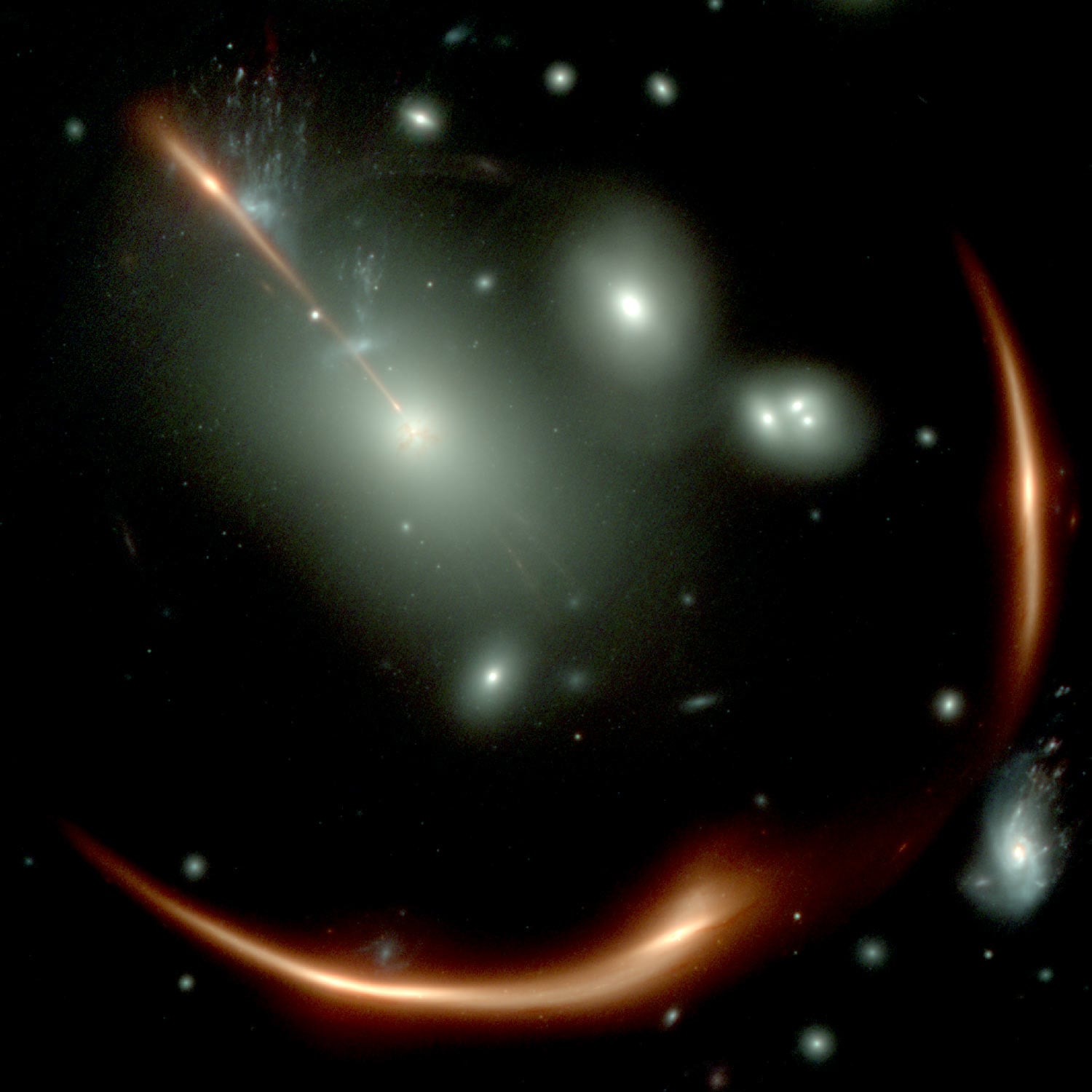
How do you measure the mass of a dormant black hole in the early Universe? That's a question astronomers at University College London (UCL) and Carnegie Science (in Pasadena, CA) wanted to answer about a distant object that exists but appears invisible. So, they turned to James Webb Space Telescope (JWST) studies of stars in the region around the supermassive black hole to find that answer. The object, MRG-M0138, lies just over 10 billion light-years away, so it appears as it was when the Universe was around 3 billion years old. It's also the most distant quiescent black hole ever found. This object is a behemoth, containing the mass of about 6 billion Suns.
The Challenge of Dormant Black Holes
Astronomers want to know a lot more about black holes like this one as they existed and "performed" in the early epochs of cosmic time. That's because the objects contain clues to what conditions were like when the Universe was just leaving its infancy. A dormant black hole doesn't emit any radiation at all. That's because it's not "eating" material and emitting high-energy jets or lighting up its accretion disk. However, it still exerts a gravitational influence on material in its near neighborhood. That includes stars.

Using Gravity to Measure Motions
The team used the motions of stars to measure the mass of the black hole. Those motions include how fast they move and the differences in motion between stars close to the black hole and those farther away. They then combined that information with a phenomenon called gravitational lensing, and a JWST image of MRG-M0138 being lensed by an intervening galaxy cluster. Lensing occurs when the light from a distant object passes through or near an intervening galaxy cluster (or galaxy). The gravitational pull of the cluster "bends" the path of the light, creating what often looks like warped mirror images of the more distant object. In this case, the gravitational influence of another galaxy, located directly between MRG-M0138 and Earth, bends the light around it, refocusing the background image and enlarging it 30 times.
Key Findings
“By combining JWST data with gravitational lensing, we could peer inside the black hole’s sphere of influence, where its gravity boosts the speeds of stars," said lead author and team member Andrew Newman of Carnegie Science. "This is one of the best techniques we have to weigh a black hole, so we were able to determine its mass with high precision." The black hole's mass is about 6 billion solar masses, making it one of the most massive known in the early Universe. The study provides a new method for measuring the masses of quiescent black holes, which are difficult to study because they do not emit light.

Implications for Black Hole Growth
Understanding the mass of this quiescent black hole helps astronomers piece together how supermassive black holes grew in the early Universe. The fact that such a massive black hole existed when the Universe was only 3 billion years old challenges current models of black hole formation and growth. It suggests that black holes can grow rapidly through mergers or accretion, even during periods of quiescence. Future JWST observations of other lensed galaxies could reveal more quiescent black holes, providing a larger sample to test theories of cosmic evolution.
Conclusion
The successful measurement of MRG-M0138's mass demonstrates the power of combining JWST's infrared capabilities with gravitational lensing. This technique opens a new window into studying the otherwise invisible population of dormant black holes in the early Universe. As JWST continues to observe distant galaxies, astronomers expect to uncover many more such objects, refining our understanding of how black holes and galaxies co-evolve over cosmic time.
This article is based on reporting by Universe Today. Read the original article.
Originally published on universetoday.com