A rare observing geometry produced an unusual interstellar data set
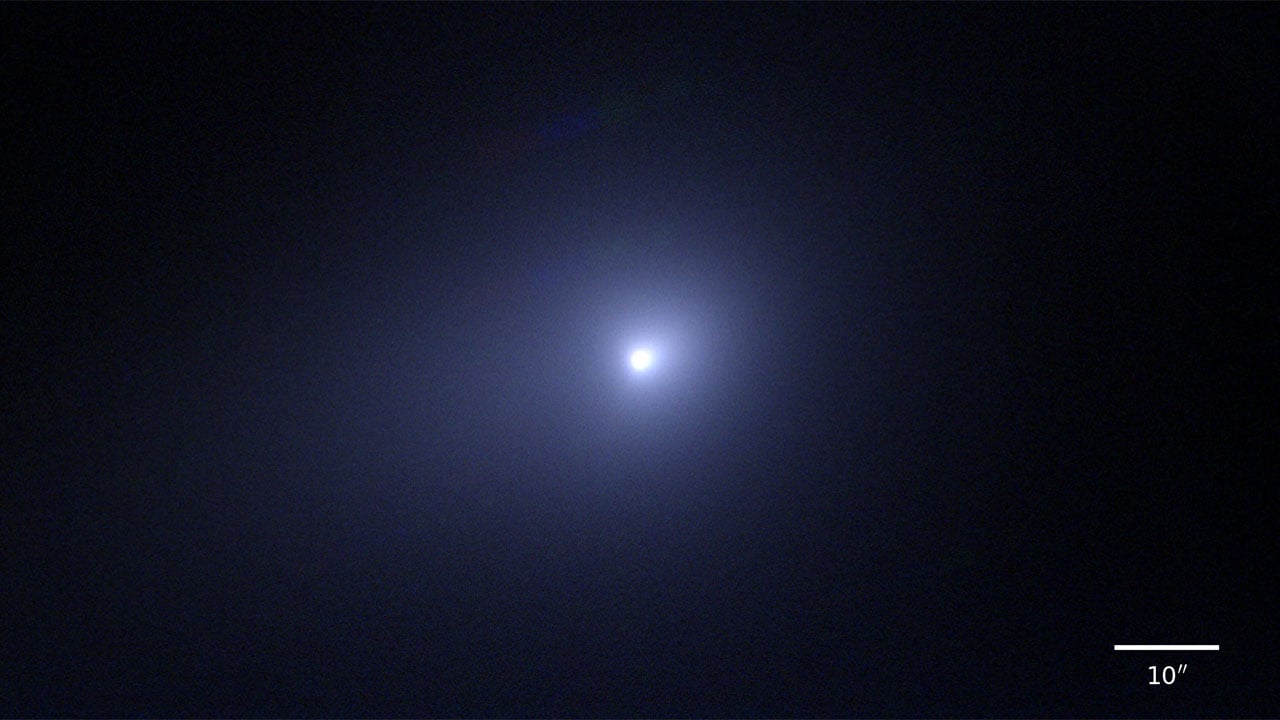
Interstellar visitor 3I/ATLAS already stood out as only the third known object from outside the Solar System to be detected passing through it. What makes the latest observations more important is how they were made. According to Universe Today, ultraviolet spectrographs aboard ESA’s Jupiter Icy Moons Explorer, or JUICE, and NASA’s Europa Clipper observed the comet simultaneously after it emerged from behind the Sun in December 2025.
The configuration mattered because the comet passed between the two spacecraft in November 2025, allowing the missions to image opposite hemispheres and detect ultraviolet emissions over several days. For scientists trying to understand an object that arrived from another star system and will not remain observable for long, that kind of geometry is exceptionally valuable.
Why post-solar observations mattered
Once 3I/ATLAS made its closest pass to the Sun, its coma brightened as heating drove stronger outgassing. That was an important moment to observe because freshly released material can reveal more about a comet’s interior composition than surface material observed earlier. Universe Today reports that previous observations had described the chemistry of outer layers, while the new ultraviolet measurements provided insight into material released from inside the object.
This distinction is central to comet science. Surfaces evolve through repeated exposure to radiation and heating, but interior material can preserve clues about formation conditions. With an interstellar object, those clues are especially meaningful because they may reflect chemistry shaped in a completely different planetary system.
The Southwest Research Institute team involved in both ultraviolet spectrograph instruments informally coordinated the observations. That coordination appears to have produced one of the more informative data sets yet assembled for 3I/ATLAS during its brief window of visibility.

Hydrogen, oxygen, and carbon stood out in the ultraviolet data
According to the supplied text, the instruments detected hydrogen, oxygen, and carbon emissions produced when gases escaping the comet’s nucleus were broken apart by sunlight. Those elemental signatures are part of the reason ultraviolet astronomy is so useful for comet studies: it can reveal the byproducts of volatile materials being released and dissociated in space.
Researchers also reported higher-than-expected carbon emissions compared with comets observed in our own Solar System, reinforcing earlier findings from other missions. That does not, by itself, solve the mystery of where 3I/ATLAS formed or exactly how its parent system evolved. It does, however, strengthen the case that this object is chemically interesting in ways that distinguish it from more familiar comet populations.
For planetary scientists, those differences are the point. Interstellar objects are not merely curiosities passing through. They are accidental sample carriers from remote environments that humanity cannot otherwise inspect directly. Every spectral anomaly or abundance pattern is a clue about how other systems build icy bodies and retain volatile compounds.
Planetary missions are showing they can do opportunistic science
There is also a broader mission lesson here. JUICE and Europa Clipper were built to study the Jupiter system and its icy moons, especially questions of habitability involving Europa, Ganymede, and Callisto. Yet their ultraviolet instruments proved flexible enough to support time-sensitive observations of an interstellar comet.
That matters because deep-space missions are expensive, long-lived assets. When teams can coordinate across missions to capture transient events, the scientific return expands well beyond the original target list. The principal investigator quoted by Universe Today described the joint observation as both fun and impactful, and that phrasing understates the practical achievement. Spacecraft launched for one purpose were able to act as a distributed observatory for a fleeting object moving through the inner Solar System.
As more major missions operate simultaneously across interplanetary space, this kind of opportunistic coordination may become increasingly important. The scientific payoff can be high precisely because transient targets do not wait for ideal planning cycles.
The significance goes beyond one comet
3I/ATLAS will eventually leave the reach of current instruments, but the lessons from this campaign will remain. The event shows that interstellar-object science benefits not only from bigger telescopes but from geometry, timing, and institutional cooperation. It also reinforces that ultraviolet measurements are essential for understanding volatile-rich bodies when solar heating exposes new material.
Most of all, the observations remind us how little data exists for objects from outside our Solar System. With only a handful of known examples, each well-observed interstellar visitor can materially reshape scientific expectations. A higher-than-expected carbon signature, two-hemisphere imaging, and interior-sensitive measurements together make 3I/ATLAS more than a passing spectacle.
It becomes a case study in how the next era of planetary science may work: multi-mission, adaptive, and ready to extract insight from rare events whenever the Solar System briefly hosts a messenger from somewhere else.
This article is based on reporting by Universe Today. Read the original article.
Originally published on universetoday.com