A radioactive isotope becomes a map of the Solar System’s surroundings
Scientists studying Antarctic ice are using an unusual marker to reconstruct the Solar System’s recent journey through space: iron-60, a radioactive isotope produced in supernova explosions. A new paper highlighted by Universe Today argues that this isotope may preserve the structure of the Local Interstellar Cloud, the diffuse region of gas and dust the Solar System is currently traversing.
Iron-60 is a powerful tracer because it has no ordinary Earthly source and a half-life of about 2.6 million years. When it turns up in Antarctic ice or deep-sea crusts, researchers can be confident it arrived from beyond Earth. That makes it a rare physical connection between planetary geology and the history of nearby stellar explosions.
The new research, published in Physical Review Letters, builds on an earlier milestone from 2019, when researchers reported the first detection of iron-60 in Antarctica. At that time, the team concluded that after ruling out terrestrial explanations such as global fallout, the excess iron-60 most likely had an interstellar origin. The new study goes further by asking whether the isotope’s distribution can reveal where that material was stored before Earth collected it.
The Local Interstellar Cloud as a cosmic archive
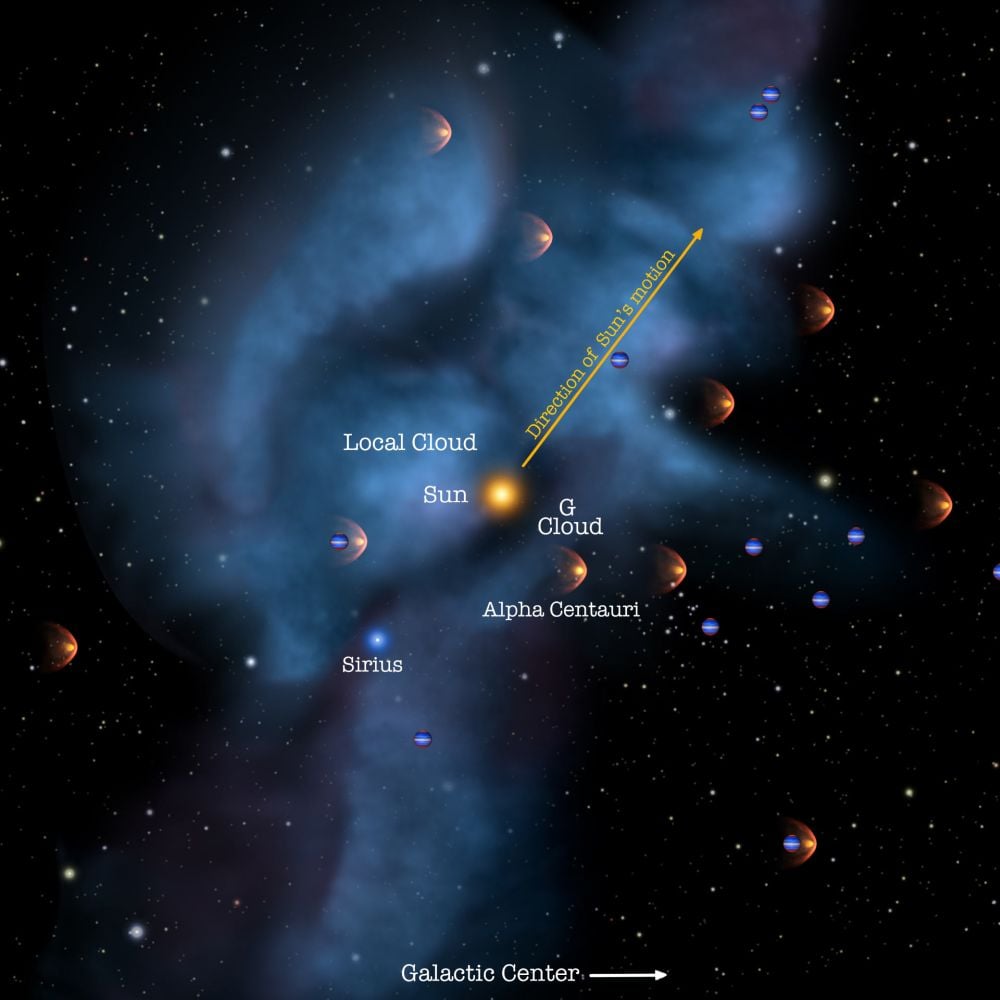
The leading idea is that the Local Interstellar Cloud, or LIC, acts as a long-term reservoir. The Solar System moves through this cloud as it travels around the Milky Way, and if the cloud contains iron-60 from past supernovae, Earth may slowly sweep up that material over time. Researchers describe the LIC as one of several warm cloudlets in the Complex of Local Interstellar Clouds in the solar neighborhood.
The origin of those cloudlets is not settled, but supernova shocks are one prominent possibility. If supernovae helped create the cloudlets or significantly shaped them, then the LIC may hold a record of explosive stellar events in the local galactic environment. The iron-60 embedded in Antarctic ice could therefore serve as more than evidence of ancient blasts. It could reflect the structure of the interstellar material the Solar System is moving through right now.
That is the conceptual leap behind the new work. Instead of treating iron-60 simply as fallout from distant cosmic events, the researchers are reading it as an environmental signature. In effect, they are asking whether Earth’s ice has stored a fingerprint of the galactic medium around us.

Why Antarctica matters
Antarctic ice offers an appealing archive because it can preserve faint extraterrestrial signals with relatively low contamination. The 2019 detection already showed that the isotope could be measured there. The latest work uses that foundation to argue that the pattern of iron-60 deposition may encode information about the Local Interstellar Cloud’s internal structure.
If that interpretation holds, the result is unusually rich. Earth would not just be recording a past supernova. It would be sampling the composition and shape of a nearby interstellar environment as the Solar System passes through it. That would connect planetary archives directly to galactic dynamics, giving researchers a new way to study local astrophysical history without leaving Earth.
The underlying logic depends on time and persistence. Because iron-60 decays over millions of years but does not last indefinitely, any material detected today must be tied to comparatively recent astrophysical processes on geological timescales. And because it is not generated naturally on Earth, its presence must be explained by delivery from space. That combination makes it one of the cleanest isotopic clues available for this kind of work.
A new way to study our galactic neighborhood
The broader appeal of the research is that it turns familiar earthly archives into tools of space science. Ice cores and seafloor crusts are usually associated with climate history or ocean chemistry. Here they become detectors for the Solar System’s movement through the aftermath of stellar explosions.
The current study does not settle every question. The source text itself notes that the origin of the local cloudlets remains uncertain and that the researchers’ earlier idea about the LIC containing iron-60 could not be proven at the time. What the new work offers is a stronger framework for testing that hypothesis. If the isotope’s pattern in Antarctic ice matches the profile expected from the Solar System crossing through the LIC, then the cloud becomes a plausible storage medium rather than a speculative backdrop.
That possibility matters because the Solar System does not move through empty space. It travels through structured regions shaped by past astrophysical events. Understanding those regions can help scientists reconstruct the recent history of the solar neighborhood and the supernovae that may have influenced it.
In practical terms, the discovery points toward a future where terrestrial measurements help chart the Milky Way’s local environment in finer detail. Iron-60 is only one isotope, but it may be enough to show that the path of the Solar System has left a measurable trace in Earth’s own frozen record.
If so, Antarctic ice is not just preserving climate history. It is preserving a map of where we have been in space.
This article is based on reporting by Universe Today. Read the original article.
Originally published on universetoday.com