A Spiral Galaxy on a Long Approach
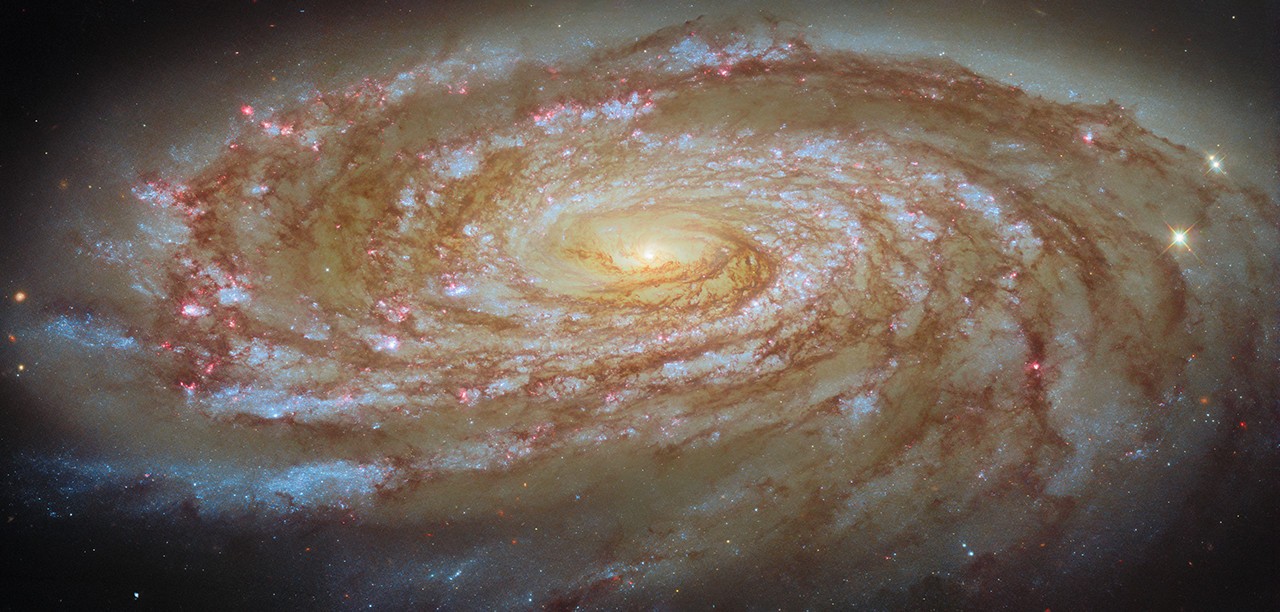
NASA and ESA’s Hubble Space Telescope has released a new image of Messier 88, or M88, an active spiral galaxy located about 63 million light-years away in the constellation Coma Berenices. The image is visually striking on its own, but the deeper story is about motion on a cosmic timescale: M88 is slowly making its way toward the center of the Virgo Cluster, where gravity will reshape it over hundreds of millions of years.
M88 is not just another pinwheel galaxy. NASA describes it as an active galaxy, meaning its core contains a supermassive black hole that is feeding on gas and dust. Astronomers estimate that black hole has a mass around 100 million times that of the Sun. It also appears to be driving gas outflows from the galaxy’s center. Around that core sits a population of older reddish stars, giving the galaxy what NASA calls a warmly glowing heart.
From there, tightly wound and symmetrical spiral arms spread outward, marked by pink and blue star clusters and dark knots of dust. Because Hubble sees M88 at an angle, the galaxy appears elongated, with its arms fanning outward in a delicate sweep.
A Member of a Much Larger System
The larger context is the Virgo Cluster, a collection of more than a thousand galaxies bound together by gravity. In such an environment, galaxies are not fixed ornaments. They move, interact, and evolve as they orbit the cluster’s center of gravity. M88 is one participant in that wider dynamical system.
According to NASA, the galaxy is currently about two million light-years from the point where it will make its closest approach to Messier 87, the massive elliptical galaxy that anchors the Virgo Cluster. That encounter is still 200 million to 300 million years away, but on astronomical terms it is part of M88’s present trajectory.
This kind of journey is not gentle. As M88 moves inward, the environment around it is expected to change the galaxy in fundamental ways. Cluster centers are harsher places than the outskirts, with denser populations of galaxies and more intense gravitational interactions. NASA’s framing emphasizes that, as with any epic journey, M88 will be fundamentally changed by what lies ahead.
Why Hubble’s View Matters
The new image does more than provide a scenic portrait. It links morphology to environment. M88’s active core, orderly spiral structure, and future movement through the cluster together illustrate how galaxies can be understood both as individual systems and as members of larger gravitational communities.
That is one of Hubble’s enduring strengths. Its images often look like isolated moments, but they are really snapshots of processes unfolding over immense spans of time. In M88’s case, the telescope captures a galaxy that appears stable and elegant now, even as it is already committed to a future shaped by cluster dynamics.
The image also highlights the layered nature of galactic structure. At the center sits a feeding supermassive black hole. Around it lies an older stellar population. Farther out, bright star clusters and dust define the spiral arms. Taken together, those features make M88 both a photogenic object and a scientifically rich one.
A Quiet Reminder of Cosmic Change
The story of M88 is ultimately about scale. A galaxy 63 million light-years away, containing a black hole 100 million times the Sun’s mass, is still only one traveler inside a cluster of more than a thousand galaxies. Its future close approach to M87 will not happen for hundreds of millions of years, yet gravity has already written that destination into its path.
That perspective is what gives the Hubble release its power. It turns a beautiful image into a reminder that galaxies are not static. They are shaped by motion, environment, and time. M88 may look serene today, but it is heading toward a more turbulent region of the cosmos, and when it arrives, it will not be the same galaxy Hubble sees now.
This article is based on reporting by science.nasa.gov. Read the original article.

Originally published on science.nasa.gov