A telescope built for one of the hardest places on Earth
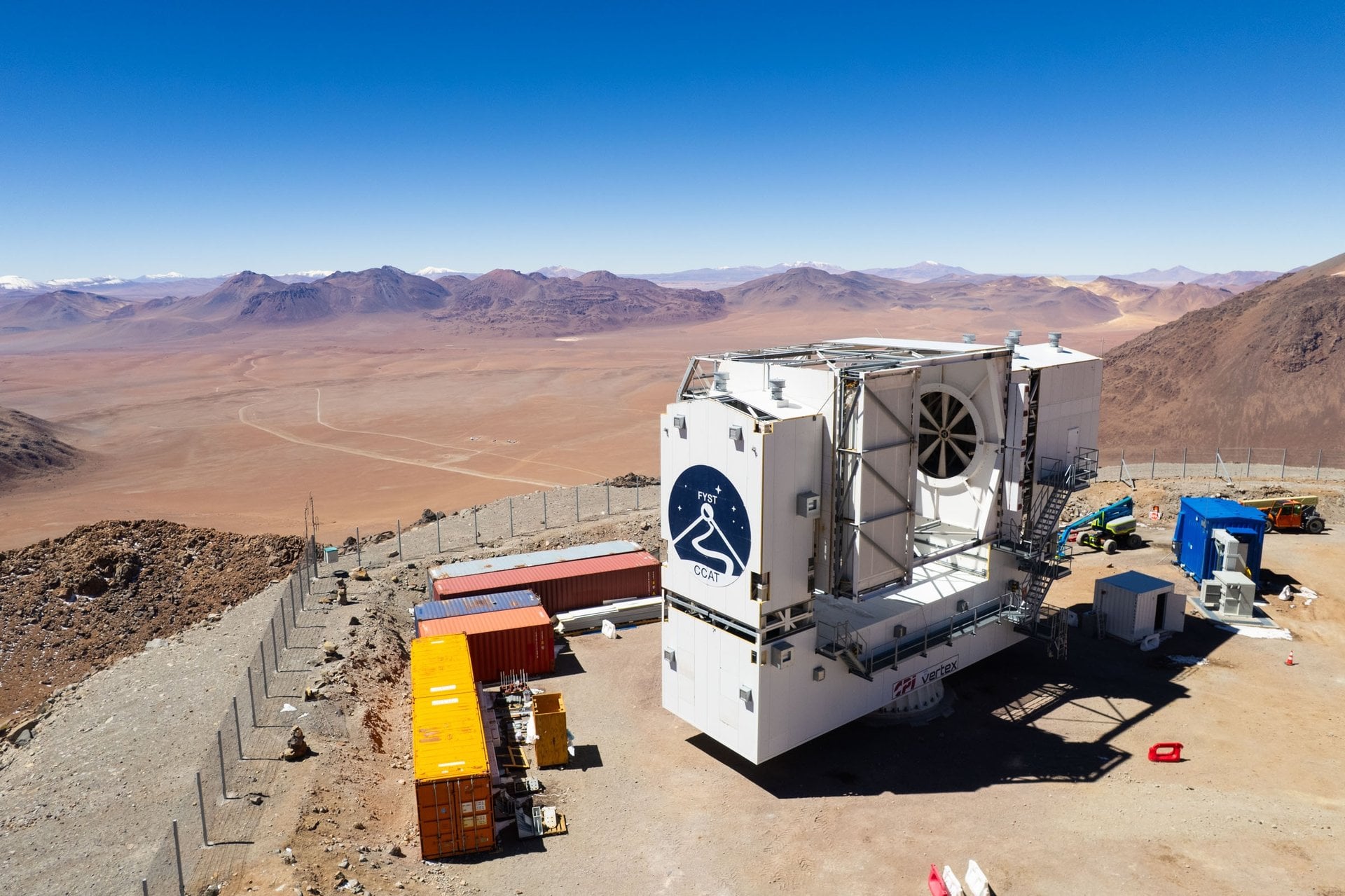
The Fred Young Submillimeter Telescope, or FYST, has officially opened on the summit of Cerro Chajnantor in Chile’s Atacama Desert, marking the arrival of a long-envisioned observatory at one of the world’s most demanding astronomical sites. According to the supplied source text, the April 9 inauguration brought more than 100 scientists, engineers, and dignitaries to a location 18,400 feet above sea level, where the air is thin enough that visitors must carry supplemental oxygen and pass medical screening.
The brutal environment is the point. FYST is a submillimeter telescope, designed to observe wavelengths between infrared and radio that are heavily absorbed by atmospheric water vapor. Cerro Chajnantor offers an unusually favorable combination of altitude and dryness, making it one of the best ground-based sites on Earth for this kind of work.
That site choice tells the story of the instrument itself. FYST is not a general-purpose observatory looking for a convenient mountain. It is a machine engineered around a narrow but scientifically rich part of the spectrum that demands extraordinary observing conditions.
Designed for speed, not just sensitivity
The supplied article describes FYST as a 6-meter telescope with an innovative Crossed-Dragone optical design. In practical terms, that configuration uses tilted mirrors to avoid obstructions and produce exceptionally clean images across a wide field of view. The result is an instrument optimized to scan large areas of sky rapidly.
Its main instrument, Prime Cam, is built to hold up to seven interchangeable detector modules and will field more than 100,000 superconducting detectors. The source says that gives FYST a mapping speed more than ten times faster than any previous submillimeter observatory.
That comparison is crucial. FYST is not simply adding another telescope to an existing fleet. It is meant to change the pace of observation in a part of the electromagnetic spectrum that has not previously been surveyed this quickly on a wide scale. The article likens the observatory less to a traditional telescope aimed at individual targets and more to a celestial movie camera, steadily building deep and broad sky maps.

A science agenda tied to first-light cosmology
FYST’s ambitions are correspondingly large. The supplied text says the telescope will probe the cosmic microwave background in search of the fingerprint of primordial gravitational waves. That places the new facility in one of cosmology’s most consequential searches: evidence from the earliest moments of the universe.
Submillimeter observations also open windows onto dusty and otherwise obscured regions of space that are difficult to study at visible wavelengths. Although the article centers the cosmic microwave background as a marquee objective, the telescope’s wide-field speed means it can contribute to survey-style science in ways that narrower, slower facilities cannot.
In that sense, FYST reflects a broader trend in astronomy. Rather than pursuing only ever-larger single-target instruments, observatories are increasingly being designed around mapping power, detector scale, and the ability to generate large scientific datasets quickly. FYST fits squarely into that model.
Three decades in the making
The source notes that the project traces back 34 years, when a group of Cornell scientists imagined what might one day be built on that remote Chilean summit. The inauguration therefore represents not just a hardware milestone but the culmination of a long scientific vision.
That long timeline is also a reminder of how astronomy infrastructure develops. Site work, instrument design, funding, logistics, and environmental constraints all stretch development over decades. FYST’s opening is the visible endpoint of a much longer period of planning and technical iteration.
The harshness of the location only reinforces that. Everything about the observatory, from access to operations, must contend with altitude, weather, and thin air. Building there was a choice to prioritize scientific advantage over convenience.

Why the opening matters
The arrival of FYST matters because it combines an elite observing site, a wide-field optical design, and an unusually large detector count into a system built for fast surveys. Those features together could expand what astronomers can do in the submillimeter regime, especially for large-area mapping and early-universe studies.
The article’s emphasis on speed is especially notable. Mapping power determines how quickly new sky coverage can be generated, how fast faint signals can accumulate statistically, and how effectively an observatory can build the broad datasets modern astronomy increasingly depends on. If FYST performs as described, it could become a major workhorse for submillimeter cosmology and survey science.
There is also symbolic weight here. A mountaintop once imagined by scientists more than three decades ago is now home to an operational telescope designed to push into some of the deepest questions in physics. That does not guarantee a discovery. But it does mean the tools for a new observational campaign are now in place.
In a field where progress often depends on patient infrastructure, FYST’s inauguration is a reminder that astronomy still advances through bold physical commitments: harsh sites, specialized designs, and instruments built to reveal parts of the universe that ordinary telescopes cannot easily see.
This article is based on reporting by Universe Today. Read the original article.
Originally published on universetoday.com