Two small galaxies are telling a big story about black holes
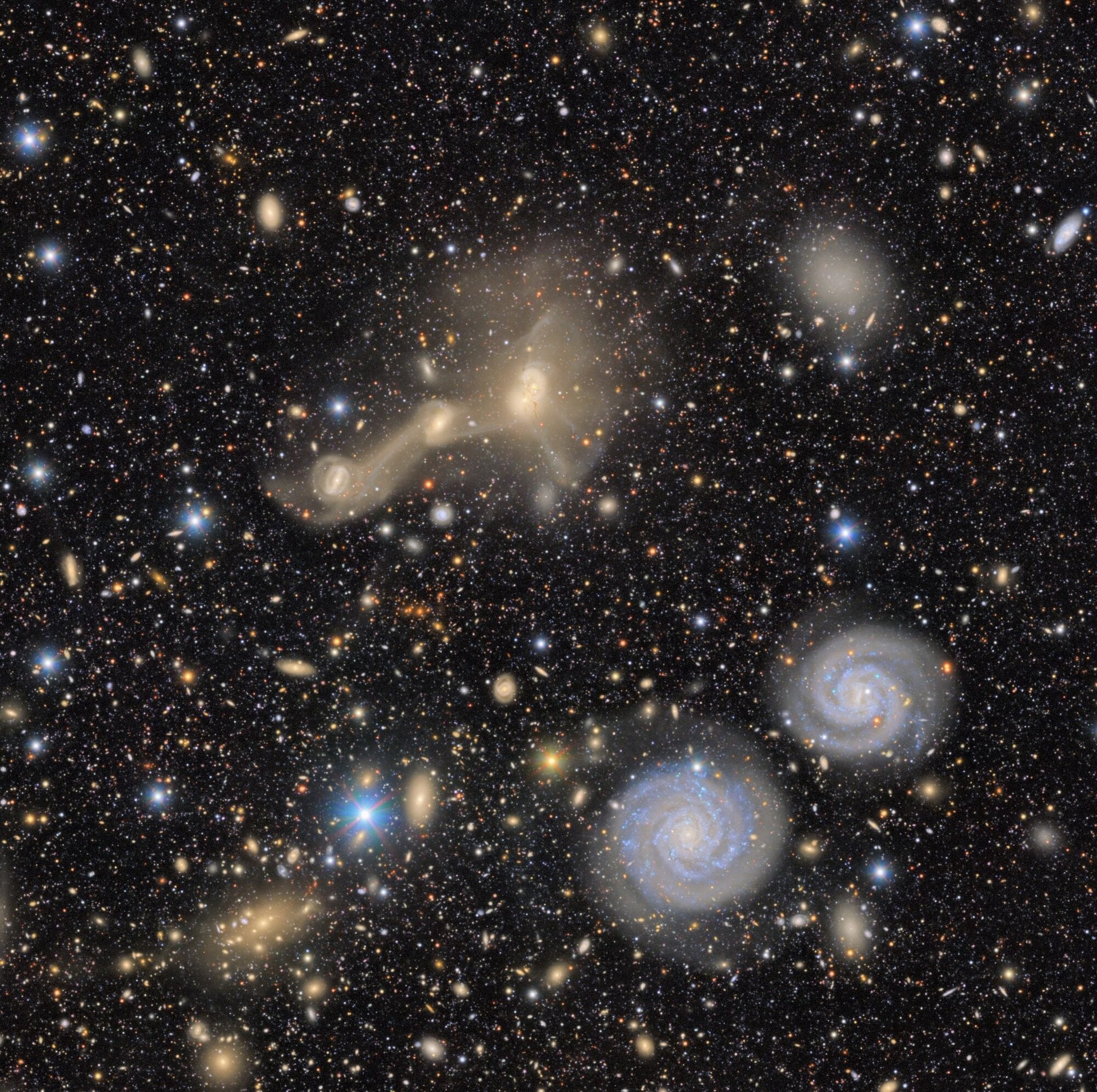
James Webb Space Telescope observations of two dwarf galaxies in the Virgo Cluster are offering fresh evidence for how black hole mergers can reshape galaxies over time. According to the supplied source text, researchers studying NGC 4486B and UCD736 found that both galaxies host overmassive black holes that account for an unusually large share of each galaxy’s mass.
The leading explanation described in the source is that the galaxies experienced mergers that stripped away many of their stars. What remained was a smaller stellar system wrapped around a black hole population that now looks disproportionately large in relation to the host galaxy. In other words, the black holes did not necessarily become implausibly huge on their own. The galaxies themselves were whittled down.
What JWST appears to have revealed
The article highlights NGC 4486B in particular. JWST observations suggest its central black hole began as two less-massive black holes that eventually collided and merged. The resulting black hole is described as about 360 million times the mass of the Sun. More strikingly, it appears to be off-center rather than sitting squarely at the middle of the galaxy.
That offset is part of why the observations are so suggestive. Monica Valluri of the University of Michigan, quoted in the supplied text, said that in most galaxies where a black hole is visible, it sits directly at the center. In NGC 4486B, the black hole is clearly displaced, as if it had wobbled out of place and were slowly moving back toward the galactic core.
The source says earlier Hubble and ground-based observations had already shown that the black hole’s location was unusual, but JWST data helped reveal the signs of a comparatively recent merger that could explain the disturbance.

Why star stripping matters
The broader argument is about galactic evolution. During interactions and mergers, galaxies can lose large numbers of stars through gravitational stripping. If that happens while their central black holes survive and eventually merge, the black holes can come to represent a much larger fraction of the remaining galaxy mass than before.
That is important because astronomers often interpret black holes in relation to their host galaxies. If mergers have dramatically altered the host, then an “overmassive” black hole may not simply reflect black hole growth alone. It may also record the violent reduction of the galaxy around it.
The Virgo Cluster is a useful environment for this kind of work because galaxies there are packed closely enough for strong gravitational encounters to be common. The supplied text explicitly notes that galaxies in the cluster are crowded together, making it easier for their mutual gravity to tear them apart and leave some systems with fewer stars and apparently oversized black holes.
A window into black hole merger history
The significance of the study extends beyond these two galaxies. The source text says that as astronomers observe more galaxy mergers and trace the effects of black hole mergers during those events, they can build a clearer picture of the long-term evolution of galaxies across the universe.
That framing is important because direct evidence of black hole merger aftermath can be difficult to obtain. Black hole collisions are dramatic, but the long-lived visual signatures in host galaxies can be subtle. An off-center massive black hole in a stripped dwarf galaxy is the kind of clue that helps connect theory to observed structure.
The candidate text also mentions predictions about what galaxies that have experienced black hole mergers should look like. The implication is that these JWST observations are beginning to match those expectations more clearly than previous data could.
Why this is a meaningful JWST result
JWST is often discussed in terms of very distant galaxies and the early universe, but this case shows its power much closer to home, in the nearby Virgo Cluster. By resolving the structure and aftermath of interactions in these dwarf galaxies, it helps astronomers read the historical record left behind by mergers.
The study described here does not claim to solve every question about black hole growth. But it does support a compelling explanation for why some small galaxies can host black holes that seem out of proportion to their present size. They may be the scarred remains of larger systems that lost much of their stellar content in repeated encounters.
That makes the “smoking gun” framing understandable. The observations appear to show not just that black hole mergers happen, but what a galaxy can look like after one of those mergers has played out inside a dense cluster environment. In NGC 4486B and UCD736, the result is a pair of diminished galaxies whose black holes still carry the mass and dynamical memory of a more turbulent past.
This article is based on reporting by Universe Today. Read the original article.
Originally published on universetoday.com