Roman’s main light-gathering optic is ready for space
NASA has completed the final inspection of the primary mirror for the Nancy Grace Roman Space Telescope, clearing one of the last symbolic and technical checkpoints before launch. Engineers at the agency’s Goddard Space Flight Center confirmed on May 20 and 21 that no specks had fallen onto the mirrors during testing and that there were no defects in the coating or alignment. With that, the 7.9-foot, or 2.4-meter, mirror has effectively had its last close-up on Earth.
The inspection may sound procedural, but for an observatory built around precision measurements, it is not a minor step. Roman is designed to capture wide panoramic views of the cosmos and to collect extremely sensitive near-infrared observations. That requires the optical system to remain exceptionally clean, aligned, and stable even after intensive environmental testing.
Why this mirror matters
The primary mirror is the telescope’s main light collector. Its job is to gather light from distant cosmic objects and focus it through the optical path toward Roman’s Wide Field Instrument detector array. Any contamination, defect, or misalignment could degrade image quality or compromise the precision needed for the mission’s science goals.
NASA’s source text emphasizes how exacting that standard is. Roman’s components have to be ultraprecise, and the mirror itself carries a silver coating less than 400 nanometers thick, roughly 200 times thinner than a human hair. That coating was chosen because it reflects near-infrared light efficiently, fitting the mission’s observing requirements.
A final look before launch
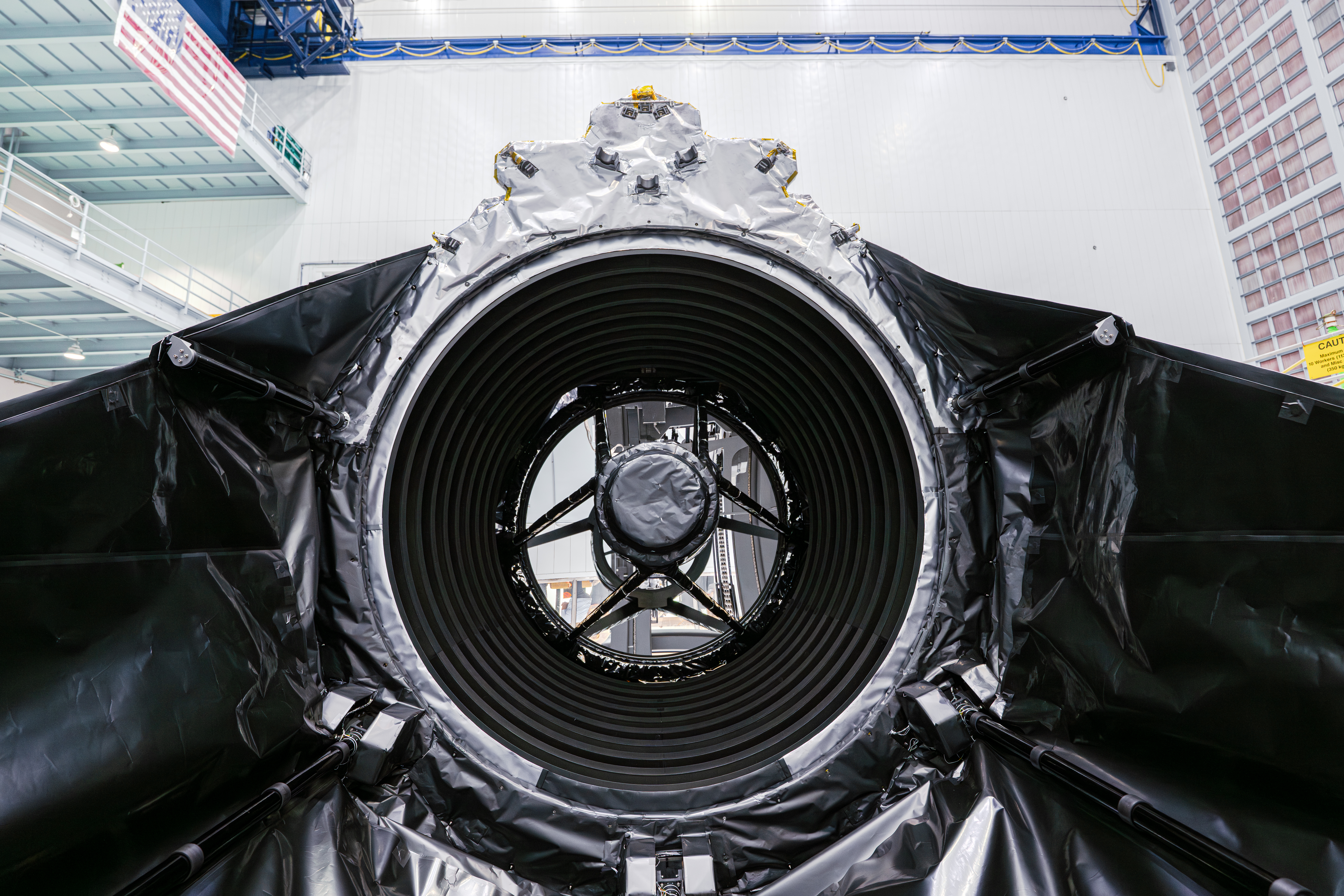
To perform the inspection, engineers turned the observatory onto its side and deployed the hood that will be stowed for launch to protect the mirror. The team then used a high-resolution camera with a powerful zoom lens for a multi-purpose visual inspection. They checked the mirrors for particulate contamination, coating defects, and alignment changes after the observatory had undergone shake testing.
That sequence is important because vibration testing is meant to simulate the physical stresses of launch. Passing the post-test inspection indicates the optical system remained properly aligned despite those stresses. According to optics lead Bente Eegholm, the inspection confirmed that the path the light will take to the instrument detector array remained in proper alignment.
Schedule pressure, but still on track
NASA said the mirror passed “with flying colors,” keeping Roman on track for an early September launch. For a flagship space observatory, holding schedule late in integration is itself meaningful. Final assembly and test campaigns often reveal issues that can force delays, especially when deployable structures, contamination control, and fine optical alignment are all involved.
The agency’s wording suggests confidence, but also respect for the moment. Roman telescope manager J. Scott Smith described the inspection as the final time the engineering team would lay eyes on the telescope before it becomes, in his words, “the eyes of humanity.” That is rhetorical language, but it captures the transition the hardware is making from development object to operating observatory.
What comes next for Roman
With the primary mirror inspection complete, Roman moves closer to launch readiness. The source material does not detail the full remaining integration flow, but the milestone indicates that one of the observatory’s most critical elements has cleared final review after environmental testing. That lowers risk at a stage where any rework would be expensive and disruptive.
Roman’s mission is to deliver broad, high-resolution views of the universe in near-infrared light, and the telescope’s central optic is now certified ready for that task. The importance of the moment is not only that the mirror looks clean and well aligned. It is that the observatory’s core promise, precise, wide-field vision from space, still appears intact as launch approaches.
This article is based on reporting by NASA. Read the original article.
Originally published on nasa.gov