NASA’s MAVEN Captures an Unexpected Atmospheric Response at Mars
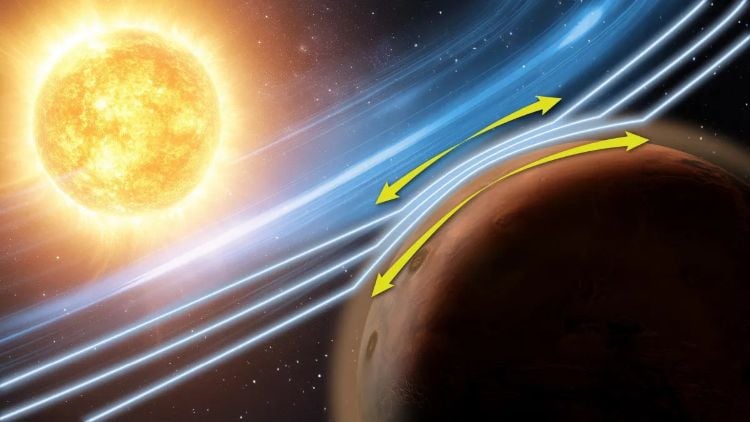
Scientists using NASA’s MAVEN spacecraft have identified the Zwan-Wolf effect at Mars, marking a notable extension of a phenomenon previously studied at Earth. According to the report summarized by Universe Today, the observation came during a powerful solar storm in December 2023, when the solar wind strongly interacted with the Martian ionosphere.
The finding is significant because Mars does not have a global magnetic field like Earth’s. On Earth, the Zwan-Wolf effect has been associated with solar wind pressure squeezing the planet’s magnetic field. At Mars, researchers instead found the effect playing out in the ionosphere, the charged region of the upper atmosphere created when solar radiation breaks apart atmospheric molecules.
A Known Effect in a Very Different Planetary Setting
The Zwan-Wolf effect has been observed at Earth for years, where the interaction involves the solar wind and the planet’s magnetosphere. Mars presents a very different case. Without a global magnetic shield, the Red Planet exposes its upper atmosphere more directly to space weather.
That is why the new observation stands out. The effect was not detected in a magnetic envelope around Mars, because no such global structure exists. Instead, MAVEN recorded evidence that the Martian ionosphere itself compressed under the force of the solar storm strongly enough for instruments to register the change.
The study cited by Universe Today was published in Nature Communications, and it relied on MAVEN data gathered during that intense December 2023 event. Researchers had suggested that the effect might occur on Mars more regularly, but only a particularly strong solar storm appears to have made it detectable with current tools.
What the Ionosphere Reveals
The ionosphere is a dynamic boundary region where atmospheric gases become ionized and electrically active. At Mars, it acts as one of the key interfaces between the planet and the solar wind. Seeing the Zwan-Wolf effect there suggests that the Martian atmosphere can respond to solar forcing in more structured ways than previously confirmed.
That matters for understanding atmospheric escape and long-term planetary evolution. Mars is widely studied as a world that once had a thicker atmosphere and surface water but later lost much of that protective envelope. Space weather interactions are part of that story, and MAVEN’s mission has long focused on how the Sun continues to shape the planet’s environment.
The new observation does not solve the larger question of how Mars changed over billions of years, but it adds a fresh data point about the upper atmosphere’s behavior under stress. It also expands the comparative science between Earth and Mars by showing that a phenomenon tied to solar-wind compression can emerge even in the absence of a global magnetic field.
Why the Observation Matters Now
The result highlights the value of long-duration planetary monitoring missions. A rare event, such as an especially strong solar storm, can expose atmospheric behavior that remains invisible during quieter conditions. In this case, the storm effectively created a natural experiment, allowing researchers to detect a process that may otherwise be too subtle to isolate.
It also reinforces how active Mars remains as a scientific target. Even after decades of missions, the planet continues to produce surprises in areas as fundamental as its interaction with the Sun. The discovery shows that atmospheric physics at Mars cannot always be understood simply by analogy to Earth or by assuming that the lack of a global magnetic field rules out familiar solar-wind effects.
For planetary scientists, the broader takeaway is that similar physical processes may be expressed in different planetary architectures. The mechanism can persist, but its location and signature may change. At Earth, that means magnetic compression. At Mars, it appears as ionospheric compression under extreme solar conditions.
MAVEN was designed to study the Martian atmosphere and its erosion by the solar wind. This observation fits directly into that mission, while also broadening the vocabulary scientists use to describe atmospheric responses across planets. The Zwan-Wolf effect is no longer only an Earth-associated concept. It now appears to be part of Mars science as well.
This article is based on reporting by Universe Today. Read the original article.
Originally published on universetoday.com