Researchers are looking below the surface of space farming
One of the biggest practical obstacles to long-term settlement on the Moon or Mars is food. Transporting supplies from Earth is expensive and operationally limiting, so any serious plan for sustained human presence eventually has to address local agriculture. A newly discussed review in Frontiers in Astronomy and Space Sciences focuses on an unusual but increasingly plausible helper: beneficial fungi.
The research team from the United States and Brazil examined how certain fungal species might make lunar and Martian regolith more suitable for crop production. Regolith is not soil in the Earth sense. It lacks biological activity and, according to the supplied source text, is limited in key plant nutrients including nitrogen, potassium and phosphorus. Mars and the Moon therefore present not just a logistics problem for farming, but a foundational materials problem.
Why fungi are being considered
Beneficial fungi already play major roles in terrestrial ecosystems. The supplied text describes them as organisms capable of driving nutrient cycling for plants, soil and other organisms. Some species also help plants operate under abiotic stress, meaning difficult non-living environmental conditions. That is important because regolith-based agriculture would expose crops to exactly the kind of stress that makes conventional farming difficult.
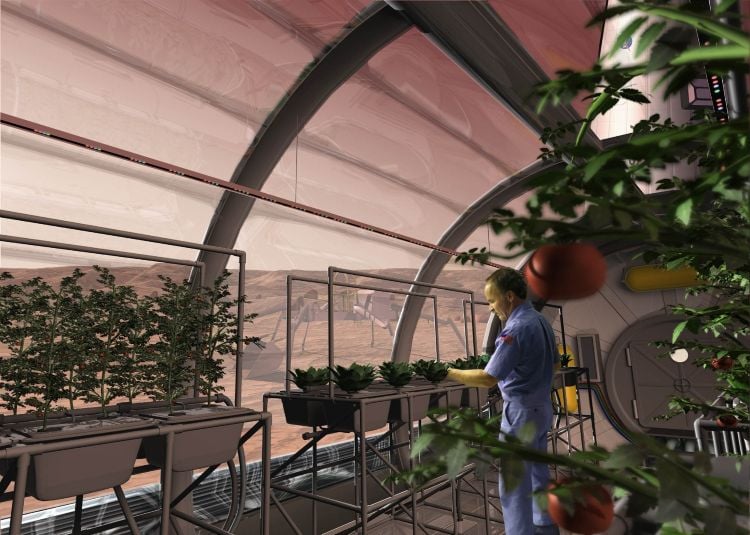
The review highlights arbuscular mycorrhizal fungi, or AMF, which act as microscopic extensions of a plant’s root system. On Earth, these fungi are known to improve nutrient uptake. The argument is that similar relationships could help plants deal with nutrient-poor extraterrestrial growing media, making regolith less hostile and more functionally soil-like.
The concept is part of a broader shift in space life-support thinking. Earlier visions of off-world agriculture often emphasized greenhouses, lighting and water recycling. Those remain essential, but the current discussion expands the focus to microbiology and ecological engineering. Instead of treating regolith only as a sterile substrate, researchers are asking whether biological systems can actively transform it.
From sterile dust to living support systems
The review does not claim the problem is solved. The source text is explicit that future studies are needed, especially tests using real lunar and Martian regolith in practical growing setups. That caveat matters because lab-friendly concepts often become harder when translated into mission hardware, radiation exposure, low gravity, contamination controls and tight habitat energy budgets.
Still, the approach has strategic appeal. If fungi can improve nutrient availability and plant resilience, they could reduce the amount of imported fertilizer and lower the long-term mass burden on missions. That would be particularly valuable for Mars, where resupply windows are infrequent and settlement scenarios assume crews will need increasing levels of local self-reliance.
The idea also fits with a larger pattern in space exploration: using biological partners to extend human capability. Microbes and fungi are compact, self-replicating tools with the potential to perform chemical transformations that would otherwise require additional equipment. In that sense, off-world farming may depend as much on invisible ecosystem design as on rockets and habitats.
There are scientific and operational questions ahead. Researchers will need to determine which fungal species remain stable and useful under extraterrestrial conditions, how they interact with crops over time, and whether they introduce new risks in tightly controlled habitats. They will also need to understand how fungal systems behave when exposed to the mineral composition and potential toxicities of actual Martian and lunar regolith.
Even with those unknowns, the review points toward a practical vision of future exploration. Sustainable settlement will not come from a single breakthrough, but from stacked biological and engineering advances that make remote environments gradually more habitable. Beneficial fungi may become part of that stack, helping convert barren dust into something closer to a working agricultural system.
- The review argues that beneficial fungi could help improve lunar and Martian regolith for crops.
- Researchers focused on nutrient limits and plant stress in off-world growing conditions.
- Future work will need to test these ideas in more realistic regolith and habitat scenarios.
This article is based on reporting by Universe Today. Read the original article.
Originally published on universetoday.com