A Moon That Keeps Rewriting the Rules
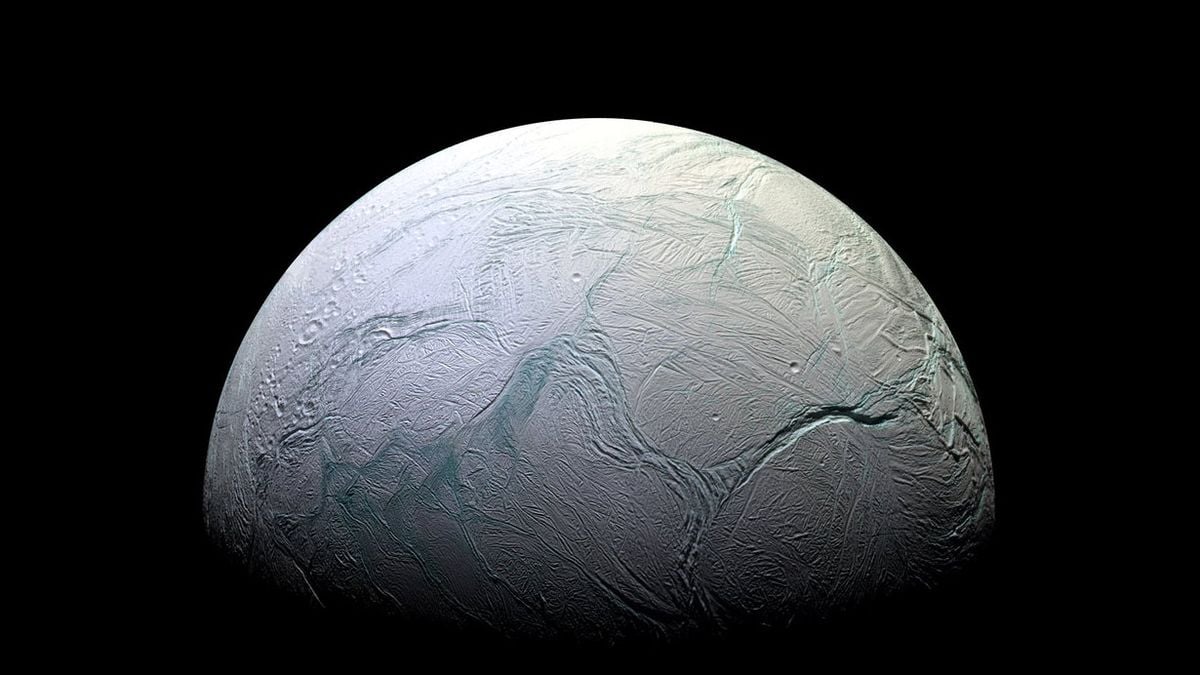
Enceladus, one of the many moons orbiting Saturn, has become one of the most compelling destinations in all of astrobiology. It belongs to a select group of "ocean worlds" scattered across the Solar System — bodies where a liquid ocean hides beneath an icy crust. On Enceladus, that ocean sits between the frozen shell above and a rocky, metallic core below. Because the moon is locked in a gravitational tug-of-war with Saturn, tidal flexing constantly kneads its interior, generating heat. That heat drives hydrothermal activity at the boundary where the ocean meets the core, creating conditions that could, in principle, support life.
The Cassini-Huygens mission transformed Enceladus from a curiosity into a priority target. During a series of daring flybys, the spacecraft flew directly through plumes erupting from the moon's southern polar region — jets of ice particles launched hundreds of kilometers into space. In those plumes, Cassini detected salts and organic compounds, both strong hints that the subsurface ocean contains the ingredients life would need.
Now, two new studies from the Planetary Sciences and Remote Sensing group at Freie Universität Berlin suggest that detecting evidence of life at Enceladus may be considerably easier than scientists previously assumed. The work was led by Prof. Frank Postberg of the Institute of Geological Sciences at Freie Universität Berlin and Dr. Vanessa Helmbrecht of the Department of Earth and Environmental Sciences at Ludwig-Maximilians-Universität. Both papers appeared in Science Advances.
Two Studies, One Central Question
Together, the two papers tackle a practical problem in mission planning: if a spacecraft were sent to sample Enceladus' plumes, how clearly could it actually identify a biosignature? Previous estimates assumed that whatever biological material exists in the ocean would be heavily diluted by the time it reached a passing probe. The new research challenges that assumption from two directions — the physics of how plume droplets freeze, and the biology of what might survive inside the moon.
Slower Freezing Concentrates the Evidence
The first study examined what happens to ocean droplets as they are forced upward through cracks in Enceladus' ice shell. The team found that these droplets freeze more slowly than earlier models predicted. That extra time matters enormously. As a droplet solidifies gradually, the salts and organic compounds dissolved within it are not locked uniformly in place. Instead, they migrate and partition into distinct regions within the freezing grain.
When those grains are then accelerated into space, they can fragment. The result is a population of ice particles in which some grains carry highly concentrated concentrations of the very substances scientists want to find. Rather than being spread thin across an entire plume, biosignatures could be packed into individual grains — small, fast-moving packets of evidence that an instrument could detect with far greater sensitivity than a diluted sample would allow.
This is a significant shift in thinking. It means the plume is not merely a faint echo of the ocean below. Under the right conditions, it can act as a natural concentrator, preserving and amplifying the chemical fingerprints of the interior.
Methanogens in Simulated Enceladus Conditions
The second study approached the question from the biological side. The researchers investigated whether methane-producing microorganisms — methanogens — could survive and continue producing methane under conditions designed to mimic those found on Enceladus. Their results indicate that these organisms could persist and remain metabolically active, generating methane as a byproduct.
That finding is consequential because methane has already been observed in Enceladus' plumes. If methanogens can thrive in environments resembling the moon's ocean, then methane detected by a future probe becomes a plausible — though not conclusive — biosignature, rather than simply a product of geochemistry. The two studies reinforce one another: one shows that biological signals could make it out of the ocean intact, and the other shows that biology of a known terrestrial type could plausibly exist there in the first place.

What the Plumes Actually Carry
The plumes erupting from Enceladus' south polar region are the key to any life-detection mission. They offer something rare in planetary exploration: direct access to an interior ocean without ever landing on or drilling through the surface. Cassini demonstrated this by flying through the plumes multiple times, tasting their contents with onboard instruments and returning data that reshaped our understanding of the moon.
Among the most important discoveries from those flybys were salts and organic compounds. Salts pointed to a salty ocean in contact with rock — a chemically rich environment. Organics indicated that carbon-based chemistry is present in abundance. Together, they painted a picture of a habitable, or at least potentially habitable, subsurface sea.
- Enceladus hosts a global ocean between its icy shell and rocky core.
- Tidal heating from Saturn drives hydrothermal activity at the ocean-floor boundary.
- Plumes launch ice particles hundreds of kilometers above the southern polar region.
- Cassini sampled those plumes directly and found salts and organic molecules.
- New modeling suggests plume grains can concentrate those substances rather than dilute them.
Why This Matters for Mission Design
For anyone planning a dedicated Enceladus mission, the implications are encouraging. Instruments are always constrained by mass, power, and sensitivity. A biosignature that is spread thinly across a plume demands extraordinary detection limits; the same signature concentrated into individual ice grains is a far more tractable target.
The research also helps refine what a probe should look for and where. If grains fragment into chemically distinct pieces during their acceleration into space, then sampling strategy, timing, and instrument targeting all become more informed. Rather than treating the plume as a homogeneous cloud, mission planners can anticipate a diverse population of particles, some of which may be unusually rich in the compounds that matter most.
The Road Ahead
None of this yet amounts to evidence of life. Methanogens surviving in a laboratory simulation is not the same as methanogens living in an alien ocean, and concentrated organics can arise from non-biological chemistry as well. What the Berlin-led research does establish is that the detection problem may be less daunting than assumed — that the physics of plume formation and the biology of candidate organisms both work in favor of a future spacecraft's chances.
Enceladus remains what it has been since Cassini's first plume flyby: a small, bright moon with a hidden sea, venting its secrets into space. The new studies suggest that when a dedicated probe finally goes to collect them, the evidence it needs may already be waiting in unusually concentrated form.
This article is based on reporting by Universe Today. Read the original article.
Originally published on universetoday.com