Long-Term Radio Imaging Gives Astronomers a Rare Direct Read on Jet Power
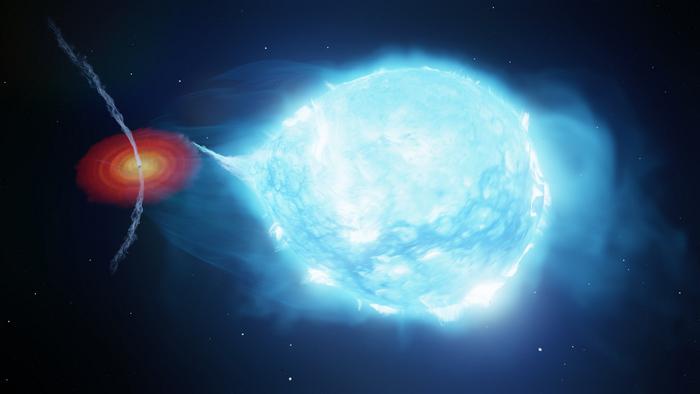
Astronomers have captured one of the clearest measurements yet of the power carried by black hole jets. In new research led by Curtin University, scientists used 18 years of high-resolution radio imaging to study Cygnus X-1, the first confirmed binary system containing a black hole and a supergiant star. The supplied source text says the team found that the system's jets carry energy equivalent to the output of 10,000 Suns.
That scale alone makes the result notable, but the broader importance lies in how the team measured it. Black hole jets are among the most dramatic structures in astrophysics. Matter pulled toward a black hole forms an accretion disk, and while some of that material falls inward, some is funneled away from the poles at extreme speed. These jets can extend across enormous distances, shaping their surroundings and redistributing energy through space.
Why Cygnus X-1 Is Such a Useful Laboratory
Cygnus X-1 offers researchers an unusually valuable environment for testing jet physics. The system pairs a black hole with a massive stellar companion whose wind interacts with the jets. According to the supplied text, the researchers used that interaction to infer the jets' power. By observing how the outflow is bent and buffeted as the black hole orbits the star, they could estimate how forceful the jets must be.
The team combined data from the Very Long Baseline Array and the European VLBI Network, using very long baseline interferometry to create a more complete view than either network could deliver alone. That long observational baseline matters. Jets are dynamic structures, and measuring them through changing orbital conditions over many years provides a far stronger basis for physical interpretation than a single snapshot could.
Half the Speed of Light and a Stronger Test of Theory
The source text says the same calculations also produced an estimate for jet speed of roughly 150,000 kilometers per second, or about half the speed of light. For astronomy, that is not merely a dramatic figure. It helps connect theoretical models of jet launching and energy transport to an actual, well-studied black hole system.
Researchers have long argued that black hole jets play a major role in structuring the universe by carrying energy away from compact objects and into surrounding environments. Measuring both jet power and speed in Cygnus X-1 gives new support to those ideas. It strengthens the case that these outflows are not secondary side effects but fundamental engines of astrophysical feedback.
The findings also underline how important binary environments can be for understanding black hole behavior. Rather than being isolated objects, many black holes exist in systems where winds, magnetic fields, orbital motion, and accretion interact in complex ways. Cygnus X-1 makes those interactions visible enough to turn an old theoretical question into something researchers can estimate quantitatively.
What This Means for Black Hole Science
Every better jet measurement improves our understanding of where accretion energy goes. Some material disappears across the event horizon, but some is redirected outward with enormous force. How efficiently black holes do that remains one of the core questions in high-energy astrophysics. The Cygnus X-1 result does not answer everything, but it provides a powerful benchmark for future modeling and observation.
It also shows the value of patience in astronomy. Eighteen years of coordinated radio data transformed a famous black hole system into a precision experiment. The result is a more grounded picture of how stellar winds can bend jets, how fast those jets travel, and how much power they carry.
That combination of long-baseline observation and physical inference is what gives the study its significance. Black hole jets have always looked spectacular. What this work adds is a stronger sense of their measurable force, placing one of the universe's most violent phenomena on firmer empirical footing.
This article is based on reporting by Universe Today. Read the original article.
Originally published on universetoday.com