A new clue from deep time
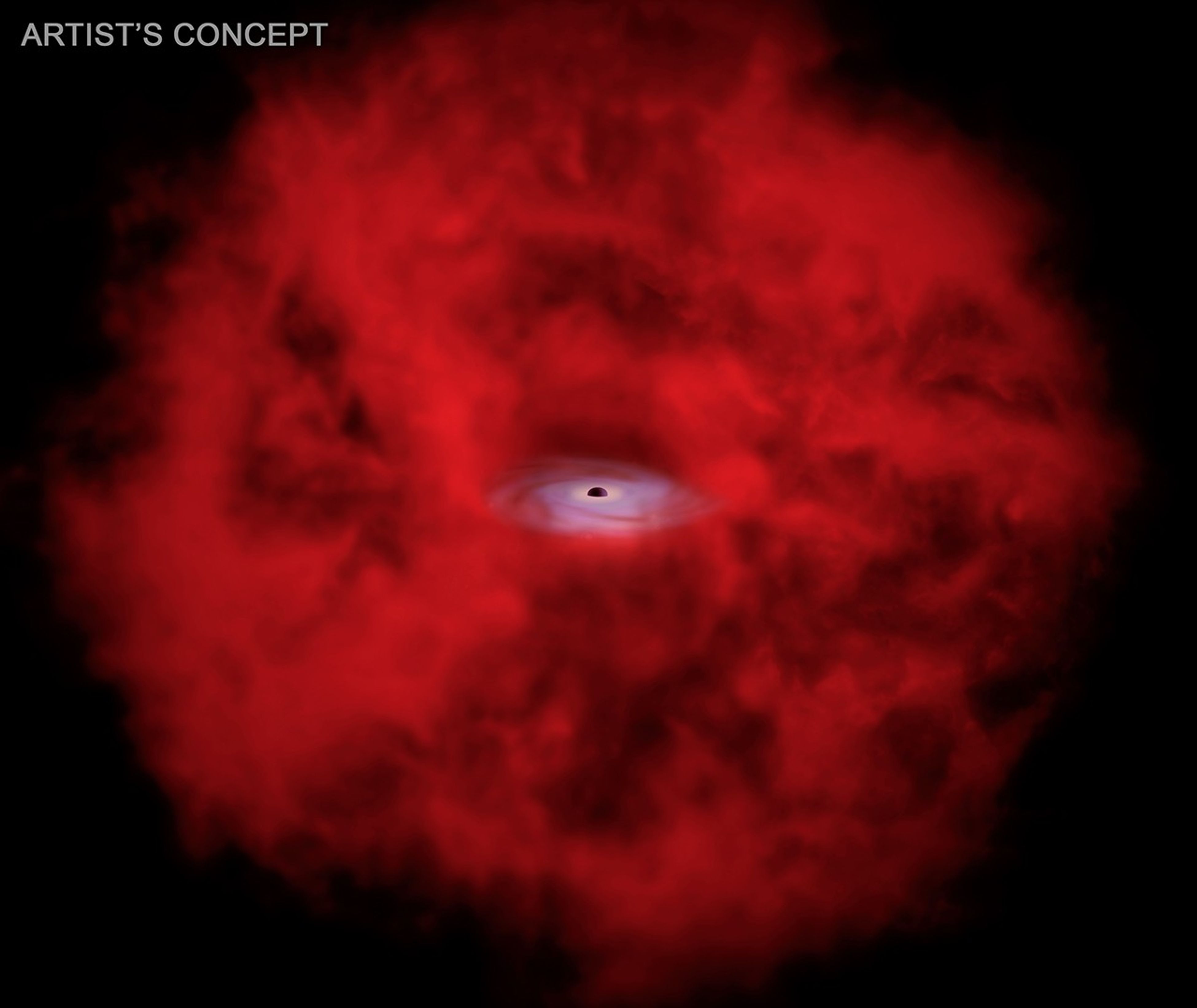
A newly discovered object detected by NASA’s Chandra X-ray Observatory may help explain one of the most puzzling populations to emerge from early James Webb Space Telescope observations. Astronomers are calling it an “X-ray dot,” and the label matters because it appears to share the defining traits of the mysterious “little red dots” found in the early universe while adding a key new signal: it shines in X-rays.
That extra wavelength could make the object unusually important. The little red dots, or LRDs, have been one of the more surprising classes of distant sources identified since Webb began science operations. They are small, red, and extremely far away, with many located roughly 12 billion light-years from Earth or more. What exactly they are has remained uncertain. The new Chandra source may help narrow the possibilities.
What makes this object different
According to NASA’s description, the object formally known as 3DHST-AEGIS-12014 is about 11.8 billion light-years from Earth. It exhibits most of the features associated with an LRD: it is compact, red, and located at a vast distance. The difference is that it also glows in X-ray light, which is not a defining feature of the earlier little red dot reports.
That combination gives astronomers a potentially valuable bridge object. NASA says the source may connect “black hole stars” and more typical growing supermassive black holes. In practice, that means the object could sit in an intermediate state useful for understanding how some of the earliest massive black holes formed and evolved.
The black hole growth problem has been a persistent one in cosmology. Observations have long shown that massive black holes already existed surprisingly early in cosmic history, forcing researchers to explain how they assembled so much mass so quickly. If the little red dots represent an important stage in that story, then an X-ray-emitting example could reveal more about the engines powering them.
Why X-rays matter here
X-rays are often associated with extreme environments, especially regions around accreting black holes where matter heats to enormous temperatures. A distant compact object that looks like a little red dot in optical and infrared observations but also produces X-rays may offer stronger evidence that black hole activity is central to the phenomenon.
That does not solve the mystery on its own. One object rarely settles a new class of astrophysical puzzles. But it can anchor competing interpretations. If researchers can show that at least some little-red-dot-like sources are powered by rapidly growing black holes, then the category may shift from being a purely descriptive observational oddity to a more physically grounded stage in galaxy and black hole evolution.
The timing also illustrates the increasingly complementary role of modern observatories. Webb is powerful at revealing distant red sources in the infrared-rich early universe. Chandra adds a different window, one that can expose high-energy processes hidden behind broad visual similarity. Together, they can turn a strange-looking point of light into a better-defined astrophysical system.
The significance of a bridge object
NASA’s framing of the X-ray dot as a “crucial bridge” is the key takeaway. Astronomers often make progress not by finding a perfect final answer, but by identifying transitional cases that link one class of objects to another. Bridge objects show how physical processes may connect across time, mass, or environment.
Here, the bridge runs between speculative early black-hole formation scenarios and the more familiar picture of growing supermassive black holes. If 3DHST-AEGIS-12014 really occupies that middle ground, it could help researchers build a more continuous narrative for how some of the universe’s earliest compact, luminous sources developed.
That would matter well beyond this single object. The number of little red dots reported in the early universe has raised the possibility that they are not rare curiosities but a widespread population. NASA says there may be hundreds or potentially thousands of these objects. If so, understanding one good X-ray example could influence how astronomers interpret a much larger census.
What comes next
The immediate next step is not to declare the mystery solved, but to look for more sources that combine LRD-like properties with detectable X-ray emission. A single object can be suggestive; a population can be diagnostic. Researchers will also want to compare how objects like this behave across multiple wavelengths and test whether they fit specific models of black hole growth.
Even at this early stage, though, the discovery is a reminder that the early universe is still producing new categories faster than theory can comfortably absorb them. That is one of the reasons the Webb era has been so scientifically disruptive. It is not only finding more distant objects. It is uncovering populations that force astrophysicists to revisit formation timelines and physical assumptions.
What NASA says defines the X-ray dot
- It is small, red, and very distant, like previously identified little red dots.
- It also emits X-rays, unlike the other LRDs referenced in the NASA summary.
- It may provide a bridge between black hole stars and growing supermassive black holes.
The early universe still resists simple classification. But with the discovery of an X-ray dot that resembles a little red dot while revealing high-energy activity, astronomers may finally have a sharper tool for asking what these strange ancient sources really are.
This article is based on reporting by NASA. Read the original article.
Originally published on nasa.gov