A rare metal may have been central to life much earlier than expected
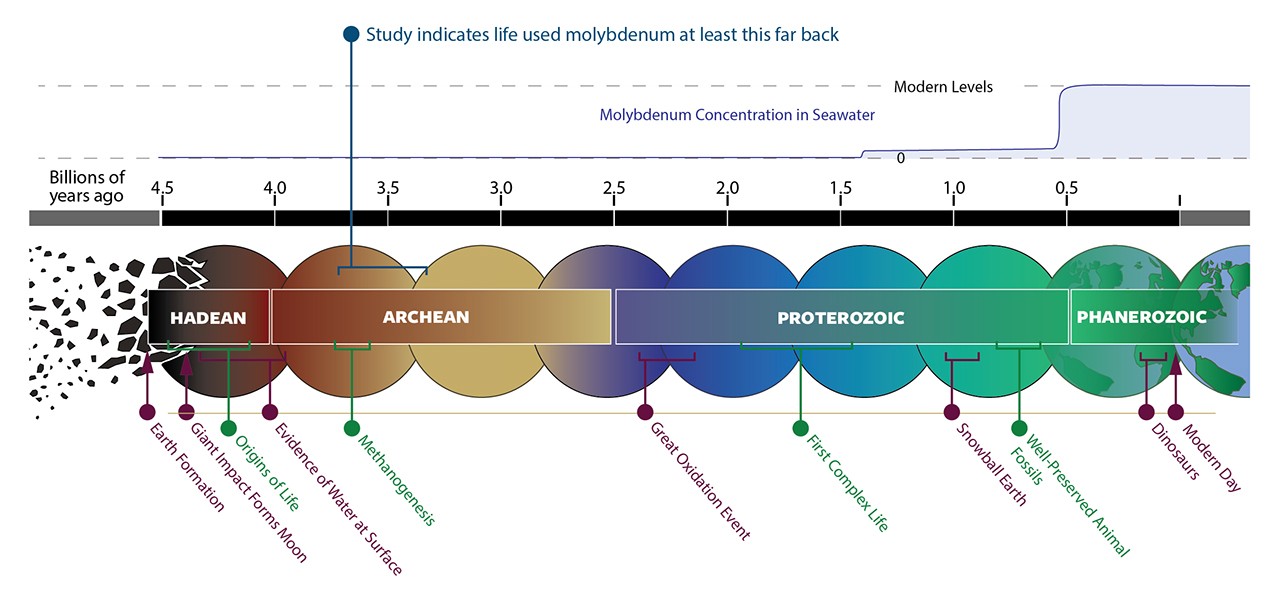
NASA-funded researchers say life on Earth was using molybdenum more than 3 billion years ago, a finding that pushes an important biochemical capability deep into the planet’s early history. The study, published in Nature Communications, is described as the first to show that molybdenum supported ancient life as far back as 3.3 to 3.7 billion years ago, well before the metal became abundant in Earth’s oceans.
The result matters because molybdenum sits inside enzymes that speed up some of biology’s most consequential reactions, including parts of the carbon, nitrogen, and sulfur cycles. Without that catalytic help, those reactions can still occur, but too slowly to sustain life as it is known today. In that sense, asking when life started using molybdenum is also a way of asking when certain powerful metabolic strategies became available.
The paradox of a scarce but essential element
On modern Earth, molybdenum is comparatively accessible. But billions of years ago, geological evidence suggests that only trace amounts were present in the oceans. Levels rose much later, around the broad period when photosynthetic microorganisms helped drive the Great Oxidation Event roughly 2.45 billion years ago. That long gap created an open question for astrobiologists: if molybdenum was so scarce on ancient Earth, did early life rely on other metals instead?
Tungsten has often featured in that discussion because it can behave similarly in cells and is still used by some organisms that live in extreme environments. The new work suggests that, even under scarcity, molybdenum entered life’s toolkit far earlier than many researchers might have expected.

Why this changes the picture of early metabolism
Senior author Betül Kaçar of the University of Wisconsin-Madison said the issue is not merely chemical trivia. Molybdenum occupies the active centers of enzymes that drive major planetary-scale reactions. If organisms were already incorporating it 3.3 to 3.7 billion years ago, then important metabolic systems may have emerged under environmental constraints that looked far less favorable than today’s.
That raises a deeper point about evolution. Life may not have waited for ideal geochemical abundance before adopting a useful element. Instead, it may have developed strategies to access and conserve rare metals long before those metals became widely available. The study’s framing suggests ancient biology was not only opportunistic but also remarkably adaptive in the face of planetary scarcity.
Astrobiology implications extend beyond Earth
Because the work is NASA-funded and explicitly tied to astrobiology, the significance extends beyond Earth’s own history. The distribution of bio-essential elements is one of the factors scientists consider when evaluating whether a world could support life. If life can exploit a scarce metal much earlier than assumed, that broadens how researchers might think about habitability on other planets or moons.
It does not mean any environment with traces of molybdenum is suddenly a likely cradle for biology. But it does suggest that low abundance alone may not rule out important metabolic chemistry. That is useful for a field trying to infer biological possibilities from incomplete planetary data.

A revision to the story of life’s early chemistry
The study also interacts with earlier thinking about the rise of molybdenum in Earth’s environment. Previous work had suggested that increasing molybdenum availability around the time of atmospheric oxygenation may have been important for later biological complexity. The new finding does not contradict that broader idea, but it does revise the earlier chapter. Life appears to have found a way to use the metal long before the oceans offered it in anything like modern abundance.
That makes the result both geochemical and evolutionary. It says something about ancient Earth’s environment, but also about the ingenuity of the organisms living within it. Early life may have been operating with a more sophisticated catalytic toolkit than expected, even while the planet itself remained chemically austere.
For astrobiology, the message is clear: scarcity does not necessarily mean absence of function. If molybdenum-dependent biology was already active on Earth this early, scientists looking for life elsewhere may need to think harder about how living systems can exploit marginal resources. Sometimes the most revealing evidence is not that a key ingredient was abundant, but that life learned to use it anyway.
This article is based on reporting by science.nasa.gov. Read the original article.
Originally published on science.nasa.gov