The Artemis coalition adds another state
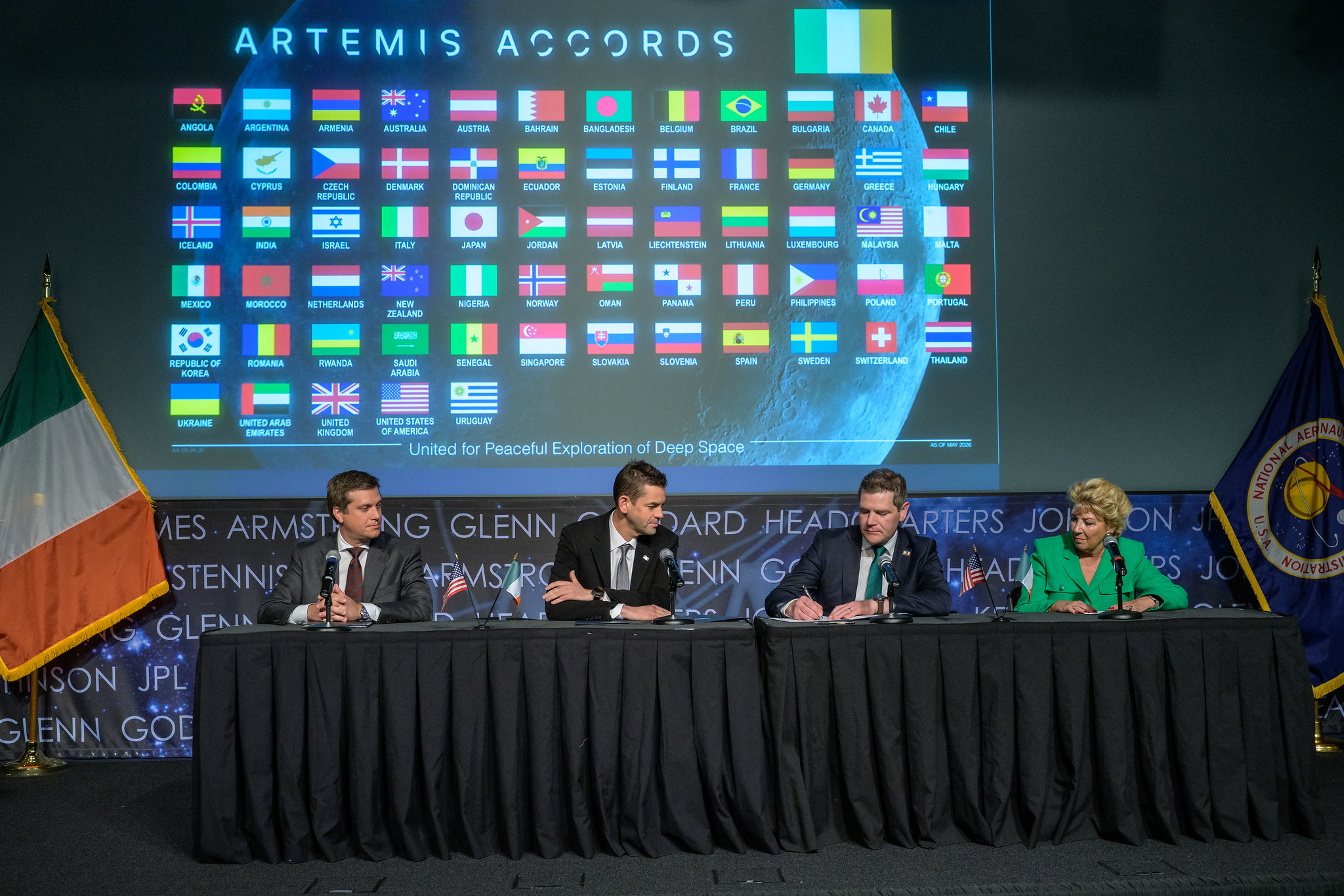
Ireland has become the 66th nation to sign the Artemis Accords, joining NASA’s international framework for what the agency describes as peaceful, transparent, and responsible space exploration. The signing took place in Washington on May 4, with Ireland’s Minister for Enterprise, Tourism and Employment Peter Burke signing on behalf of the country.
The move is symbolically significant beyond the single addition. With Ireland’s signature, all 23 member states of the European Space Agency are now part of the accords. That gives the framework a stronger European base at a moment when lunar policy is moving from abstract diplomacy to operational planning around missions, infrastructure, and commercial activity.
What the accords are meant to do
The Artemis Accords were established in 2020 by the United States and seven founding partner nations in response to growing governmental and private-sector interest in lunar activity. Their purpose is to create a practical set of principles for civil exploration beyond Earth, especially on and around the Moon.
NASA presents the accords as a way to reduce ambiguity before activity intensifies. As more countries and companies prepare for missions that may involve landing sites, resource use, operational coordination, and scientific collaboration, the value of a shared framework rises. The accords are not a substitute for all international space law, but they are designed to shape expectations for how participants behave.
The language used at the ceremony emphasized responsibility and transparency, two themes that have become central to space diplomacy as lunar ambitions move closer to execution. In that sense, the significance of a new signature is cumulative. Each added country expands the political legitimacy of the framework and increases pressure on future lunar missions to fit within an agreed set of norms.

Why Ireland matters in this context
Ireland is not entering the conversation as an isolated newcomer. It is already a member of the European Space Agency and described by NASA as a valued international partner. The country’s accession therefore strengthens an existing alliance structure rather than opening a brand-new one.
That matters because the Artemis effort is not only about rockets and astronauts. It also depends on shared industrial, scientific, and diplomatic ecosystems. When all ESA member states are aligned under the accords, coordination across Europe potentially becomes easier, at least at the level of political signaling and broad civil-space principles.
The ceremony also highlighted the cultural and political symbolism of the moment. NASA Administrator Jared Isaacman described Ireland as joining at a pivotal point, framing Artemis II as the opening act in humanity’s return to the Moon and the next phase as a sustained campaign rather than a one-off visit. In that formulation, the Moon is not simply a destination for prestige missions. It is becoming the staging ground for longer-term presence.
Why timing matters now
The timing of Ireland’s signature reflects a larger shift in space policy. Lunar exploration is no longer organized solely around national flag-planting. It is being framed as a long-duration campaign involving recurring missions, commercial partners, surface operations, and eventually permanent or semi-permanent infrastructure. As that shift accelerates, political agreements that once looked aspirational start to become operationally relevant.
NASA’s remarks underscored that change. The agency is now talking about building a base and staying, language that signals a move from symbolic return to persistent activity. In that context, agreements about norms, behavior, and cooperation become more than diplomatic stagecraft. They become part of the governance layer for a crowded new domain.
The accords have also grown steadily since their founding, suggesting that many governments prefer to join a coalition-led framework rather than remain outside the main rule-setting conversation. Ireland’s decision reinforces that pattern.

The broader implication for lunar governance
The core story here is not that one country signed one document. It is that the architecture of lunar cooperation is continuing to consolidate around a widening coalition. That does not settle every debate about how the Moon should be governed, nor does it guarantee universal participation. But it does show that the U.S.-led Artemis model continues to attract governments that want a defined place in the next phase of exploration.
For Europe, full ESA member-state participation adds coherence. For NASA, it adds another diplomatic marker at a moment when Artemis is being presented as both a mission series and a durable international project. For the wider space sector, it signals that rule-making is advancing alongside hardware.
Ireland’s signature will not by itself change launch schedules or surface operations. What it does change is the map of who has chosen to align with the current leading framework for civil activity beyond Earth. In the coming years, as lunar missions become more frequent and more commercially entangled, that map may matter almost as much as the spacecraft themselves.
This article is based on reporting by NASA. Read the original article.
Originally published on nasa.gov