Io may be running much hotter than scientists thought
Io, Jupiter’s volcanic moon, has long been treated as one of the most extreme worlds in the solar system. It is covered with volcanic depressions known as paterae, shaped by intense internal heating driven by the gravitational tug-of-war between Jupiter and neighboring moons. Now, a new preprint drawing on data from Juno’s Jupiter InfraRed Auroral Mapper, or JIRAM, argues that researchers may have been significantly underestimating the amount of heat these volcanic systems release.
If the result holds, it would matter well beyond a bookkeeping adjustment. Io’s thermal output is central to how scientists understand the moon’s interior, its magma circulation, its heat transport, and the broader consequences of tidal heating in planetary bodies. A hotter Io would imply that some long-standing estimates of how energy is distributed across its volcanic terrain have missed a substantial portion of the total picture.
Why earlier measurements may have missed the bigger signal
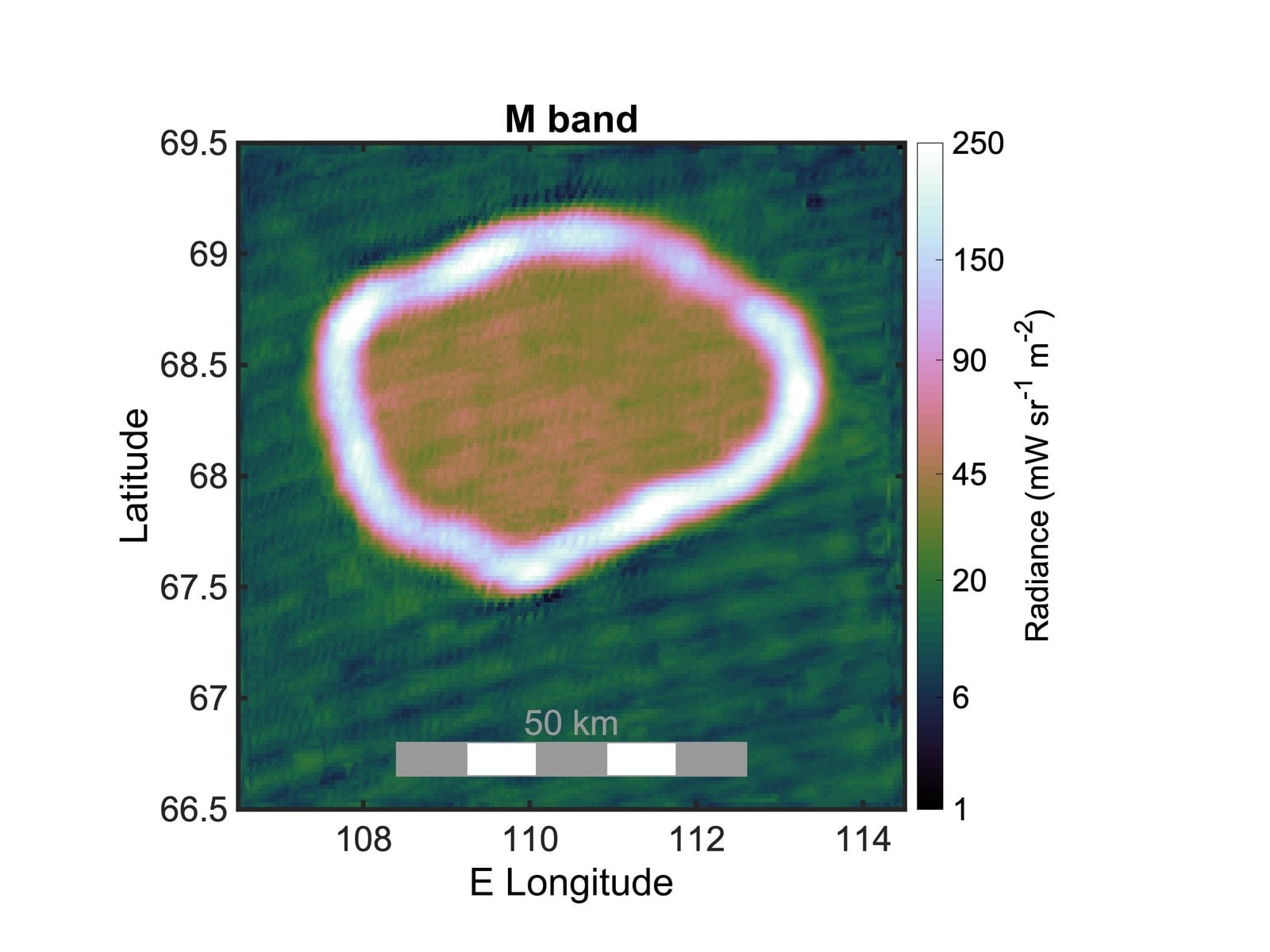
The problem, according to the report, lies in how the volcanoes were observed. Previous estimates relied on infrared measurements concentrated in a single wavelength band, the M-band. That band is very good at detecting the hottest zones, particularly the bright outer rings of lava lakes where exposed magma can reach temperatures up to about 900 kelvin. Those peripheral areas stand out clearly because they are thermally intense and therefore easy to identify as hotspots.
But Io’s paterae are not composed only of these blazing margins. They also include much broader central regions covered by a cooler crust, generally in the 220 to 230 kelvin range. That crust forms as lava exposed to the vacuum of space solidifies and thickens over time, creating an insulating lid above the molten material beneath. While cooler than the perimeter, these central areas occupy far more surface area.
The new argument is that earlier M-band observations were effectively biased toward the hottest, most obvious parts of the volcanoes while overlooking the thermal contribution of the larger, cooler crustal zones. In other words, the most visually dramatic regions may not represent the bulk of the heat budget.
How a lava lake can be hottest at the edges
At first glance, it might seem counterintuitive that the outer sections of a lava lake would be hotter than the center. The explanation described in the report is physical rather than paradoxical. The center often has time to develop a crust, which acts as an insulating cap over the molten interior. The outer reaches, by contrast, can contain newly exposed lava that has not yet cooled and solidified to the same extent.
The periphery may also be fed by processes that continually move hotter material outward. The report mentions both a piston-like action tied to volcanic dynamics and subsurface churning analogous to processes on Earth that can push the hottest magma toward the edges. The result is a thermal structure in which narrow rings burn extremely hot while a much larger central surface radiates more quietly.
That matters because thermal output depends on more than peak temperature. Surface area matters too. A small region at very high temperature can dominate in visibility, while a vast cooler region can still contribute a large share of total emitted heat. If past methods emphasized one while discounting the other, total output estimates would be skewed low.
Why the stakes are larger than one moon
Io is not merely an oddity. It is the best natural laboratory in the solar system for studying extreme tidal heating. Jupiter’s gravity and the gravitational influence of neighboring moons constantly flex Io’s interior, generating heat that powers widespread volcanism. Any revision to Io’s total thermal emission feeds back into models of how that energy is generated, stored, and released.
A higher output would imply that internal processes may be moving more heat to the surface than many models have assumed. That could affect interpretations of magma reservoirs, resurfacing rates, crust formation, and the balance between localized hotspots and broader background heating. It may also shape how researchers think about other tidally heated worlds, even if none match Io’s intensity.
Because the study is described as a preprint, it should still be treated as provisional. But the underlying observational logic is notable. Planetary science often advances not by finding a wholly new object, but by realizing a familiar object has been measured in a way that systematically misses part of the signal. Io’s paterae have been studied for decades. The claim here is that a key observational window highlighted the spectacular edges while undervaluing the quieter interior.
A familiar world, seen differently
Juno’s JIRAM instrument is helping researchers revisit old assumptions with new data. In the case of Io, that means looking beyond isolated hotspots and reconsidering how volcanic systems radiate energy across different temperature regimes. The preprint’s central message is that the cooler crust of lava lakes may not be a minor thermal footnote, but a major contributor to the moon’s total output.
That would make Io even more extraordinary than it already appears. The moon is widely recognized as the most volcanically active world in the solar system, with more than 400 volcanic depressions. If its heat loss has indeed been underestimated for decades, then one of planetary science’s most extreme environments may have been even more extreme all along.
The result will need further scrutiny, but it arrives with a useful scientific lesson. Instruments do not merely record nature; they filter it. A wavelength that excels at finding brilliant hotspots can still undercount the power of everything less conspicuous. In Io’s case, that may mean the most dramatic moon in the Jupiter system has been hiding part of its energy in plain sight.
This article is based on reporting by Universe Today. Read the original article.
Originally published on universetoday.com