Chicxulub’s aftermath may have lasted far longer underground than scientists thought
The asteroid impact that ended the age of non-avian dinosaurs is usually remembered for its immediate devastation: a giant crater, firestorms, an impact winter and a mass extinction that eliminated roughly three-quarters of Earth’s species. But new research highlighted by Universe Today points to a much slower, quieter legacy beneath the crater itself. According to the study, the Chicxulub impact structure hosted a hydrothermal system that may have remained active for around 8 million years, far longer than earlier estimates suggested.
That matters because hydrothermal systems are more than geological curiosities. They are one of the leading environments scientists consider when asking how simple life might first emerge. Where heat, water and chemically reactive rock interact over long periods, the ingredients and energy sources needed for prebiotic chemistry can accumulate. If the new estimate holds up, Chicxulub was not only a site of planetary destruction. It may also have created a durable subsurface environment with conditions relevant to the origins of life.
Why a long-lived hydrothermal system matters
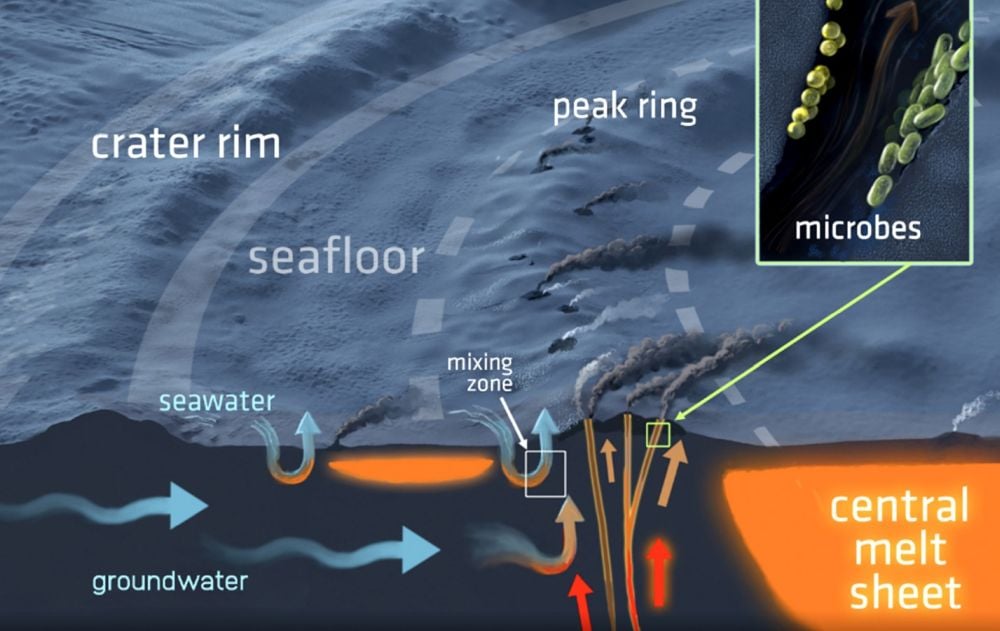
Impact-generated hydrothermal systems form when a high-energy collision fractures rock and leaves behind enough residual heat for water to circulate through the damaged crust. In Chicxulub’s case, the impact was powerful enough to create a vast zone of shattered, permeable rock. Superheated fluids moving through that rock would have altered minerals, transported nutrients and sustained chemical gradients over time.
The central scientific question is duration. A hydrothermal system that cools too quickly offers only a narrow window for complex chemistry. A system that persists for millions of years provides repeated opportunities for reactions to occur, compounds to concentrate and potentially simple microbial communities to take hold if other conditions are favorable.
The new study, as summarized in the source material, argues that Chicxulub’s system lasted about 8 million years. That extends previous thinking about how long the crater remained geologically active underground. It also strengthens the case that large impacts can do two things at once: reset surface ecosystems through catastrophe while creating protected subsurface habitats that may remain viable long after surface conditions deteriorate.
From extinction event to possible habitat
This dual role is what makes Chicxulub so scientifically compelling. The impact around 66 million years ago triggered one of the best-known extinction events in Earth history. Yet the same collision also generated heat, fractures and fluid flow, all essential ingredients for hydrothermal activity. In other words, the crater was both a destructive force and a possible engine for chemical and biological opportunity.
Researchers have long considered hydrothermal systems plausible environments for early life because they combine porosity, water circulation and rich geochemistry. The source text notes that these systems can be nutrient-rich and chemically dynamic, and that similar settings are discussed not only for early Earth but for other planetary bodies as well. A longer-lived Chicxulub system therefore expands the relevance of the crater beyond Earth’s extinction record. It becomes a case study for planetary habitability.
That wider relevance is important because impact craters are common across the Solar System. If large impacts can generate subsurface hydrothermal systems that remain active for millions of years, then craters on Mars and elsewhere may deserve even more attention in the search for ancient habitable environments. The Chicxulub result does not prove life emerged in such settings. It does suggest those settings may endure long enough to matter.
What the study changes
The shift here is not that scientists were unaware of hydrothermal activity at Chicxulub. The existence of such a system was already recognized. The advance is in the revised timescale. A system lasting roughly 8 million years implies a far more persistent energy source and a more extended period of water-rock interaction than shorter estimates allowed.
That longer timeline affects several lines of inquiry:
- It gives origin-of-life researchers a more realistic long-duration environment in which prebiotic chemistry could proceed.
- It increases the plausibility that microbial colonization, if it occurred, had enough time to establish and spread through subsurface niches.
- It strengthens the argument that impact craters can be durable habitats rather than brief thermal anomalies.
- It sharpens the astrobiology case for studying ancient crater systems on other worlds.
The source text also notes that although hydrothermal systems are known from many impact structures on Earth, clear evidence of microbial colonization has been identified in only a small fraction of known craters. That limitation matters. Scientists still need better records, better sampling and better preservation of ancient rocks to move from habitability arguments to direct biological evidence.
Why this matters beyond Earth history
The biggest consequence of the Chicxulub finding may be conceptual. Major impacts are often treated primarily as sterilizing events. This research supports a more nuanced view: the same impact can devastate a planet’s surface while simultaneously generating subsurface refuges and chemically active environments. In planetary science, that is a significant reframing.
It also links extinction research, geology and astrobiology in a useful way. Chicxulub is one of the best-studied impact structures on Earth, which makes it an unusually strong natural laboratory for testing ideas about crater-driven habitability. If researchers can show that its hydrothermal system remained active for millions of years, then models for other crater environments gain a more credible benchmark.
For Developments Today readers, the broader takeaway is that one of Earth’s most famous catastrophe sites may also help answer one of science’s oldest questions. Not whether the Chicxulub impact caused disaster; that is well established. The more intriguing possibility is that, underground, the crater sustained a long-lived environment where life-supporting chemistry could continue long after the skies cleared.
That does not turn Chicxulub into the birthplace of life, and the available source material does not claim it was. But it does underscore why impact craters remain central to origin-of-life research. The new study pushes the conversation from short-lived post-impact heat to multi-million-year geological persistence. That is a meaningful shift, and one likely to influence how scientists prioritize crater systems on Earth and beyond.
This article is based on reporting by Universe Today. Read the original article.
Originally published on universetoday.com