A chemical clue points to a violent planetary ending
Astronomers say they have found evidence that a subgiant star known as TOI-5882 consumed one of its planets, offering a rare forensic look at how planetary systems can unravel. The case rests on an unusual signal in the star’s spectrum: a high abundance of lithium, an element that is relatively common in planets but usually scarce in stars because stellar interiors destroy it at high temperatures.
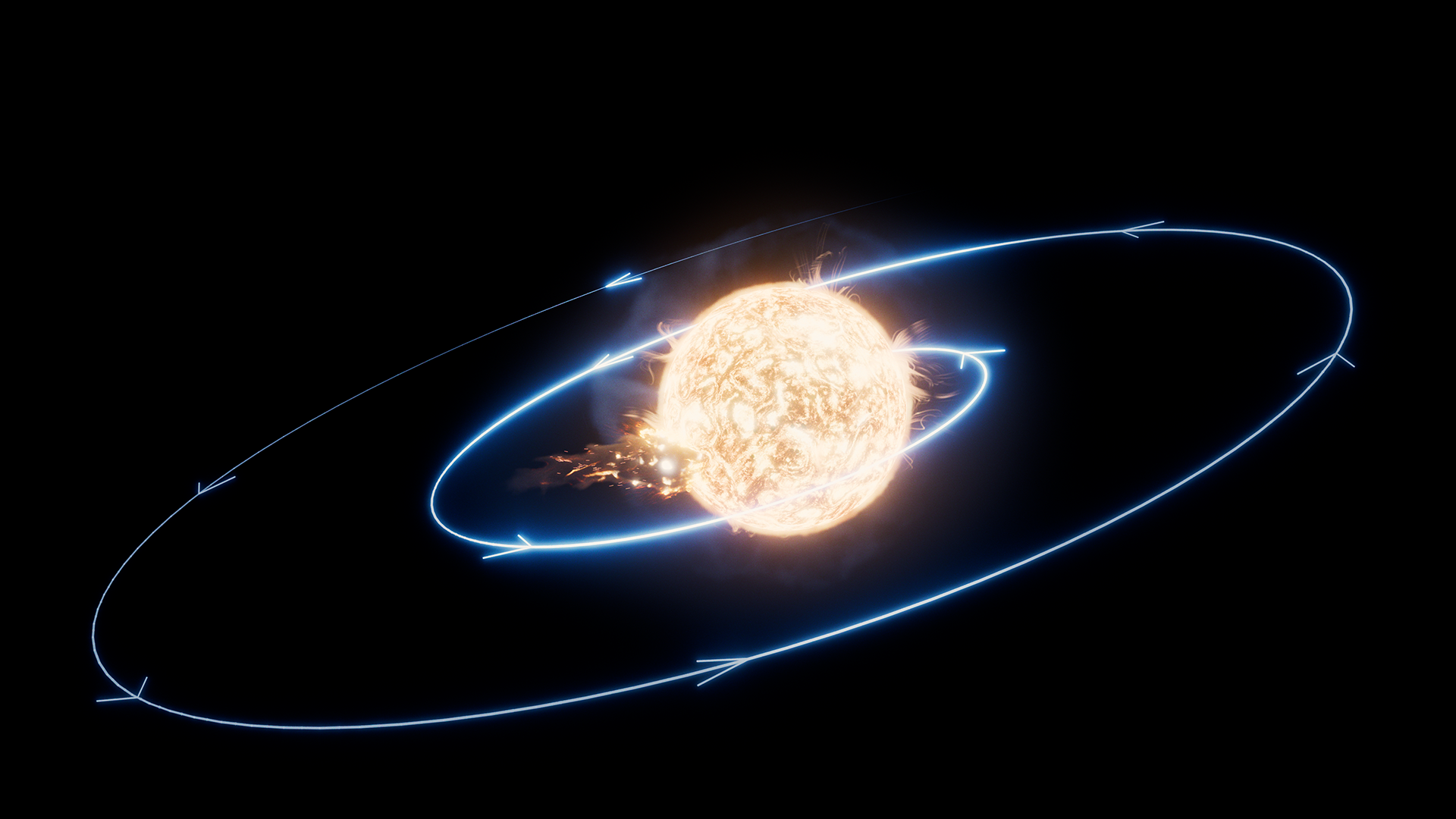
The report, summarized by Universe Today, describes work by a team of 14 researchers from the United States and Chile. TOI-5882 was already of interest because it has a massive brown dwarf companion, TOI-5882 b. The researchers argue that this companion may have helped disrupt the system by pushing a planet onto an inward spiral toward the star. As the world moved closer, the star’s gravity would have torn it apart and mixed its material into the star’s upper layers.
That sequence cannot be watched directly in real time. According to the report, the actual engulfment phase would unfold over only days or weeks, making it extremely unlikely that astronomers would catch the event as it happened. Instead, they have to reconstruct the incident from lingering evidence. In this case, the evidence is written in starlight.
Why lithium matters
When astronomers spread starlight into a spectrum, they can identify the chemical fingerprints of elements in a star’s atmosphere and convection zone. In stars like the Sun, hydrogen and helium dominate, while many heavier elements appear only in small quantities. Lithium is especially useful because it tends not to survive deep inside stars. If astronomers detect an unusually strong lithium signal in a star where they do not expect it, one possible explanation is that the star recently absorbed lithium-rich planetary material.
That is the core logic of the TOI-5882 case. The star appears to have more lithium than astronomers would normally expect. Because planets can contain abundant lithium compared with stellar atmospheres, swallowing a planet could temporarily enrich a star’s outer layers with that element. The report quotes University of Michigan graduate student Brooke Kotten, who led the study, describing the problem in blunt terms: a star can reveal what it has eaten.
Planetary engulfment has become an increasingly active area of research because it connects stellar evolution, orbital dynamics, and exoplanet demographics. It also addresses a broader question: how many planetary systems experience late-stage instability severe enough to send worlds into their stars? The answer matters for understanding not just dramatic one-off events, but the long-term architecture and survival of planetary systems.
The role of the brown dwarf companion
One of the most intriguing features of the TOI-5882 system is the presence of the brown dwarf companion. Brown dwarfs sit in the mass range between planets and stars and can exert powerful gravitational influence. In this case, the companion may have disturbed the orbit of another planet strongly enough to set the engulfment process in motion.
That possibility gives the system more than a simple before-and-after storyline. It suggests a mechanism. Rather than assuming a planet gradually drifted inward on its own, astronomers can point to a plausible dynamical agitator already known to exist in the system. If that interpretation holds up, TOI-5882 would represent not just evidence of a star having consumed a planet, but also an example of how massive companions can destabilize planetary neighborhoods.
These interactions matter because many exoplanet systems are more dynamically complicated than the Solar System. Giant planets, brown dwarfs, and stellar companions can all reshape orbits over time. Some worlds get ejected into interstellar space. Others are pushed into highly elongated orbits. A few may end up in the most destructive outcome possible: direct destruction inside the star they orbit.
A forensic science of lost worlds
The report captures why astronomers find these cases so compelling. Planetary engulfment is difficult to observe directly, but it can leave chemical and dynamical traces that persist long enough to be studied. That turns each candidate case into a reconstruction problem. Researchers gather indirect evidence, test alternative explanations, and try to determine whether the star’s composition tells the story of a vanished planet.
In practical terms, this is a reminder that exoplanet science has entered a more mature phase. The field is no longer limited to counting worlds and measuring their sizes. It is increasingly concerned with system histories: how planets migrate, how companions perturb them, how stars evolve, and how these processes interact over billions of years. A planetary system is not static. It is an environment shaped by collisions, resonances, radiation, and, in some cases, outright consumption.
TOI-5882 also shows the value of spectroscopic analysis beyond simple classification. Light is still the main evidence stream in most of astronomy, and careful interpretation of spectra can reveal not just what an object is made of today, but what may have happened to it in the past. In that sense, the high lithium signal is not merely a chemical anomaly. It is a possible record of a planetary death.
Why the finding matters
No single system can settle the full question of how common planetary engulfment is, and the report as provided does not detail every competing explanation the researchers considered. But the case is important because it adds to a growing set of observations suggesting that stars can betray evidence of destroyed worlds. The more such examples astronomers identify, the better they can estimate how often planetary systems become unstable and what signatures those episodes leave behind.
There is also a broader cultural pull to discoveries like this. Exoplanet science often emphasizes habitable worlds and stable orbits, but the universe is equally full of failure modes. Planets can be stripped, scattered, frozen, or consumed. Understanding those endings is part of understanding planetary evolution as a whole.
If the TOI-5882 interpretation is correct, astronomers have found the aftermath of a planetary engulfment event, preserved in the chemistry of a subgiant star. It is a stark result: a world no longer exists, but its remains may still be visible in the light of the star that destroyed it.
This article is based on reporting by Universe Today. Read the original article.
Originally published on universetoday.com