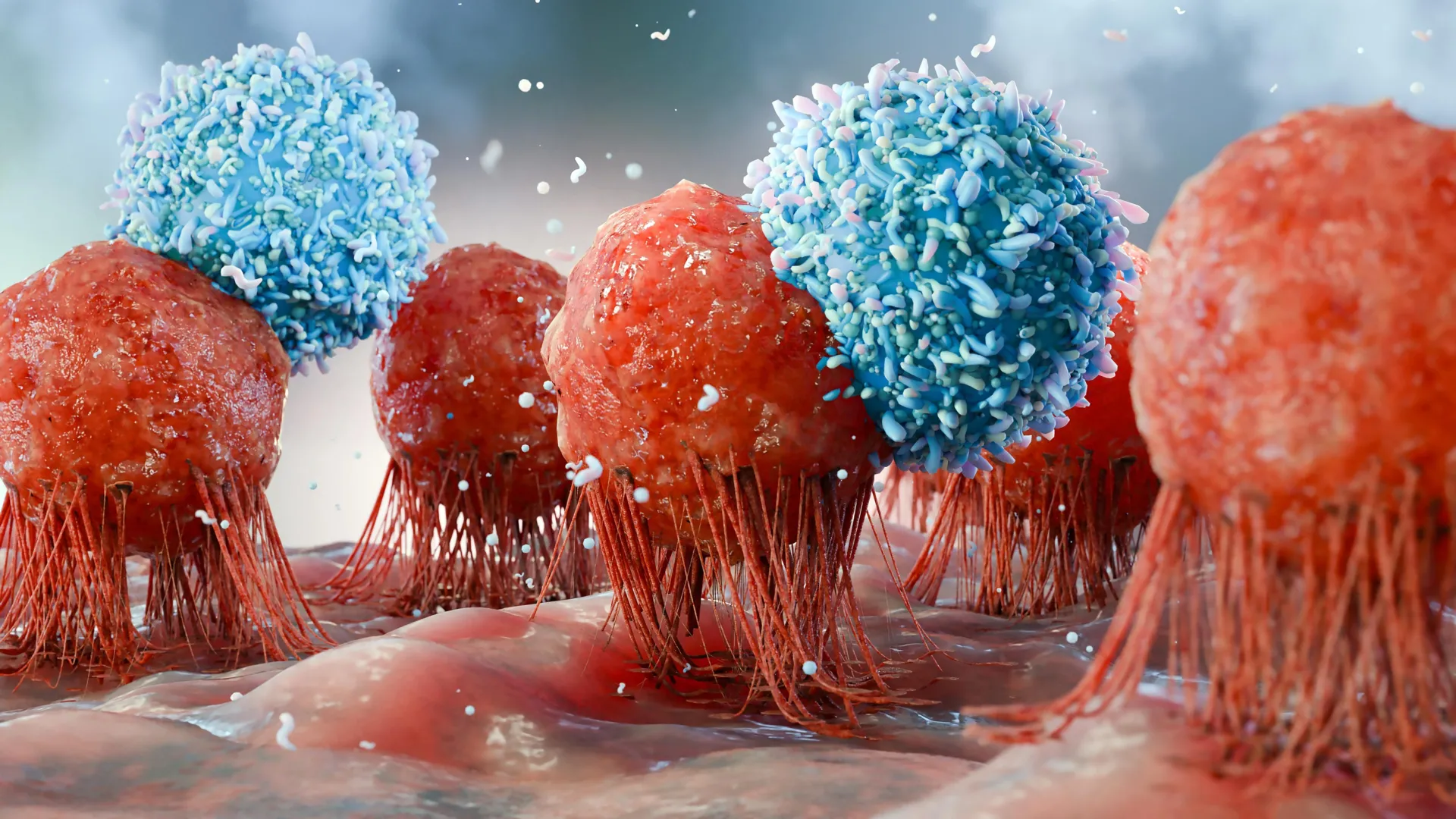
Researchers at the University of Southern California have reported a new approach to cancer immunotherapy built around immature immune cells that can be expanded, genetically engineered and potentially renewed inside the body. In mouse experiments, the engineered cells settled in bone marrow, generated new immune cells and slowed the progression of both blood cancers and solid tumors.
The research, published in Cell, is an early-stage study rather than a demonstrated treatment for people. Its significance is the possibility of addressing two persistent challenges in cell-based cancer therapy: manufacturing enough therapeutic cells and maintaining their activity after they are delivered.
Starting with immune-cell progenitors
The USC team focused on granulocyte-monocyte progenitors, or GMPs. These immature immune cells normally develop into macrophages and other cells involved in immune responses and protection from infection.
Instead of beginning with mature immune cells, the researchers worked with these progenitors. They found that GMPs could be extensively grown in the laboratory while retaining their ability to mature into functional immune cells. The cells could also be genetically modified to recognize particular cancer markers and to support broader immune activity.
That combination is the foundation of the proposed platform. A renewable population of engineered progenitors could, in principle, continually give rise to tumor-fighting immune cells rather than functioning as a fixed supply of mature cells.

What happened in mice
In the reported experiments, the engineered cells established themselves in the bone marrow of mice. There, they produced new immune cells and slowed tumor progression in models of blood cancers and solid tumors.
Those results are important proof-of-concept evidence, but they should not be read as evidence that the method will work in patients. Findings in mouse models are an essential stage of biomedical research, yet they do not resolve questions about safety, durability, dosing or effectiveness in humans.
Still, the study points to a different way of thinking about engineered cell therapies. Rather than relying only on a one-time batch of mature therapeutic cells, the approach aims to use precursor cells capable of generating further cancer-directed immune cells in the body.
A possible answer to manufacturing constraints
Cellular immunotherapies have shown that the immune system can be directed against cancer, but producing large numbers of cells and sustaining their effect can be difficult. The USC researchers describe their work as a scalable and engineerable GMP platform for cellular immunotherapy.
Its potential advantage is not simply cell growth in a dish. The approach combines laboratory expansion with the capacity of immature cells to generate descendants after reaching bone marrow. If that behavior can be controlled safely and translated beyond the current experiments, it could offer a route to longer-lasting, ready-made immune-cell treatments.
The platform also aims to strengthen the body's natural defenses. By programming progenitors to recognize cancer markers while preserving their developmental capacity, the researchers seek to create cells that can contribute to a broader anti-tumor response as they mature.

What the findings do and do not show
The reported work shows that engineered GMPs can be expanded, modified and tested in mice, where they generated immune cells and slowed cancer progression. It does not show a cure, establish effectiveness in humans or specify a near-term clinical therapy.
Further research will need to determine whether the platform can be safely adapted for people, whether engineered progenitors remain controlled after transplantation and which cancer settings are most suitable for testing. Researchers will also need to examine how durable the immune response is and how the engineered cells interact with normal tissues and immune systems.
Even with those questions outstanding, the study opens a potentially useful direction for cancer immunotherapy. It shifts attention from engineering only the immune cells that act immediately to engineering a renewable source of cells that can continue to produce cancer-directed immune defenders.
Why the approach stands out
The central advance is the pairing of developmental biology with cell engineering. GMPs are naturally poised to become multiple immune-cell types. The USC team used that property to create a system intended to supply genetically modified anti-cancer cells over time.
For cancer research, that is a meaningful conceptual step. The work suggests a way to build immune therapies around a self-renewing production process inside the body, while remaining clear that the evidence so far comes from laboratory and mouse studies. Whether the approach can eventually become a practical human therapy will depend on the next stages of validation.
This article is based on reporting by Science Daily. Read the original article.

Originally published on sciencedaily.com