Arctic sea ice reached another historically low summer minimum
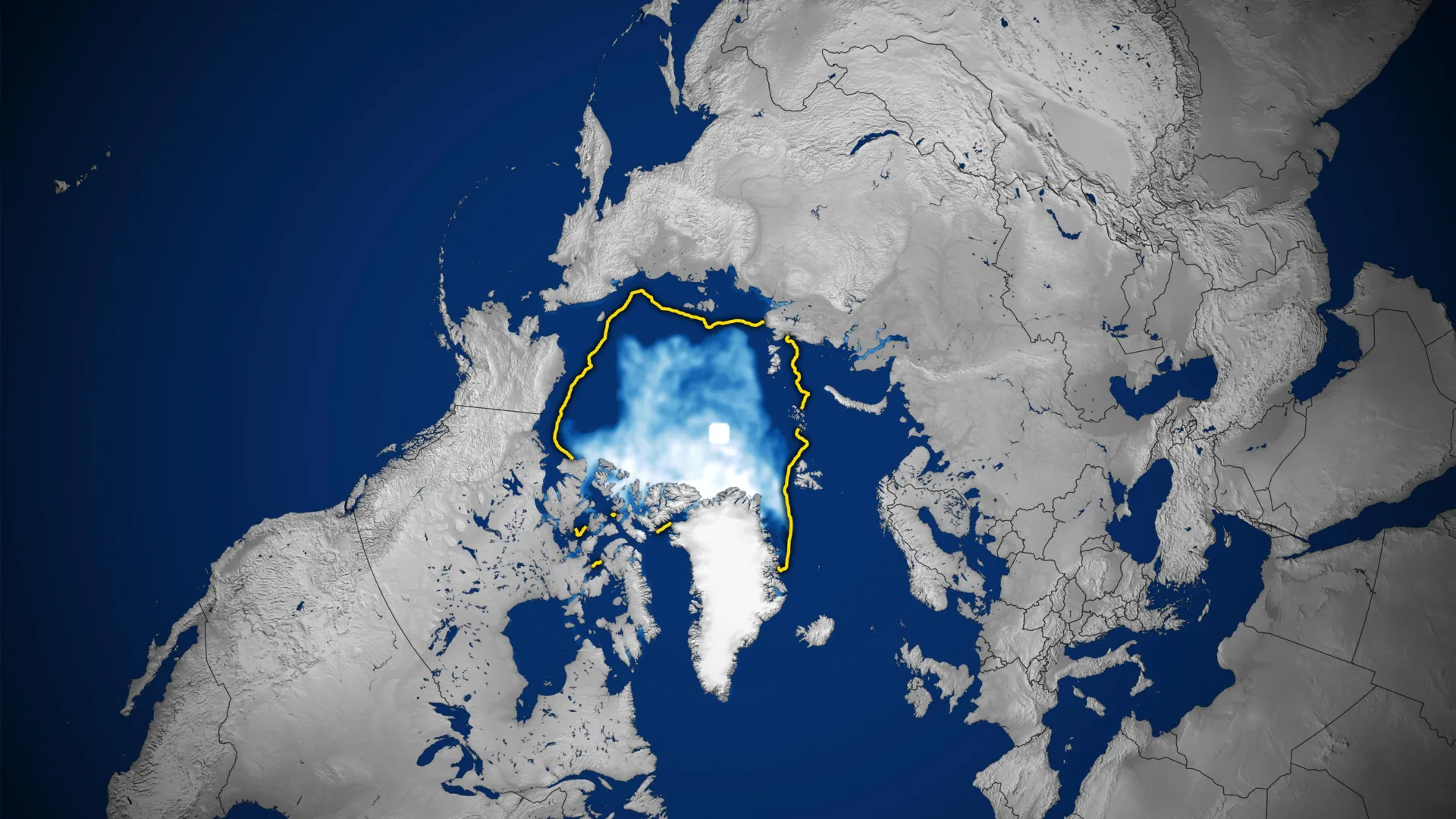
Arctic sea ice reached its annual low point on September 12, 2026, covering approximately 4.6 million square kilometres, according to NASA and the National Snow and Ice Data Center. That extent tied the September minimums recorded in 2008, 2010 and 2025 for the 10th-lowest level in the satellite record.
The ranking is one data point in a much longer transformation. Nearly five decades of satellite observations show that Arctic sea ice has declined at both ends of its seasonal cycle: the winter maximum, when the ocean’s ice cover is largest, and the late-summer minimum, when it is smallest.
Sea ice naturally expands through the dark winter months and retreats during warmer months, usually bottoming out in September. The annual rhythm continues, but the amount and character of ice remaining in the Arctic have changed substantially. Much of the surviving ice is younger and thinner, making it more vulnerable to melting and breakup.
A long record shows a persistent decline
Satellite monitoring has tracked Arctic sea ice continuously since late 1978, providing scientists with a record that now approaches five decades. The observations show a long-term downward trend that accelerated during the 2000s and produced a sequence of exceptionally low summer extents.
Every summer from 2007 through 2026 ranks among the 20 lowest September extents in the satellite record. The smallest September extent remains the 2012 minimum. The 2026 figure did not set a new record, but it adds to a striking consistency: low-ice summers have become the norm in the modern satellite era rather than rare exceptions.
Numbers alone do not capture the full shift. Ice that persists through multiple summers tends to be thicker and more resilient than ice formed during a single winter. As older ice becomes less common, seasonal conditions can have a greater effect on how much survives the melt season.

A recent pause does not erase the trend
The pace of summer sea-ice loss has not been uniform. During the past decade, September coverage has been comparatively stable relative to the rapid losses seen earlier in the record. That short-term slowdown is important for scientists studying the roles of weather, ocean conditions and climate variability.
It is not, however, evidence that the broader decline has been reversed. The underlying satellite record still shows that ice cover has contracted substantially in both summer and winter. A period without a new record low can coexist with a long-term loss of extent and with continuing changes in ice age and thickness.
This distinction is central to interpreting annual rankings. A tie for 10th-lowest is not a stand-alone climate diagnosis; it must be viewed alongside the long sequence of low years and the physical condition of the remaining ice. Scientists use those combined measurements to understand not just how much ice exists on a given day, but how likely it is to endure future melt seasons.
Why thinner, younger ice changes the Arctic
Sea ice is more than a surface indicator. Its bright surface reflects sunlight, while open ocean absorbs more energy. Changes in seasonal ice cover can therefore influence how the Arctic Ocean gains and stores heat. The ice also shapes marine habitats and affects communities, shipping routes and operations that depend on predictable conditions.
When more of the ice is young and thin, it can be more readily reshaped by wind, fractured by storms or melted during warm periods. That does not mean every year will decline in a straight line. Arctic sea ice responds to changing weather and ocean conditions from season to season. But the long-term reduction in durable ice leaves less margin for those variations.

The prospect of an almost ice-free summer
Scientists cited in the NASA Earth Observatory summary warn that the Arctic could experience a nearly ice-free summer before 2050. In this context, “nearly ice-free” does not mean every piece of Arctic sea ice disappears. It refers to very low September coverage, a threshold that would represent a profound departure from the conditions observed for most of human history.
The 2026 minimum therefore belongs to a larger story rather than a single-year spectacle. It shows an Arctic that still freezes and thaws with the seasons, but does so with less ice than in past decades and with remaining ice that is increasingly vulnerable.
Continued monitoring will be essential. The satellite record gives researchers a common measure for comparing one season with another, while observations of ice thickness, age and regional conditions help explain why any particular year rises or falls. Together, those measures make clear that the Arctic’s recent low-ice state is not simply an anomaly. It is a defining feature of a changing climate system.
This article is based on reporting by Science Daily. Read the original article.
Originally published on sciencedaily.com