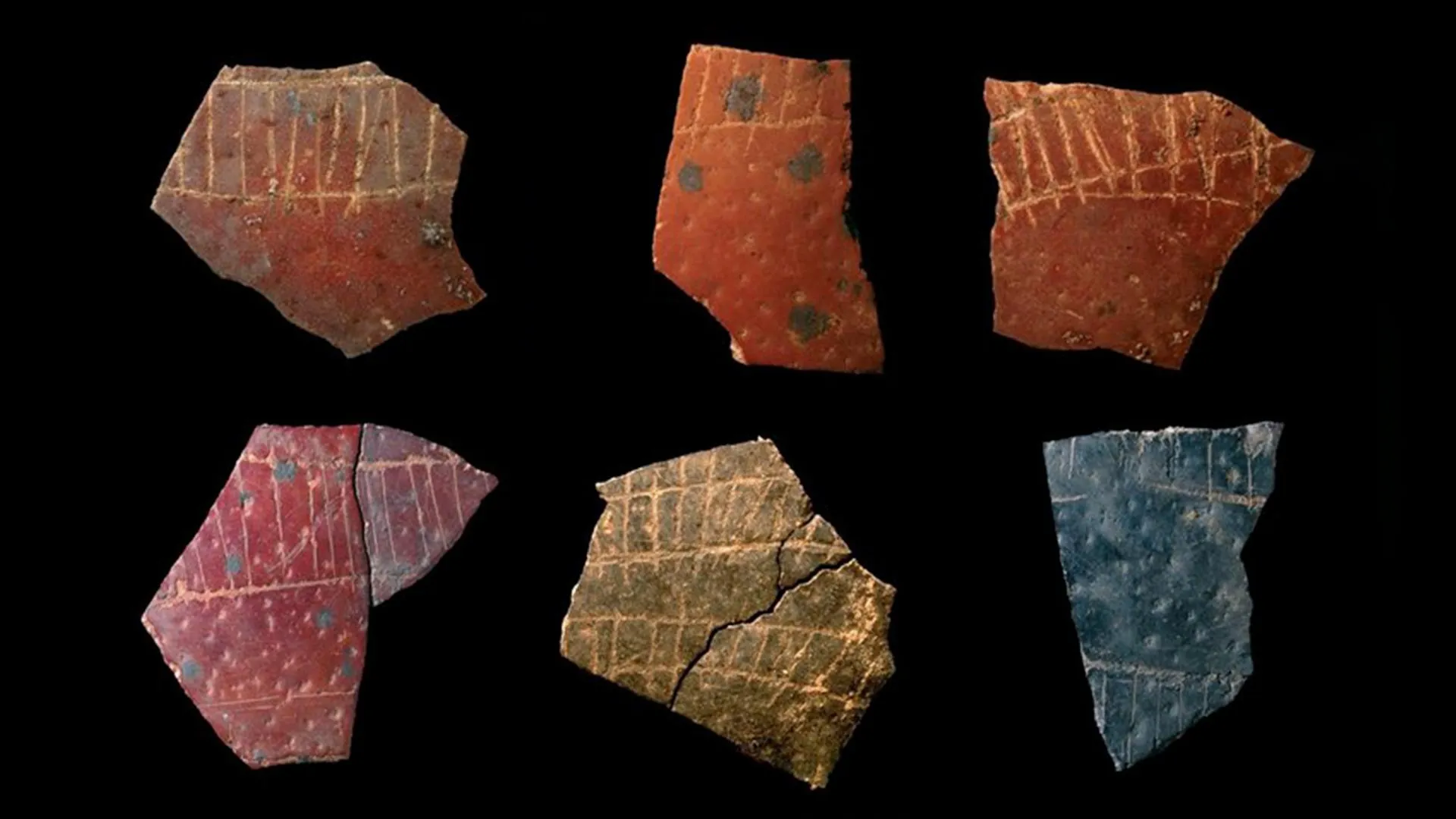
Ancient markings look less like doodles and more like design
More than 60,000 years ago, people in southern Africa were engraving ostrich eggshell containers with patterns that now appear strikingly systematic. According to a new study highlighted by ScienceDaily and attributed to researchers led by the University of Bologna, those marks were not just casual decoration. The team argues that the engravings followed recurring geometric principles, including parallel lines, right-angle relationships, grids, rotations, and repeated motifs.
That matters because it pushes the discussion beyond whether early humans could make symbolic marks at all. The stronger claim is that these engravers may have been applying rules, repeating visual structures, and in some cases planning a pattern before cutting into the shell. If that interpretation holds up, the fragments point to a sophisticated form of spatial reasoning deep in the Middle Stone Age.
What the researchers studied
The study focused on 112 engraved ostrich eggshell fragments recovered from three sites in southern Africa: Diepkloof and Klipdrift in South Africa, and Apollo 11 in Namibia. Ostrich eggshells in that period were likely used as water containers, making them everyday objects rather than rare ceremonial artifacts. That practical context is important. If repeated geometric engraving appeared on ordinary containers, it suggests structured visual behavior may have been embedded in routine life rather than restricted to exceptional objects.
Researchers applied geometric and statistical methods to reconstruct the direction, angle, and path of engraved lines. The summary says those techniques had not previously been applied to these artifacts in the same way. Their results reportedly showed that more than 80% of the configurations contained consistent spatial patterns. Right-angle relationships appeared repeatedly, as did parallel lines and more elaborate arrangements such as hatched bands, grids, and diamond-like motifs.
That consistency is the foundation of the paper’s argument. A few straight lines on a fragment could be accidental or improvised. But recurring structures across many fragments from multiple sites are harder to dismiss as random. The authors’ interpretation is that the engravings reflect a shared visual logic.

Why archaeologists care about “rules”
Claims about symbolism in early human artifacts are common, but claims about rule-based composition are more consequential. A repeated design grammar implies that the maker was not simply leaving a mark. Instead, the person may have been organizing space according to learned principles: keep lines parallel, repeat an angle, mirror a segment, or build a motif from smaller units.
That kind of organization sits near the boundary between decoration, notation, and communication. The study summary does not claim the engravings formed a writing system, and the available source text does not support going that far. But it does suggest a visual grammar “in embryo,” meaning a structured way of producing and perhaps recognizing patterns.
For archaeologists and cognitive scientists, that is important because it ties symbolic behavior to planning. If a design includes repeated spacing, right angles, and patterned bands, the maker may have been mentally representing the finished composition before executing it. In other words, the artifact may preserve not just the mark itself but evidence of foresight.
Daily tools, shared culture
The use of ostrich eggshells as portable containers adds another layer to the finding. Containers move with people. They are handled, seen, exchanged, and reused. If engravings on those containers followed recurring conventions, the patterns may have served as recognizable markers within a group, between groups, or across generations.
The study summary does not assign a single function to the markings, and that restraint is useful. They may have helped identify ownership, contents, lineage, or social affiliation. They may also have held aesthetic or symbolic value. What the research appears to establish more firmly is not why the patterns were made, but that they were organized with notable regularity.
That distinction matters because prehistoric interpretation often runs ahead of the evidence. Here, the source text supports a narrower but still significant conclusion: people were producing geometric designs with repeatable structure long before agriculture, cities, or formal writing.

What this changes and what it does not
The new analysis strengthens the idea that early Homo sapiens in southern Africa had advanced cognitive and cultural capacities. It suggests they were capable of abstract visual organization and perhaps of transmitting those conventions socially. The recurrence of the motifs across sites also supports the possibility that this was not an isolated experiment by a single individual.
At the same time, the evidence is still fragmentary in a literal sense. These are broken pieces of containers, not complete objects, and reconstruction always involves interpretation. The summary indicates that the team used quantitative methods to reduce subjectivity, but future work will likely test whether the same conclusions hold with larger samples or additional sites.
Even so, the study adds weight to a broader shift in human origins research. Instead of treating complex cognition as a late development tied to large monuments or dense settlements, more archaeologists are finding it in subtle, portable, everyday artifacts. The intelligence is not just in spectacular ruins. It is in pattern, repetition, and design on objects people carried through ordinary life.
A quieter kind of breakthrough
There is no spacecraft launch or gene-editing milestone here, but the result is still a meaningful development story. The fragments point to a long prehistory of ordered thought: an ability to impose structure on surfaces, repeat conventions, and perhaps imagine a finished pattern before making it real. That is one of the foundations of culture.
If the authors’ interpretation continues to withstand scrutiny, the engraved eggshells from southern Africa will stand as evidence that early humans were doing more than marking objects. They were working within a system of visual order. More than 60,000 years later, that order is still legible.
This article is based on reporting by Science Daily. Read the original article.

Originally published on sciencedaily.com


