A construction milestone beyond Earth
A robotic system developed by researchers at the California Institute of Technology has autonomously assembled part of a structure in orbit, according to a Caltech announcement summarized by ScienceDaily. The demonstration is described as the first time a structure has been autonomously constructed in space without astronauts carrying out the assembly work.
The result matters because launch vehicles impose hard limits on the size and shape of spacecraft hardware. Large antennas, telescope reflectors and solar-power systems must either fit inside a rocket fairing or be folded for launch and deployed later. Autonomous assembly offers another route: send compact components into orbit and have a machine build a larger structure there.
How the system works
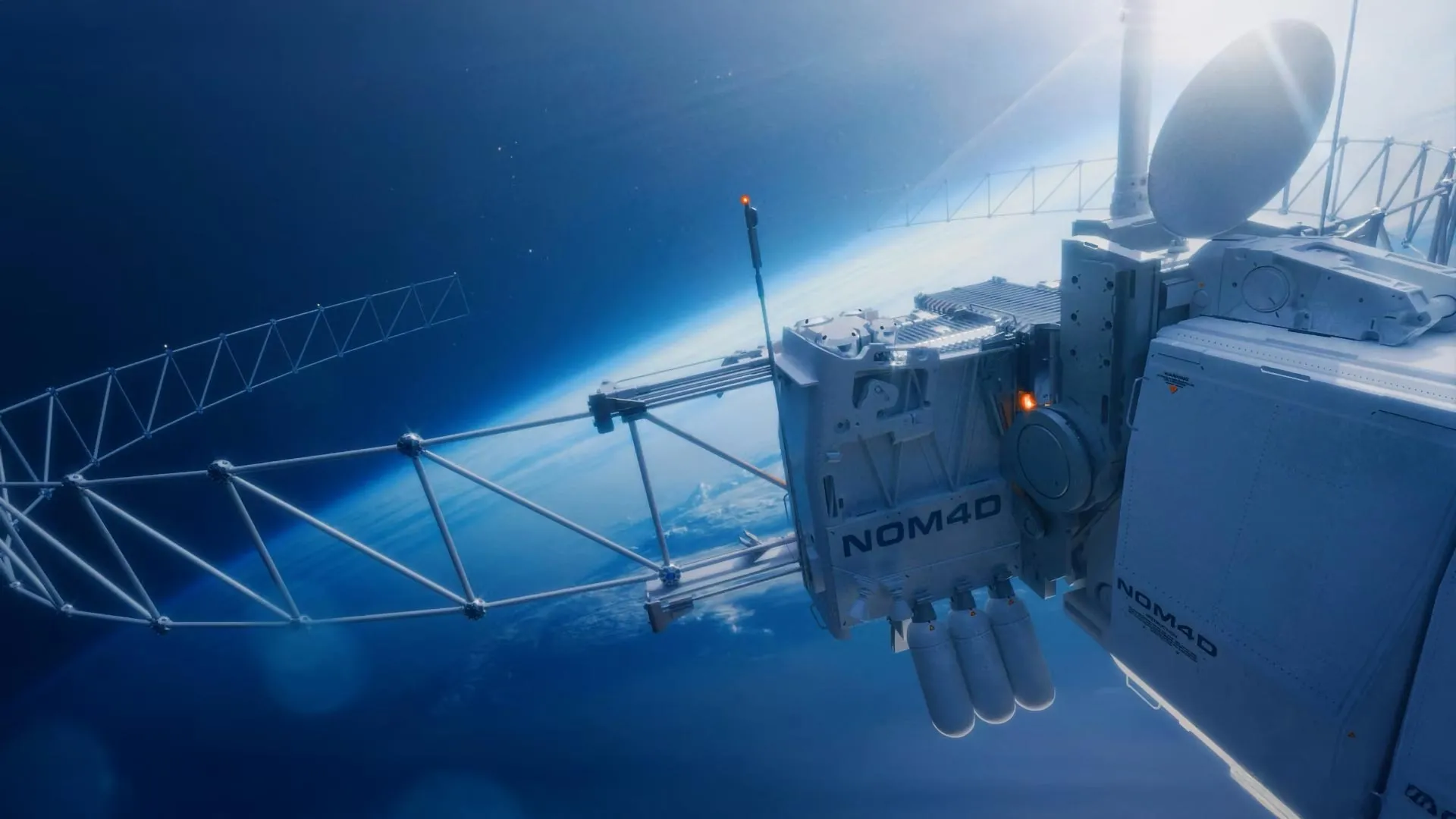
The work is part of DARPA's Novel Orbital and Moon Manufacturing, Materials, and Mass-efficient Design program, known as NOM4D. Caltech's Autonomous In-Space Tensioned Reflector Assembly, or ASTRA, demonstration uses an automated arm to retrieve structural tubes and connecting joints from nearby dispensers. The robot joins those components into repeated sections called bays, which together form a truss.
Caltech says the ASTRA system has been operating in orbit for six months while attempting to build a reflector antenna measuring 1.4 meters across. Its design combines composite-fiber tubes, aluminum connectors and a lightweight reflective surface made from Kapton, a polymer film commonly used on spacecraft. That mix illustrates the underlying engineering problem: the machine must position and join lightweight parts reliably in an environment where access for repair is limited.

Why autonomous assembly could change mission design
In-space construction could allow mission planners to design infrastructure around its operational purpose rather than around a rocket's payload envelope. A larger reflector could support communications or sensing systems that would be difficult to launch as a single intact object. The same basic approach could eventually support large scientific telescopes, communications antennas and orbital solar-power stations, all applications identified in the source material.
It also shifts some spacecraft complexity away from one-time deployment mechanisms and toward reusable robotic capability. Instead of requiring astronauts to connect individual pieces, a robotic arm can collect standardized elements from storage and create a larger framework. That is a potentially important change for missions far from Earth, where crew time is costly and human spacewalks carry significant operational risk.
A limited but important demonstration
The announcement does not present autonomous orbital construction as solved at large scale. It notes that technical difficulties and scheduling constraints affected the demonstration. But assembling part of a truss autonomously in orbit is a meaningful systems-level test: it requires components, storage, robotic manipulation and structural joining to work together outside a laboratory.
The next challenge will be moving from a relatively small proof of concept to structures with greater scale, more connections and useful operational loads. The engineering demands rise quickly as structures get larger, particularly for precision applications such as reflector antennas and telescopes. Even so, the Caltech demonstration provides evidence that autonomous assembly can be tested in the space environment rather than remaining solely a ground-based concept.

What comes next
DARPA's NOM4D program is exploring manufacturing and assembly methods intended to make very large structures possible in space and on the Moon. The ASTRA effort supplies a concrete orbital data point for that broader goal. If the approach matures, future missions could launch modular materials and let robotic systems construct the supporting architecture after reaching orbit.
For now, the main achievement is narrower but consequential: a robot has assembled part of a space structure autonomously. That capability could become a foundation for spacecraft and scientific instruments whose scale is no longer defined entirely by the dimensions of the rocket that carried their pieces off Earth.
This article is based on reporting by Science Daily. Read the original article.
Originally published on sciencedaily.com