Washington is trying to speed quantum progress without waiting for the security fallout
The White House has issued a pair of executive orders designed to tackle the quantum era from both directions: build useful quantum computing capacity faster, and harden U.S. systems before those machines can break current cryptography.
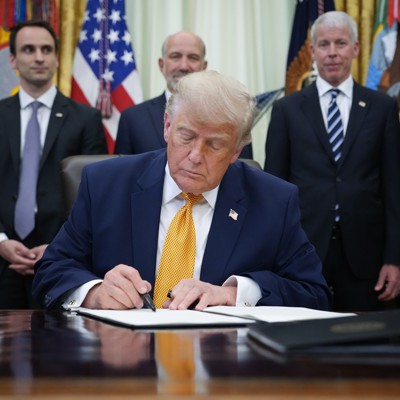
The orders, signed on June 22, 2026, reflect a policy view that quantum computing is no longer just a long-range research agenda. It is now a dual-track national issue involving industrial policy, scientific competition, cybersecurity, and infrastructure deadlines. One order launches what the administration calls “a national effort” to create a quantum computer capable of performing basic operations and improving quantum sensors. The other sets the federal government on a timetable to move toward cryptographic standards intended to resist quantum-enabled attacks.
National Cyber Director Sean Cairncross summarized the balancing act during the signing ceremony by saying innovation and security have to be balanced. That line captures the basic logic of the two orders: quantum capability is strategically valuable, but the same technological progress could undermine today’s encryption systems if governments and companies do not prepare early enough.
An industrial and scientific push for useful quantum systems
The first order, titled Ushering In The Next Frontier Of Quantum Innovation, is aimed at accelerating practical progress rather than simply sustaining broad research support. According to the supplied source text, it directs the creation of a “Quantum Computer for Application Development and Discovery Science Effort” at a Department of Energy facility. The order also includes measures to support quantum-computing supply chains, foster workforce development, and explore private-sector and international partnerships.
Those elements suggest a strategy that reaches beyond laboratory prototypes. Supply-chain support matters because advanced computing programs depend on specialized hardware, materials, and fabrication capabilities that can become strategic chokepoints. Workforce development matters because even if the underlying science advances, deployment will lag without enough engineers, researchers, and security specialists who understand how to build, maintain, and use the systems.
The order also expands the Quantum Information Science and Technology Counterintelligence Protection Team to study threats to domestic quantum-computing efforts. That provision places quantum not only in the science and innovation portfolio, but also in the national-security and counterintelligence domain. In other words, the administration is signaling that U.S. quantum work is valuable enough to defend as a strategic asset.

The second order addresses a problem experts have warned about for years
The companion order, Securing the Nation Against Advanced Cryptographic Attacks, focuses on the opposite side of the same technological curve. If large-scale quantum computers eventually become capable of breaking widely used public-key encryption schemes, then governments, critical infrastructure operators, and major enterprises face a long migration away from vulnerable systems. That migration is difficult because cryptography is deeply embedded in networks, software, devices, identity systems, and industrial controls.
The order assigns major roles to the Office of Management and Budget, the Department of Commerce, the Department of Homeland Security, the Cybersecurity and Infrastructure Security Agency, and the National Security Agency. The source text notes that the National Institute of Standards and Technology has already been leading the effort to identify and test new encryption algorithms, so the executive action appears to convert years of technical preparation into firmer implementation pressure.
Most significant are the dates. The order sets a 2030 deadline to update key elements of critical infrastructure and a 2031 deadline for what it calls “high-impact environments.” Those dates matter because post-quantum migration is widely understood to be a long, complex process. Systems often cannot be swapped overnight, and some data must remain secure for many years after it is created or transmitted.
Why the deadlines matter even before quantum computers arrive
The urgency behind post-quantum planning does not depend on the immediate existence of a fully capable quantum computer. The policy concern is that encrypted data stolen today could be stored and decrypted later if quantum capabilities mature. That is one reason migration timelines have become more concrete in recent years, and why deadlines carry weight even if the most powerful quantum systems are still under development.
In the Defense One report, Garfield Jones of QuSecure called the order on post-quantum cryptography an “unambiguous signal” of the need for action. That wording fits the broader message of the administration’s approach. Rather than treating quantum security as a distant compliance issue, the order frames it as infrastructure modernization with a fixed clock.
The pairing of the two executive orders is what makes the policy moment notable. Governments often separate innovation programs from defensive modernization, but in quantum computing the two are inseparable. The same federal push that helps develop more capable systems also increases pressure to replace cryptographic foundations that may not survive a future breakthrough.

A coordinated federal posture, but real execution will be the test
On paper, the two orders provide a coordinated posture: invest in useful quantum capabilities, protect the supply chain and research base, expand counterintelligence protections, and force progress on quantum-resistant encryption. In practice, success will depend on execution across many agencies and sectors that move at very different speeds.
Building useful quantum systems is a hard technical challenge. Migrating critical infrastructure to new cryptographic standards is a different kind of hard: organizational, expensive, and spread across legacy environments that are often difficult to inventory, let alone replace. The federal deadlines create structure, but they do not remove that complexity.
Even so, the orders mark a shift from abstract preparedness to more explicit state direction. The administration is placing quantum computing in the category of technologies that require simultaneous acceleration and containment. That is a sign of maturity in the policy conversation. Quantum is no longer being discussed only as a future scientific milestone. It is being treated as a near-term governance problem with strategic, economic, and security consequences.
For industry, infrastructure operators, and federal agencies, the message is straightforward: quantum capability development is being pushed forward, and quantum-resilient security is no longer optional planning for some distant horizon. The timetable has started.
This article is based on reporting by Defense One. Read the original article.
Originally published on defenseone.com