A Navy ship built drones while underway
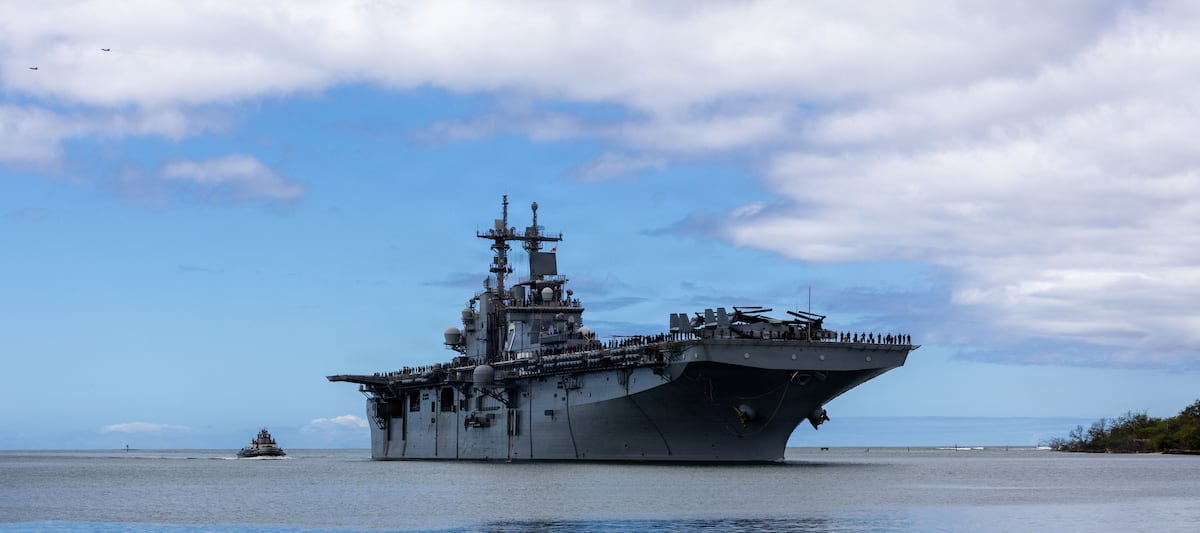
Firestorm Labs has demonstrated a manufacturing concept the U.S. Navy has been seeking for years: producing useful unmanned systems and repair parts aboard a warship at sea instead of waiting for shore-based resupply. According to Defense News, the company used its containerized xCell microfactory aboard the Wasp-class amphibious assault ship USS Essex to manufacture more than 1,000 parts and 12 first-person-view Squall drones while the ship was transiting toward the Rim of the Pacific exercise, or RIMPAC 2026, in Hawaii.
The significance of the demonstration is straightforward. Naval operations become much more difficult when ships have to rely on long supply chains for replacement parts, small systems, or rapidly consumable tools. In a contested environment, resupply flights and shipments can be delayed, intercepted, or made prohibitively risky. A containerized factory that travels with the ship offers a different model: produce what is needed on site, use sailors or embarked personnel to assemble systems, and cut the time between demand and delivery from days or weeks to hours.
That is the promise Firestorm Labs is now trying to prove in real operating conditions, not just in a workshop on land.
What was built aboard USS Essex
Defense News reports that Firestorm Labs manufactured 12 of its proprietary, 3D-printable Squall drones aboard the Essex and produced more than 1,000 total parts during the transit. Service members then assembled the drones and later flew them as adversary aircraft during a counter-drone exercise at RIMPAC 2026 in Hawaii.
The output was not limited to complete aircraft. The team also printed mechanical test components to assess the performance of the 3D printer used in the shipboard production effort. In addition, they fabricated repair parts requested by crew members aboard the Essex. That broader mix is important because it shows the microfactory was not operating as a single-purpose drone line. It was being used as a general expeditionary manufacturing node that could support both experimentation and practical ship needs.
The conditions also mattered. Defense News said waves as high as 12 feet hit the ship during the effort. Building precision parts and drone components in that environment is a much stronger test than demonstrating the same capability in a controlled, stationary setting.
The microfactory concept
Firestorm calls the xCell a factory-in-a-box. The idea is to package additive manufacturing and related production capability into a transportable container that can be deployed aboard naval vessels and used to produce unmanned aerial systems and spare parts close to the point of need.
That model fits neatly with a broader military push toward modular, portable, rapidly deployable capabilities. A container can be moved by ship, truck, or other transport assets, installed where required, and used without needing a permanent industrial base nearby. For a service operating across long maritime distances, the appeal is obvious.
Why the Navy cares about manufacturing at the edge
The Navy's interest in this approach is part of a larger shift in logistics and force design. Defense News notes that the Defense Department, and the Navy in particular, is focused on modular payload capabilities that can deliver mission-ready assets quickly. The point is not only to save money or improve convenience. It is to improve resilience under pressure.
If a ship can produce drones, replacement components, or repair items on board, it reduces dependence on vulnerable logistics chains. Firestorm summarized the value in a social media release cited by Defense News, arguing that every part printed on deck is one less part that must be flown or shipped across contested waters. The same logic applies to time. A repair that would otherwise wait for a supply run can potentially be addressed much sooner if the required part can be made on station.
For naval commanders, that means more options. A warship or expeditionary formation that can replenish certain categories of equipment internally may be able to stay in theater longer and absorb disruptions more effectively.
The demonstration lines up with a broader Pentagon push
This at-sea production test did not happen in isolation. The article places it within a wider Pentagon and Navy effort to use containerized systems as deployable military capability. Chief of Naval Operations Adm. Daryl Caudle announced a "containerized capability campaign plan" in March at the McAleese Defense Programs conference, outlining a vision in which transportable containers housing capabilities such as drones and weapons could be deployed to regions around the world.
Defense News also points to a related Pentagon move from May: framework agreements with Anduril, CoAspire, Leidos, and Zone 5 to acquire more than 10,000 containerized missiles over three years beginning in 2027 under the Low-Cost Containerized Munitions program. Those agreements address munitions rather than additive manufacturing, but the common thread is the same. The department wants capabilities that can be packaged, moved, and fielded quickly without relying on fixed installations.
In that context, Firestorm's demonstration aboard Essex looks less like a niche experiment and more like an early proof point for a logistics and force-structure direction the Pentagon is already endorsing.
Why small drones matter
The use of first-person-view drones is also notable. These systems are relatively low cost, tactically flexible, and increasingly relevant across modern military operations. Printing them at sea suggests a future in which ships might replenish some categories of expendable or attritable unmanned systems without needing to wait for a port call or replenishment ship.
Even if the current output is modest, 12 drones is enough to illustrate the operational logic. A shipboard factory does not need to replace every function of an industrial base to be valuable. It only needs to produce enough of the right items, fast enough, to make a meaningful difference during deployment.
The real test is reliability and scale
The demonstration is promising, but it also points to the next questions the Navy will have to answer. Can a microfactory operate consistently over long deployments? How broad a range of parts and systems can it produce to an acceptable standard? How much crew time and training does it require? And how easily can it be integrated into normal shipboard workflows without creating new burdens?
The Essex test begins to address the baseline issue of feasibility. It shows that additive manufacturing of drones and repair parts can happen aboard a ship at sea under nontrivial conditions. What comes next is determining whether the model is dependable and scalable enough to become part of routine naval operations.
- Firestorm Labs built more than 1,000 parts and 12 drones aboard USS Essex while the ship was underway.
- Service members assembled and later flew the drones in a RIMPAC 2026 counter-drone exercise.
- The Navy and Pentagon are already pursuing wider containerized capability programs, making shipboard production a natural fit for current logistics thinking.
The larger strategic appeal is clear. In future conflicts, logistics may be attacked as aggressively as frontline forces. A military that can manufacture some of what it needs closer to the fight gains resilience. Firestorm Labs' work aboard USS Essex does not solve that challenge on its own, but it offers a concrete example of how distributed, containerized production could help the Navy sustain operations when supply chains are strained.
This article is based on reporting by Defense News. Read the original article.
Originally published on defensenews.com