CBO puts a massive price tag on a proposed new Navy capital ship
A Congressional Budget Office report has attached an extraordinary estimated cost to the Navy's proposed Trump-class guided missile battleship program: $275 billion for a 15-ship fleet built between 2028 and 2056. According to the supplied report, the first vessel alone would cost $23.4 billion, while the remaining 14 ships would come in at roughly $18 billion each.
That pricing would place the first ship well above the approximate $13.3 billion cost cited for the USS Gerald R. Ford, the Navy's premier nuclear-powered aircraft carrier. Cost comparisons between ship classes are never perfect, but the signal here is hard to miss. Even before a keel is laid, the proposed program sits in a range that would reshape debates over fleet composition, industrial capacity, and whether the Navy can realistically absorb such an effort alongside existing shipbuilding demands.
What the proposed battleship would be
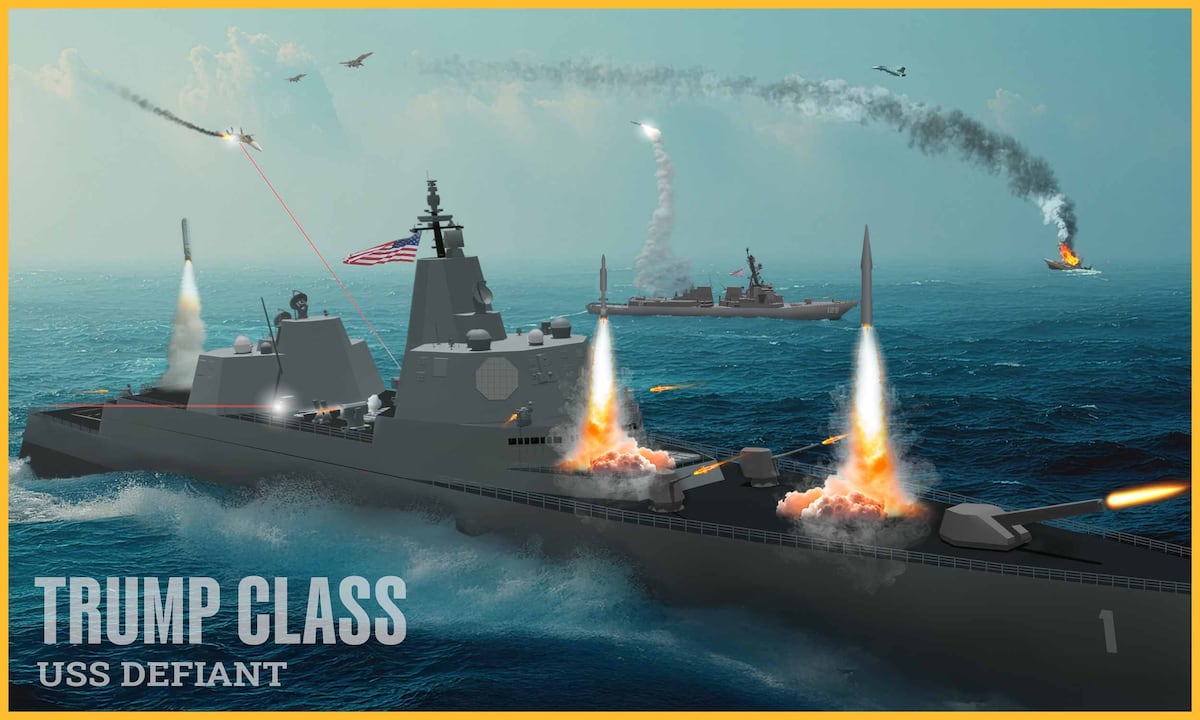
The report describes a 35,000-ton nuclear-powered surface combatant designated BBG(X), or the Trump-class guided missile battleship. If built to the described specifications, it would be the largest surface combatant in the world and the biggest such vessel the Navy has produced since World War II. It would also be more than three and a half times the size of an Arleigh Burke-class guided missile destroyer and more than twice the size of a Zumwalt-class guided missile destroyer.
The planned weapons suite outlined in the source text is expansive: anti-air, land-attack, and anti-ship missiles, plus hypersonic missiles, nuclear cruise missiles, large lasers, and a rail gun. On paper, that combination points to a ship conceived as both a symbol and a magazine, built to carry substantial firepower across multiple mission sets. In concept, it is a return to the idea of a dominant surface combatant, but equipped for missile warfare and future-directed energy roles rather than the gun duels associated with historical battleships.
Still, the CBO estimate underscores that technical ambition and budget feasibility are separate questions. A ship that tries to combine nuclear propulsion, extreme scale, and a broad mix of advanced weapons will inevitably test the limits of procurement discipline. The report does not just present a total cost; it frames the industrial and scheduling burden that would come with trying to make the plan real.
Industrial capacity may be as important as money
The source text says the Navy's plan would require construction of 15 Trump-class battleships from 2028 to 2056, effectively a new battleship about every other year while the service also continues building two DDG-51 destroyers annually. That is not merely a procurement question. It is a throughput question for a shipbuilding base that has struggled for years with delays, cost growth, and performance shortfalls.
The CBO report, as summarized in the supplied material, says total tonnage of large surface combatants to be constructed by 2058 would need to increase by 60 percent. By 2035, shipyards would need to produce 12 percent greater tonnage under the newer plan than under the 2025 version. Those are major industrial deltas in a sector where capacity cannot be expanded quickly or cheaply.
That concern is reinforced by the additional context in the source text from a Government Accountability Office review released in March. According to that report, the Navy's shipbuilding system has spent nearly two decades underperforming: not enough ships have been built, newly constructed vessels have failed to function as expected, and deliveries have slipped by as much as three years. In testimony cited in the supplied article, GAO official Shelby S. Oakley said unrealistic expectations on cost and schedule have diverted resources and left programs and builders operating in what she described as a perpetual state of triage.
That history matters because the proposed battleship program would not enter a healthy industrial environment. It would enter a stressed one. Any estimate for the Trump-class therefore has to be read against the background of an ecosystem that has repeatedly struggled to execute less ambitious plans.
Why the debate will extend beyond the Navy
A $275 billion estimate guarantees scrutiny from Congress, defense planners, and outside analysts. Supporters can argue that a nuclear-powered large surface combatant might reduce operating costs over time, a point the source text says the report raises. They may also argue that the Navy needs a more survivable, heavily armed platform for a future maritime fight shaped by long-range missiles and contested logistics.
Critics, however, will likely focus on concentration of risk and affordability. A single ship with a price tag above $23 billion is not just expensive. It represents an opportunity cost measured in other vessels, munitions, maintenance, and readiness accounts. If shipyards are already strained, adding a giant nuclear surface combatant could crowd out other priorities or deepen delays elsewhere in the fleet.
The politics are likely to be just as complex as the industrial math. Battleships carry symbolic weight that destroyers and frigates do not. That can help a program gain attention, but it can also sharpen skepticism if the concept appears more aspirational than executable. The CBO estimate does not settle that debate. It does, however, force it onto more concrete ground.
The numbers now define the conversation
- CBO estimates the full program at $275 billion.
- The first ship is projected to cost $23.4 billion.
- The remaining 14 ships are estimated at $18 billion each.
- The fleet would be built from 2028 to 2056.
- Shipyards would need substantially higher output to support the plan.
For now, the most important shift is not the design itself but the scale of the commitment implied by the estimate. Large naval programs are often defended in strategic language, but budgets and shipyard capacity eventually determine whether concepts survive. With the CBO's new figure on the table, the Trump-class proposal moves from headline-grabbing idea to a test of whether the United States is willing and able to fund, build, and sustain a new kind of capital ship at historic cost.
This article is based on reporting by Defense News. Read the original article.
Originally published on defensenews.com