A first public look at the B-1B with ARRW
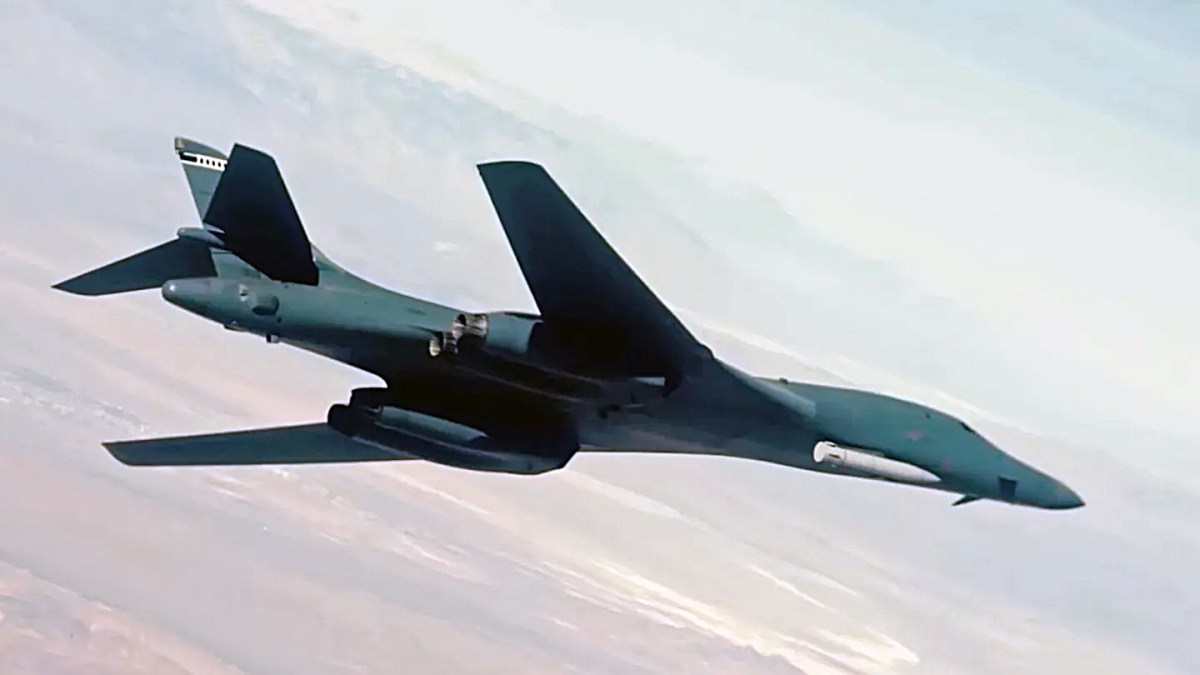
The U.S. Air Force has publicly released imagery showing a B-1B Lancer bomber carrying an AGM-183 Air-launched Rapid Response Weapon, or ARRW, for the first time, according to reporting from The War Zone. The imagery came from a brief clip posted by Edwards Air Force Base, though the exact date of the flight shown was not clear from the supplied report.
Even with that uncertainty, the release is significant. Public imagery of a weapon integrated on an aircraft is not the same thing as a combat deployment, but it is a visible sign that the pairing has moved beyond theoretical planning. In this case, it links two military programs that had each faced questions about their future: the B-1B bomber and the ARRW hypersonic missile.
The supplied report says the B-1B is now officially slated to remain in service until 2037, while the aircraft has also been earmarked as a hypersonic weapons test platform. At the same time, ARRW, which had once been expected to become the U.S. military’s first operational hypersonic weapon, has re-emerged after a period of uncertainty. The Air Force now wants to develop an improved version as well as a separate air-launched ballistic missile.
Why the bomber matters in the hypersonic picture
The B-1B has an unusual place in this story because it connects legacy airpower with an emerging weapons category. The bomber was originally designed with up to eight external hardpoints for stores, and the supplied report notes that the Air Force had also developed pylons that would have allowed it to carry nuclear-tipped AGM-86B air-launched cruise missiles. After the Cold War, however, the aircraft lost its nuclear mission and the external pylons fell largely into disuse for weapons carriage.
That historical background makes the new imagery important. It shows the Air Force revisiting physical capacity that existed in the aircraft’s design but had not been central to its more recent identity. In effect, the B-1B is being adapted back into a platform for large external stores at a time when the Pentagon is still working through how to field air-launched hypersonic systems.
The supplied report also points out that as far back as 2020 the Air Force had detailed plans to add ARRW to the B-1B. The newly released imagery does not create that effort, but it provides a clearer public marker that the concept is advancing in visible form.

ARRW’s return from uncertainty
The missile itself is a major part of the story. According to the report, ARRW had at one point been expected to become the first operational hypersonic weapon in U.S. service, but its future later came into question. The new budget request now appears to pull it back into relevance, with the Air Force seeking an improved version.
That is meaningful because hypersonic programs often move through cycles of promotion, testing setbacks, restructuring, and redefinition. A public image of ARRW under a B-1B does not resolve those programmatic questions, but it does show the weapon still has institutional momentum. Budget language can be abstract. Aircraft imagery is concrete. When the two line up, the signal becomes harder to dismiss.
The report also mentions a separate air-launched ballistic missile effort, suggesting the Air Force is not betting on a single path. Instead, it appears to be broadening its portfolio of long-range high-speed strike options. That makes ARRW less of a one-off and more of a piece within a larger strike modernization effort.
The strategic message
There is also a signaling component to the public release itself. Hypersonic weapons occupy an outsized place in military competition because they are associated with speed, range, and the challenge they pose to defenses. Showing a bomber carrying such a weapon sends a message about ongoing development and the willingness to invest in operationally relevant launch platforms.
The B-1B’s expected service life extension to 2037 reinforces that message. Rather than treating the bomber solely as a legacy asset nearing retirement, the Air Force is tying it to future capability experiments and potentially future strike roles. That makes the aircraft a bridge between older bomber force structure and newer weapons concepts.
For observers of defense procurement, the story is therefore about more than a single photograph or clip. It is about the relationship between platform longevity and weapons evolution. If an existing bomber can be adapted to support new classes of missiles, it may preserve value in the fleet while reducing the pressure to wait for entirely new aircraft before expanding strike options.

A visible step, not a final answer
The supplied reporting leaves some important questions open, including exactly when the imagery was captured and what stage of integration or testing it represents. Those limits matter, and they caution against overstating the milestone. Public carriage imagery does not prove readiness, deployment, or near-term operational availability.
Still, it marks a clear development. The Air Force has now allowed the public to see a B-1B carrying ARRW, and that comes at a time when the bomber’s future has been extended and the weapon’s future has been revived. Taken together, those facts indicate movement in a program area that had appeared uncertain.
For the Pentagon, that may be part of a broader effort to rebuild credibility around hypersonic strike progress. For the defense industry, it is a reminder that older platforms can remain relevant if they are reworked for new payloads. For military watchers, it is one of the clearest recent visual signs that the Air Force is still actively shaping its air-launched hypersonic roadmap.
This article is based on reporting by twz.com. Read the original article.
Originally published on twz.com