Cheap drones are still forcing expensive military adaptations
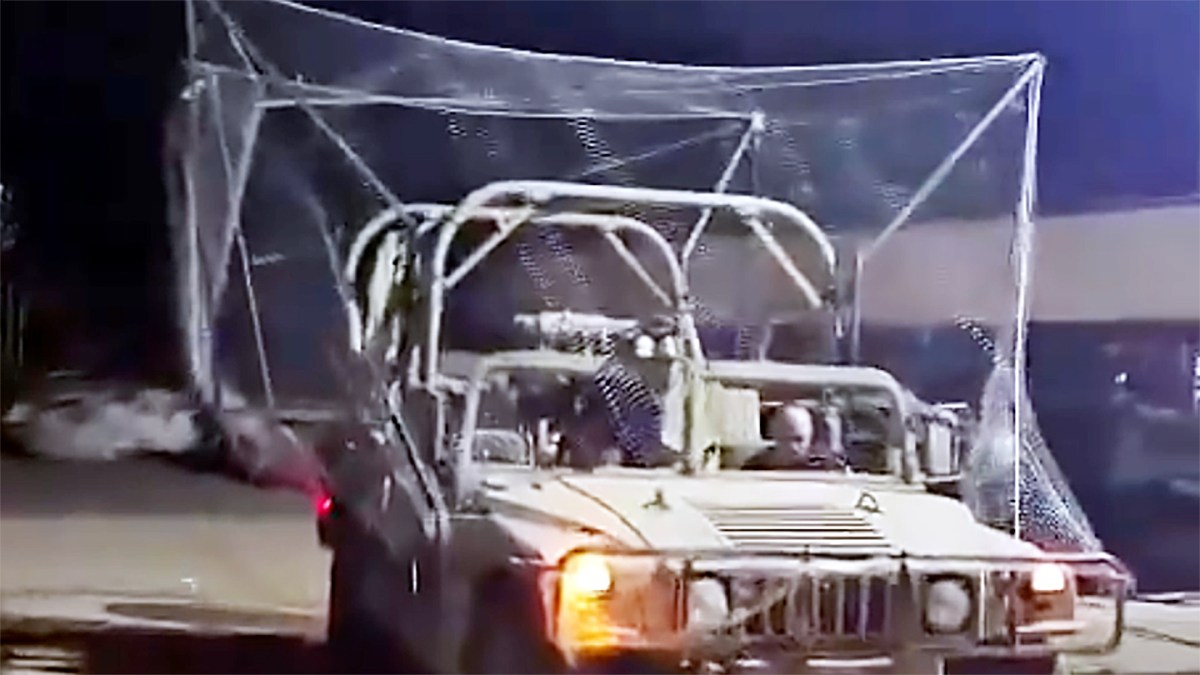
Israel’s apparent move to add anti-drone netting to combat vehicles is a small visual change with large strategic implications. According to reporting from The War Zone, the Israel Defense Forces are now using netting on at least some vehicles as Hezbollah intensifies attacks with fiber-optic controlled first-person-view drones. The image is striking precisely because it looks improvised: a combat vehicle fitted with extended arms and draped mesh, more like a cage or a goal frame than a traditional armor upgrade.
That visual awkwardness is the point. It captures a basic reality of the modern drone battlefield. Armies do not always get to wait for elegant, integrated solutions. When small attack drones can reach troops and vehicles quickly, cheaply and repeatedly, field expedients begin to matter. Netting may not look like a high-technology answer, but its appearance signals that the threat has become urgent enough to justify visible, immediate adaptation.
The War Zone says Hezbollah has been increasing its use of fiber-optic controlled FPV drones against Israeli troops and vehicles over the course of the nearly two-month-old war. Those attacks are continuing even amid what the report describes as an ongoing but extremely fragile ceasefire. That detail matters because it shows how drone pressure can persist even in periods that are not defined by full conventional maneuver. FPV systems can sustain threat levels in contested zones without the attacker needing to rely on more complex airpower or larger munitions.
What the netting is meant to do
The logic behind anti-drone netting is straightforward. The War Zone explains that drones may become caught in nylon or mesh metal netting and be disabled before striking the vehicle directly. In some cases, netting may also keep an exploding drone farther from occupants, potentially reducing lethal effects. But the report is equally clear that this second scenario is limited and depends heavily on the vehicle type and the warhead involved.
That caveat is crucial. Netting is not a magic shield. It can complicate an incoming drone’s final attack geometry, interfere with detonation position or absorb some of the impact pathway, but it does not erase explosive force. The article explicitly notes that, based on the video being circulated, the level of protection provided to passengers in the open-top Israeli vehicle would likely be very limited if a trapped drone’s warhead detonated.
In other words, netting is best understood as a mitigation layer, not a full defensive system. It may improve survival odds in some cases. It may reduce the effectiveness of some drones. It may buy seconds, distance or chance. But it does not solve the core problem that very small, maneuverable attack drones can reach vehicles at close range.
The controversy behind the adaptation
The emergence of the netting comes amid rising frustration inside Israel over what is perceived as the IDF’s inability to counter Hezbollah’s FPV drone threat. The War Zone says that frustration intensified after an attack in which an Israeli soldier was killed and six were wounded. A follow-up strike was then launched while the wounded were being evacuated, narrowly missing the helicopter involved in the medical response.
That sequence illustrates why FPV drones have become such a destabilizing battlefield tool. They do not only threaten front-line vehicles. They can also menace response operations, casualty evacuation and the wider rhythm of movement in contested areas. Once a force believes it may be watched and attacked during rescue or extraction, the psychological and operational impact expands beyond the initial strike.
The controversy also shows the political burden of drone adaptation. Commanders can no longer treat small drones as a secondary nuisance while focusing attention only on missiles, artillery or armored threats. When low-cost FPV systems repeatedly penetrate defenses or inflict casualties, public criticism grows quickly, especially when visible countermeasures appear late or improvised.
Why options remain limited
The War Zone’s framing is notable because it does not oversell the netting. The article states plainly that options for defending against FPV attacks remain very limited. That assessment aligns with a broader pattern visible across recent conflicts. Small drones occupy an uncomfortable space for defenders: they are cheap enough to be used in quantity, maneuverable enough to evade simple countermeasures and close enough to the target in their final approach that even good detection may not produce enough response time.
Electronic warfare can help in some cases, but fiber-optic controlled drones are a particular challenge because they are not relying on the same vulnerable radio-control link that many other small drones use. Physical barriers can help in some cases, but they are partial measures and can interfere with mobility, visibility or weapon operation. Hard-kill defenses exist, but they are rarely easy to scale economically against swarms of low-cost threats.
This is why improvised-looking protection systems keep appearing in modern combat. Forces are trying to create enough friction to break the drone kill chain, even if they cannot reliably shut it down entirely. Netting belongs to that category of battlefield adaptation: imperfect, limited, but potentially worthwhile when the alternative is direct exposure.
A sign of the wider drone war
Israel’s use of vehicle netting should be read as more than a local tactical adjustment. It is another indicator of how rapidly the offense-defense balance has shifted around small drones. A weapon that was once easy to dismiss as improvised or low-end now compels established militaries to modify vehicles in visible ways and under active pressure.
The larger lesson is uncomfortable but clear. The spread of FPV drone warfare is compressing the time available for doctrinal adjustment. Armies are being forced to experiment in real time, often with partial solutions, because the threat evolves faster than procurement cycles. Netting on a vehicle is therefore not just a protective measure. It is evidence of a battlefield where adaptation itself has become a survival requirement.
For now, the appearance of these systems on Israeli vehicles underlines a stark fact: defending troops from close-range drone attack remains one of the hardest unsolved problems in contemporary warfare. The tools being used against that threat may look simple, but the challenge they represent is not.
This article is based on reporting by twz.com. Read the original article.
Originally published on twz.com