Amphibious shipping is back at the center of force planning
The U.S. Marine Corps and Navy are intensifying a joint effort to expand and stabilize the nation’s amphibious fleet after a steep readiness decline in 2025 exposed how fragile the force has become. Speaking at the 2026 Sea-Air-Space Conference, Marine Corps Commandant Gen. Eric Smith said the two services share a “unified sense of purpose” around increasing both the size and availability of amphibious ships. His comments point to a broader recognition that the existing fleet is failing to meet operational demand at a time when global commitments remain heavy.
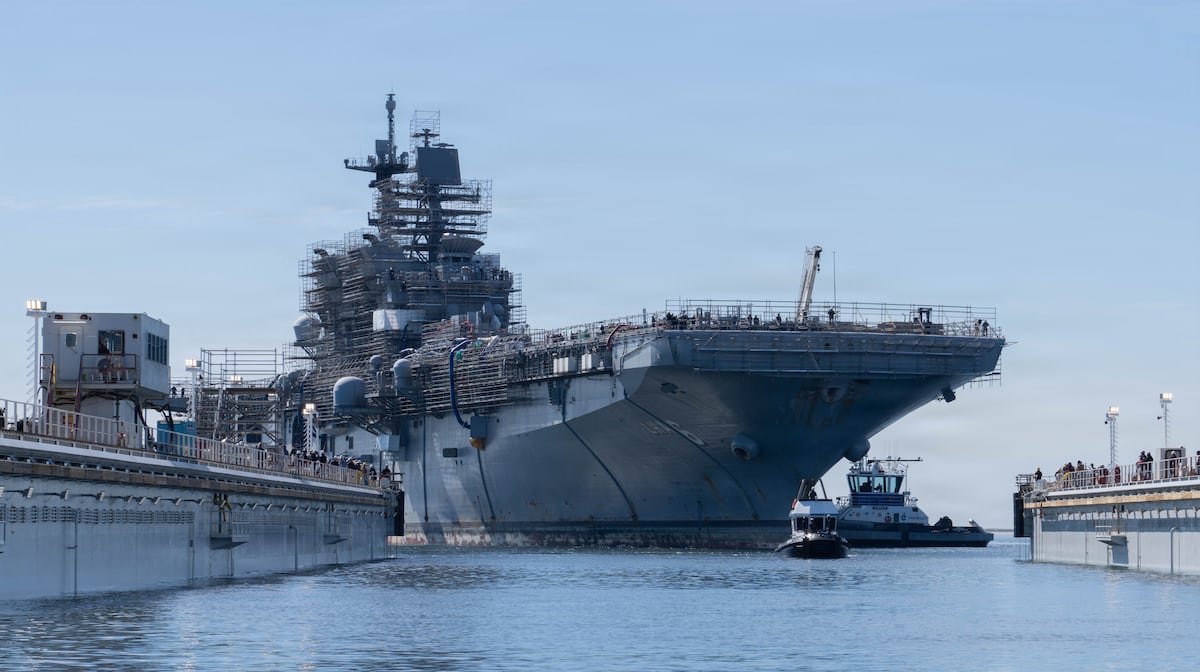
Smith said the current inventory of 31 amphibious ships is not enough to satisfy the presence requirements requested by combatant commanders. That is a significant statement because amphibious shipping sits at the core of traditional Marine expeditionary operations. These ships are not simply transports. They are the platforms that allow Marines to move, stage, deter and, if needed, conduct operations from sea to shore. When too few are available, readiness problems ripple outward into deployment cycles, regional presence and crisis response timelines.
Readiness fell hard in 2025
The urgency behind the new push is tied to last year’s performance. According to the source report, the readiness rate for amphibious ships dropped to 41% in 2025. That decline mattered immediately. Increased U.S. operations in Latin America and the Caribbean aimed at fighting drug cartels placed additional strain on the fleet, while the shortage of ready ships contributed to a five-month delay in Marine Expeditionary Unit deployments. Those delays are not an abstract scheduling issue. Marine Expeditionary Units are built to provide flexible, forward-deployed response options, and prolonged disruption can narrow the military’s available choices during periods of tension.
As of April 2026, only four amphibious ships were deployed across North America, the Caribbean and the Pacific, according to Navy data cited in the report. At the same time, the amphibious assault ship USS Tripoli was operating in the Arabian Sea in support of the U.S. blockade of the Strait of Hormuz, and USS Boxer had deployed from the Pacific to the Middle East. The report also noted that the Tripoli Amphibious Ready Group was sent to the Middle East in mid-March as reinforcements for the war in Iran. In other words, the fleet is being asked to sustain broad geographic commitments while starting from a shallow bench.
A three-part plan to get more capacity
Smith outlined three ways the services intend to improve the situation. The first is to extract more usable time from the ships already in the inventory. He said the Navy and Marine Corps are optimizing maintenance schedules and “fourth-generation runs” to increase near-term availability. The operational logic is clear: if the fleet cannot grow quickly enough through procurement alone, the fastest immediate gains must come from keeping current hulls ready for service and reducing avoidable downtime.
The second element is targeted service life extension. Smith said the services plan to invest in the “best of breed” ships, meaning vessels that remain in the strongest mechanical and physical condition. Rather than apply resources evenly across the class, this approach prioritizes platforms most likely to deliver reliable returns if kept in service longer. In budgetary terms, that is a pragmatic middle path between accepting fleet erosion and waiting for entirely new ships to arrive years later.
The third element is procurement of new and more capable ships, a step Smith said requires congressional support and predictable long-term investment. He argued that the shipping industry needs increased, sustained and dependable funding if the fleet is to expand meaningfully. That point goes beyond a one-year appropriation debate. Shipbuilding works on long timelines, and stop-start funding patterns can undermine industrial planning, workforce stability and production efficiency. If the services are serious about fleet growth, they need the budget environment to support it consistently.
The budget question is only partly answered
Smith said President Donald Trump’s proposed fiscal year 2027 budget represents a substantial “down payment” on what he described as a generational effort to rebuild amphibious capacity, but he made clear that it is only a starting point. That phrasing matters. It suggests the Marines do not view the problem as a short-term readiness dip that can be corrected with a narrow maintenance package. They see a structural issue that demands years of follow-through from both civilian leadership and uniformed leadership.
The emphasis on predictability also reflects a long-running tension in defense planning. The military can identify capability gaps, but industrial recovery requires a stable demand signal. Without it, suppliers and shipbuilders face pressure to stretch limited orders, delay investments or absorb uncertainty that ultimately raises cost and slows output. Smith’s remarks therefore carry both an operational and an industrial warning: the United States cannot expect a credible amphibious fleet if it treats shipbuilding as a sporadic priority.
Traditional amphibious power and littoral mobility
Even as he argued for rebuilding traditional amphibious capacity, Smith said the Marine Corps is also focusing on littoral mobility, the ability of Navy and Marine forces to move to and from shore and operate in coastal environments. He described the Indo-Pacific as the world’s most challenging environment because of its scale and noted that most of the Pacific falls within the littorals. That framing shows the Corps trying to avoid a false choice between legacy amphibious operations and newer concepts tailored to dispersed maritime geography.
The strategic challenge is to do both at once. The Marines say they can never walk away from core amphibious capabilities, but the operating environment is changing and demand for flexible movement in contested coastal zones is growing. That means the fleet problem is not only about quantity. It is also about whether the available ships and associated mobility concepts match the missions commanders are now asking for.
The joint Navy-Marine push marks an important moment because it aligns the two services publicly around the same diagnosis: the current fleet is too small, too strained and too unreliable for the mission set being assigned to it. Whether that consensus translates into a larger, healthier amphibious force will depend on execution in maintenance yards, discipline in service-life extension choices and sustained congressional support for shipbuilding over time.
This article is based on reporting by Defense News. Read the original article.
Originally published on defensenews.com