The Pentagon is pushing beyond drone launchers toward self-sustaining swarms
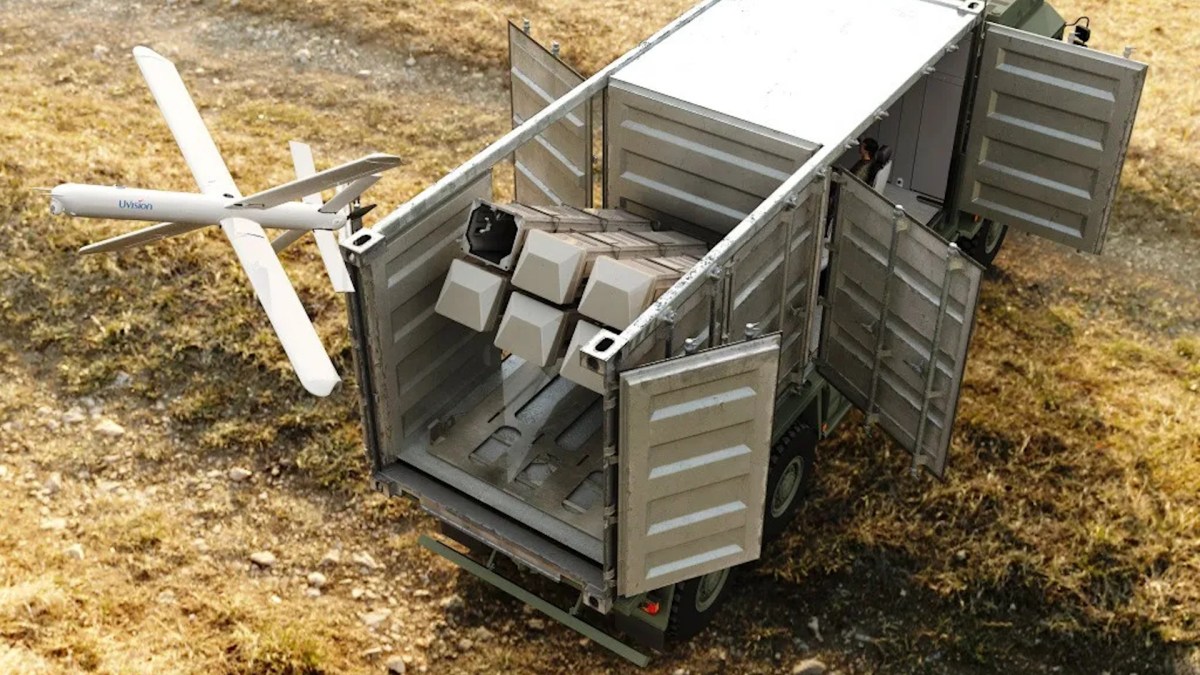
DARPA is seeking concepts for containerized drone systems that can do much more than release aircraft into the air. According to the source material, the agency wants remotely operated containers that can launch, recover, and otherwise support drones with a high degree of autonomous operation, forming part of an “autonomous constellation” that could network as many as 500 drones at once.
The request points to a notable shift in military thinking. The problem is no longer just how to build more drones. It is how to field distributed systems that can hide in plain sight, survive in contested environments, and keep a swarm operating with minimal infrastructure.
Why containers matter
Containerization offers obvious tactical advantages. A launcher or support node hidden in an unassuming form factor can be moved through commercial-style logistics channels, pre-positioned in sensitive areas, or dispersed across land and maritime environments. In military terms, that widens the threat envelope and complicates an opponent’s defensive picture.
The source explicitly frames this as a system that could be deployed in contested areas or even positioned behind enemy lines. That makes the concept fundamentally different from traditional airbase-centered drone operations. Instead of requiring large amounts of visible infrastructure, a swarm could emerge from a distributed network of hard-to-identify support points.
DARPA’s interest also goes beyond launch. The agency is asking for systems that can recover drones and provide support functions, addressing one of the major operational weaknesses of many smaller unmanned aircraft. Commercial Group 1 through Group 3 systems are often limited in endurance, payload, and electrical power, and when used at scale they usually demand substantial basing and recovery arrangements. DARPA appears to want to break that dependency.
Lessons from recent conflicts
The source links DARPA’s thinking to recent examples from Ukraine and the Middle East. It cites Ukraine’s Operation Spiderweb covert drone attacks on Russian airbases and Israel’s near-field attacks from within Iran during the opening phase of the 12 Day War as demonstrations of the value of launching drone effects from unexpected locations.
Those examples matter because they show how relatively low-cost unmanned systems can achieve strategic surprise when geography and attribution become ambiguous. If launch points are mobile, concealed, or embedded in ordinary-looking containers, warning time shrinks and defensive coverage becomes much harder to optimize.
DARPA’s concept extends that logic. Rather than treating each drone attack as a one-off event, the agency is exploring whether swarms can be sustained as a networked battlespace presence. That would move operations from isolated strikes toward persistent, adaptable constellations performing surveillance, reconnaissance, or kinetic missions.
A swarm at meaningful scale
The number in the source material is striking: up to 500 drones at once. At that scale, the challenge is not simply mass. It is coordination, power management, communications resilience, maintenance, and recovery. A swarm that large only becomes useful if it can function as an integrated system rather than a crowd of expendable aircraft competing for bandwidth and control.
That is why autonomy is central to the request. Human operators cannot micromanage hundreds of vehicles in a fast-moving contested environment. DARPA is clearly interested in systems that can distribute decisions, adapt to losses, and maintain mission effectiveness without constant direct control.
The implications are broad. A 500-drone autonomous constellation could perform layered reconnaissance, electronic support, strike, decoy, or relay functions simultaneously. It could also create severe dilemmas for defenders by saturating sensors and forcing choices about what to intercept first.
What this says about future warfare
The request reflects a broader transition in military technology from platform-centric thinking to system-centric thinking. A containerized swarm node is not impressive as a standalone object. Its importance comes from what it enables: hidden basing, scalable mass, distributed autonomy, and operational persistence.
This also suggests the Pentagon is absorbing lessons from both state and non-state drone innovation. Recent conflicts have shown that cost imbalances matter. Expensive defenses can be strained by waves of cheaper, networked systems. If launch and recovery become more portable and more covert, the offense-defense balance shifts further.
For adversaries, that means more uncertainty about where a drone threat begins. For planners, it means logistics, concealment, autonomy software, and recovery mechanisms are becoming as strategically important as airframes themselves.
Where the concept still faces constraints
A request for information is not a fielded program. Many hard engineering problems remain unresolved in the public record, including how such systems would secure communications, manage power, handle maintenance, and recover damaged or low-endurance drones under fire. Autonomy at scale also brings command, safety, and targeting questions that become more complex as the number of aircraft rises.
Still, the direction is clear. DARPA is asking industry to think in terms of deployable ecosystems rather than individual drones. The most interesting part of the request is not the container itself. It is the ambition to create a largely self-sustaining unmanned battlespace architecture that can appear quickly, operate with limited support, and present threats from almost anywhere.
That is a meaningful evolution in military capability design. If DARPA can translate the concept into workable systems, containerized swarms may become one of the most disruptive force-multipliers of the next drone era.
This article is based on reporting by twz.com. Read the original article.
Originally published on twz.com