An anniversary jet takes to the air
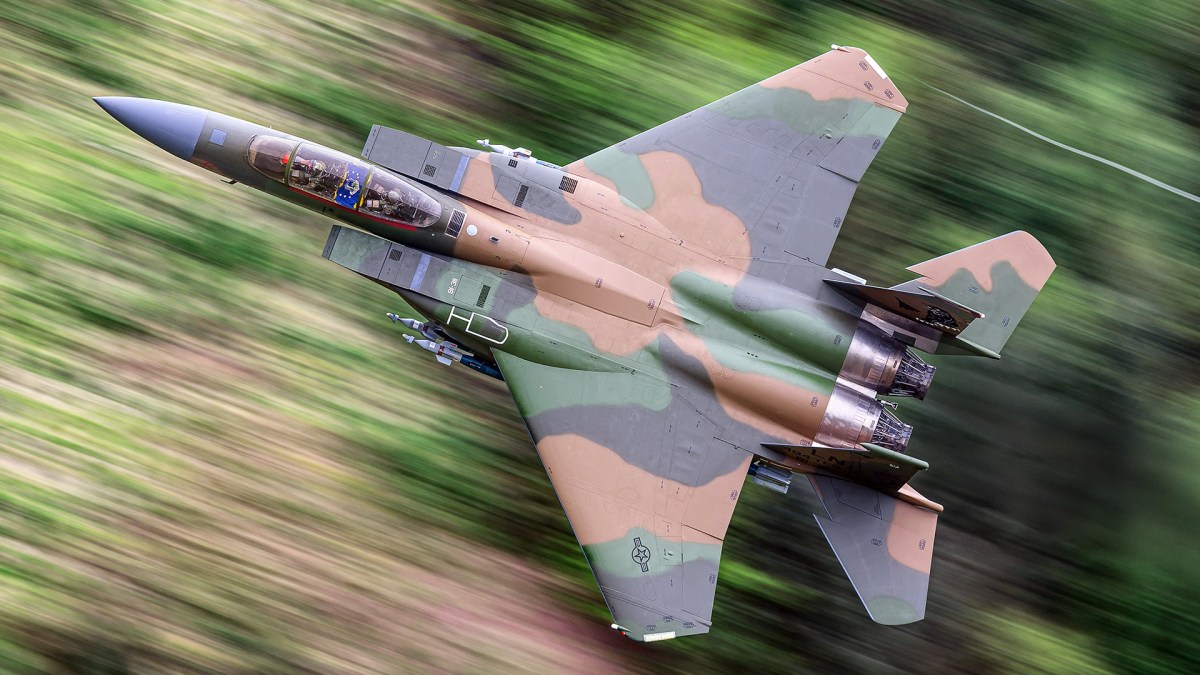
A U.S. Air Force F-15E Strike Eagle painted to commemorate the 40th anniversary of Operation Eldorado Canyon has now made what appears to be its first recorded flight in the special scheme. The aircraft, assigned to the 48th Fighter Wing at RAF Lakenheath, was photographed flying the Mach Loop in Wales while carrying eight inert GBU-12 laser-guided bombs, turning what might have been a routine training sortie into a highly visible act of institutional remembrance.
The aircraft, serial 91-0311, had already been unveiled on April 28 at RAF Lakenheath. But its flight through the famous low-level routes of North Wales gave the paint scheme a broader public debut and tied the jet’s symbolism to the kind of tactical flying long associated with strike aviation. For aviation observers, that first airborne appearance matters: commemorative liveries are designed to be seen, and this one was built to connect today’s Strike Eagle force with one of the most scrutinized missions in the 48th Fighter Wing’s history.
A modern fighter carrying the visual memory of the F-111F
The paint scheme intentionally recalls the F-111F Aardvark aircraft flown by the same wing during the 1986 U.S. raid on Libya. Instead of the standard Strike Eagle finish, the jet wears a camouflage pattern in two shades of green and tan, along with the original 494th Tactical Fighter Squadron marking and a red tail band. The tails also carry the wording “40 years Eldorado Canyon,” the 494th panther emblem, an F-111 silhouette, and the 48th wing’s Statue of Liberty insignia.
The result is less a decorative update than a deliberate cross-era visual bridge. The U.S. Air Force often uses heritage markings to reinforce continuity between current units and past combat operations, but this aircraft goes further by making the Strike Eagle function as a rolling memorial to a specific mission and a specific predecessor type. Even the choice to leave the nose radome in standard gray emphasizes that this is still an operational F-15E, not a museum piece.
Why KARMA 52 is on the nose
One of the most consequential details on the aircraft is the inscription “Karma 52” on the nose, placed alongside another F-111 silhouette. That refers to KARMA 52, the Lakenheath-based F-111F serial 70-2389, the only F-111 lost during Operation Eldorado Canyon. During that raid, the aircraft was armed with four GBU-10 laser-guided bombs. Its loss has remained one of the enduring personal and historical markers of the operation.
Commemorative aircraft often celebrate victory, lineage, or unit pride in abstract terms. This one includes a specific reminder of the operation’s cost. That makes the jet notable not only for its appearance but for the way it balances public spectacle with a more sober historical message. The aircraft celebrates the squadron’s legacy, but it does so while naming an aircraft that did not come home.
A training sortie with symbolic weight
According to the source account, the aircraft departed Lakenheath as EAGLE 31 alongside a wingman, then took fuel from a KC-135 Stratotanker before heading to North Wales. After the low-level portion of the mission, the pair flew to the Holbeach Air Weapons Range, where the inert bombs were dropped. On paper, the mission profile fits squarely within normal combat training. In context, the details matter because they underscore that this was not a static showpiece event but an operational flight involving aerial refueling, terrain-following routes, and weapons-range work.
That combination adds credibility to the message the Air Force is trying to send. Heritage in military aviation carries more force when it is attached to present-day readiness rather than ceremonial display alone. Flying the jet through the Mach Loop with a bomb load made the connection between past strike missions and current expeditionary capability visible in a single sortie.
Why the flight drew attention
The Mach Loop is one of the most photographed low-level military flying areas in the world, and any unusual aircraft passing through it is likely to gain immediate attention among aviation enthusiasts. A specially painted Strike Eagle carrying a heritage scheme linked to a famous Cold War-era raid was always going to stand out. But the broader interest goes beyond spotting culture. The flight arrived at a moment when air forces are increasingly focused on how to sustain tradition and identity while their fleets, weapons, and strategic priorities change.
The F-15E is a very different aircraft from the F-111F it visually evokes, and the mission environment of 2026 is not the mission environment of 1986. Yet units still rely on lineage to explain who they are and what kind of work they inherit. In that sense, this aircraft is a communications tool as much as a tactical platform.
More than an eye-catching paint job
The anniversary Strike Eagle’s first recorded flight matters because it turns a static tribute into a living one. RAF Lakenheath’s F-15Es remain front-line aircraft. When one of them wears a scheme built around Operation Eldorado Canyon, flies low-level routes, and drops inert precision-guided training weapons, it does more than mark a date on a calendar. It shows how the Air Force uses current operations to carry historical memory forward.
That is ultimately why the sortie resonated. It was visually dramatic, historically loaded, and operationally grounded. For a unit with deep ties to one of the most remembered strike missions of the late Cold War, that is exactly the point.
This article is based on reporting by twz.com. Read the original article.
Originally published on twz.com