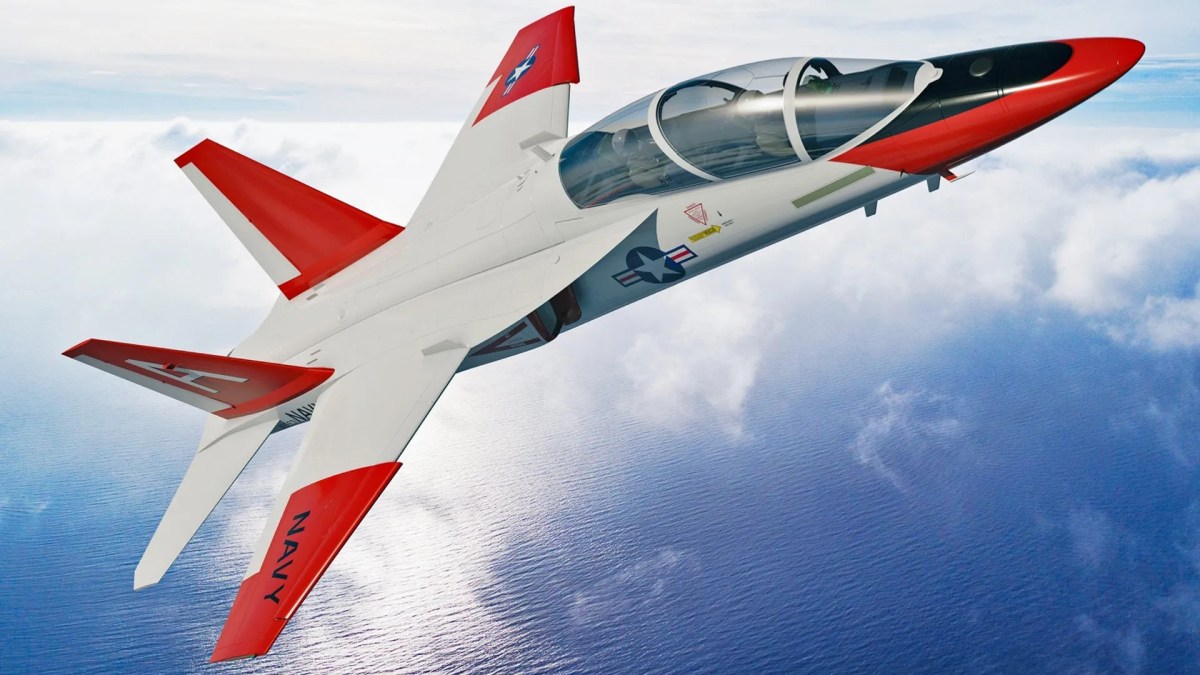
Boeing has dropped out of the Navy's jet trainer competition
Boeing will not bid on the U.S. Navy's Undergraduate Jet Training System competition, shrinking the field for one of the service's most consequential pilot-training procurements. The company had previously planned to offer a Navy-tailored version of the T-7A Red Hawk, the jet trainer it is building for the U.S. Air Force.
The decision leaves two known competitors in the race, according to The War Zone's report: a Sierra Nevada Corporation team now partnered with Northrop Grumman and General Atomics, and a Leonardo-Textron team. Lockheed Martin and Korea Aerospace Industries had already exited in April.
What the Navy is trying to replace
The competition is meant to replace the Navy's T-45 Goshawk fleet. The service issued a formal request for proposals in March and currently plans to acquire 216 new jet trainers. The source text says the Navy has just under 200 T-45s in inventory today.
This is not a minor fleet refresh. The trainer selected for UJTS will shape how future tactical jet pilots are prepared for naval aviation, including under a training approach that no longer requires carrier qualifications or even simulated touch-and-go carrier landings at bases on land.
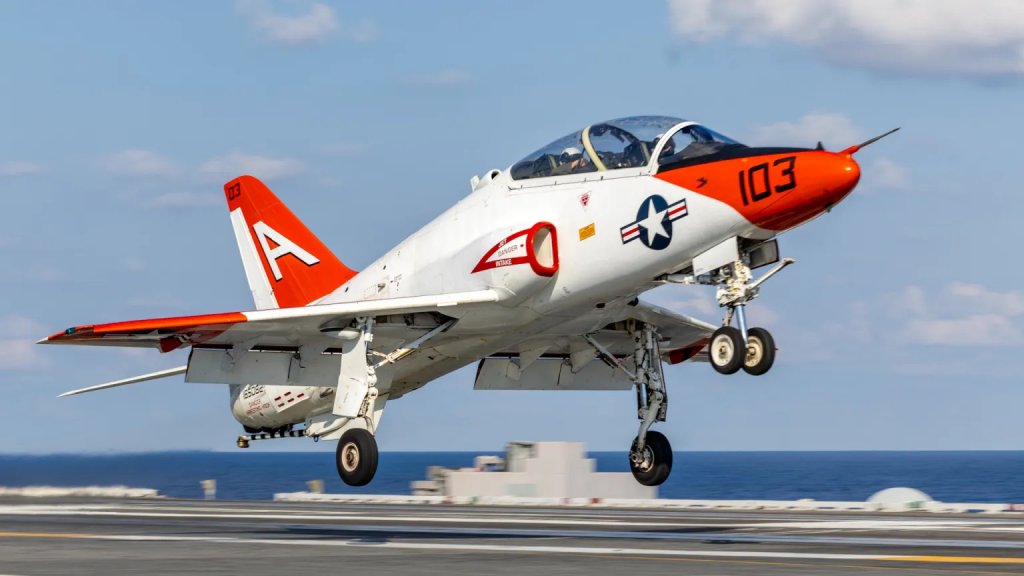
That shift makes the platform decision more than a hardware purchase. It is tied to a broader redesign of naval aviation training, one that could alter cost, syllabus structure, and the kind of aircraft the Navy sees as best suited to the early pipeline.
Why Boeing says the T-7A no longer fits
Boeing told The War Zone that the T-7A does not meet the Navy's current UJTS requirements. The company said it had informed the service that it would not bid on the existing request for proposals after a careful evaluation.
The report says Boeing links that decision to the General Electric F404 turbofan. That detail matters because propulsion choices can cascade into requirements around performance, integration, logistics, and long-term support. Whatever the precise mismatch, Boeing's public position is that the current Navy requirement and the T-7A-based approach are no longer aligned.
At the same time, Boeing emphasized that it remains committed to delivering the T-7A as a modern training solution for fourth-, fifth-, and sixth-generation pilots as requirements evolve. That phrasing suggests the company still sees value in the aircraft's broader training role even if the present Navy competition is no longer the right fit.
A narrower field changes the procurement dynamic
With Boeing out and Lockheed Martin already gone, the competition has tightened dramatically. That affects leverage, evaluation risk, and the degree of design variation available to the Navy. The War Zone notes that the remaining known competitors are both offering twin-engine designs.
A smaller field can simplify downselection, but it can also reduce flexibility. For the Navy, that means the remaining bids carry more weight. For industry, it means the contest is now more clearly about which of the surviving teams can convince the service that its design best supports the future training curriculum.
It also highlights how requirements can reshape procurement even before final proposals are submitted. Boeing's withdrawal is a reminder that not every aircraft that looks viable on paper will survive contact with service-specific demands.
What the story tells us
The most important takeaway is not just that one company stepped aside. It is that the Navy's next trainer is being defined by a changing concept of pilot preparation, and that concept is influencing who can credibly compete. Boeing's exit makes the race easier to map, but it also underscores how specialized the requirement has become.
The winner will inherit an outsized role in naval aviation's training pipeline. Boeing, for now, will not be that winner.
- Boeing will not bid on the Navy's Undergraduate Jet Training System program.
- The service plans to buy 216 new trainers to replace the T-45 Goshawk fleet.
- Two known competitors remain: an SNC-led team and a Leonardo-Textron team.
- Boeing says the T-7A does not meet the Navy's current UJTS requirements.
This article is based on reporting by twz.com. Read the original article.
Originally published on twz.com