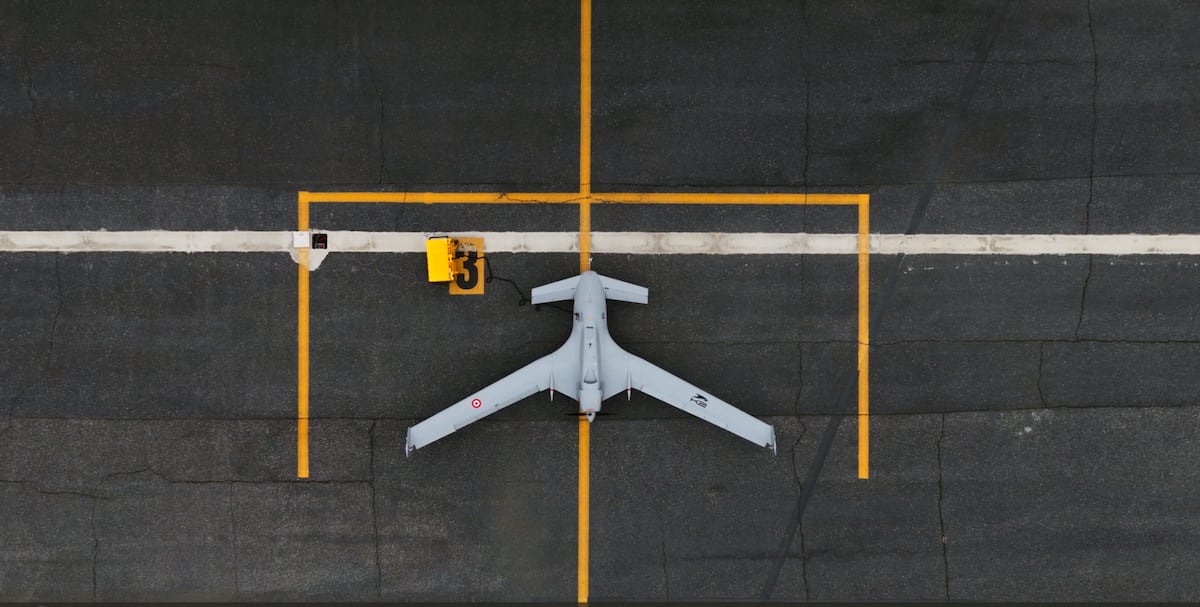
A New Era in Autonomous Strike Weapons
Turkish defense company Baykar has released flight test footage and performance data for its K2 loitering munition, showcasing autonomous swarm behavior and navigation in GPS-denied environments. The tests represent a significant leap forward in one-way attack drone technology, addressing one of the most pressing vulnerabilities on the modern battlefield: electronic warfare.
The K2 is a fixed-wing platform measuring 5.1 meters in length, with a 10-meter wingspan and a maximum takeoff weight of 800 kilograms. Of that weight, 200 kilograms is allocated to a warhead payload. Baykar states the K2 can travel more than 2,000 kilometers, cruise at over 200 km/h, and remain airborne for more than 13 hours — positioning it as a long-endurance precision strike option for military forces seeking alternatives to expensive cruise missiles.
Swarm Intelligence Without Satellite Signals
What distinguishes the latest K2 test results is the platform's ability to operate and coordinate without relying on global navigation satellite systems. GPS jamming and spoofing have emerged as dominant forms of electronic warfare in recent conflicts, particularly in Ukraine, where drone operators frequently encounter degraded or denied satellite signals. Baykar's engineers designed the K2's navigation architecture specifically to contend with this environment.
In the test scenarios released by the company, five K2 platforms flew in an AI-assisted swarm formation, using onboard sensors, cameras, and software to determine their relative positions to one another without external satellite guidance. Each aircraft completed all assigned tasks while maintaining formation — a capability that could allow military forces to overwhelm defenses through coordinated simultaneous attacks from multiple vectors.
The system uses terrain-referenced visual navigation, scanning ground features through gimbal and underside cameras to derive positional estimates. This approach allows the K2 to read the landscape beneath it as a substitute for satellite-derived coordinates — a technique that becomes increasingly important as adversaries develop more sophisticated jamming capabilities.
Datalink Architecture and Targeting
The K2 carries an electro-optical and infrared gimbal camera that provides day and night reconnaissance capability alongside a visual target lock-on function for terminal guidance. The datalink architecture supports both line-of-sight and beyond-line-of-sight satellite communications, giving operators flexibility in how they manage strikes at extended ranges.
Coordinate-based targeting allows operators to pre-program strike coordinates, while the visual lock-on function enables dynamic retargeting against moving or newly identified objects. Combined with the platform's extended endurance, this makes the K2 suitable for both preplanned precision strikes and time-sensitive targeting scenarios.
Affordable Mass: The Strategic Calculus
Baykar has been explicit about the K2's market positioning: it is designed to be cheap enough to field in large numbers, reducing dependence on high-cost precision munitions. This philosophy reflects a broader shift in military thinking prompted by the conflict in Ukraine, where high rates of ammunition consumption have strained the stockpiles of both sides and their suppliers.
The ability to launch five or more K2s in coordinated swarms amplifies this affordability argument. Rather than expending a single expensive missile against a hardened target, forces could deploy multiple loitering munitions simultaneously, saturating defenses and increasing the probability of a successful strike. Swarm attacks are also more difficult for air defense systems to intercept because they require rapid engagement of multiple threats from different directions.
Baykar already manufactures the widely exported TB2 drone and the more advanced Akinci, both of which have seen combat use in Libya, Ukraine, Azerbaijan, and elsewhere. The K2 represents the company's push into the loitering munition segment — a market that has exploded since Iran-supplied Shahed drones demonstrated the destructive potential of inexpensive autonomous weapons in the Ukraine conflict.

GPS Jamming as the Defining Design Requirement
The prevalence of GPS denial in modern warfare has reshaped drone design requirements across virtually every program. Navies are experimenting with inertial navigation backups, while drone manufacturers have turned to optical flow sensors, terrain matching, and visual simultaneous localization and mapping to maintain precision in contested electronic environments.
Baykar's terrain-referenced approach for the K2 mirrors developments in Western programs, including US Navy efforts to equip Tomahawk cruise missiles with terrain contour matching to reduce GPS dependence. The convergence of these design choices across different defense ecosystems reflects a consensus view that future conflicts will be characterized by severe electromagnetic interference.
The K2 tests come as NATO allies are conducting Cold Response 2026, a large-scale Arctic exercise in Norway that is itself stress-testing drone operations in challenging environments. Norwegian reconnaissance units are simultaneously refining techniques for hiding from surveillance drones while deploying their own unmanned systems for deep reconnaissance — a microcosm of the drone-versus-counter-drone dynamic now shaping military doctrine globally.
Implications for Regional Conflicts
Turkey's Baykar has carefully cultivated a reputation as a supplier of sophisticated but relatively affordable military technology to a diverse customer base, including Ukraine, Azerbaijan, and several African nations. The K2, with its extended range and swarm capability, could find buyers among countries seeking asymmetric options against larger adversaries.
The timing of the announcement is notable. With the Strait of Hormuz under threat and the US conducting strikes on Iranian targets, the market for long-range strike drones is drawing intense interest from defense planners worldwide. Systems that can navigate without GPS and coordinate autonomously represent a meaningful capability edge in environments where electronic warfare is assumed to be pervasive.
This article is based on reporting by Defense News. Read the original article.
Originally published on defensenews.com